

How to find a reliable long-term virtual assistant


Hiring a virtual assistant sounds simple until you’ve done it once and watched it fall apart. You post a job, interview a few candidates, pick someone who seems great, and two months later you’re back to square one because they disappeared, missed deadlines, or never quite understood what you needed. It’s one of the most common frustrations we hear from business owners across the United States. The good news is that this cycle is completely avoidable. This guide walks you through every step of building a process that consistently delivers a trustworthy, long-term virtual assistant who actually moves your business forward.
Table of Contents
Key Takeaways
Point | Details |
Build clear processes first | Success starts with well-documented, repeatable workflows before hiring your VA. |
Use paid trials | Always validate reliability with real tasks and feedback before making a long-term offer. |
Choose vetted sources | Sourcing your VA from reputable agencies greatly improves long-term reliability. |
Maintain engagement | Regular feedback and clear metrics keep virtual assistants focused and accountable over time. |
Clarify your needs and define repeatable processes
Before you post a single job listing, you need to do the internal work first. Most VA hiring failures don’t start with the wrong candidate. They start with a vague job description that attracts the wrong people and sets everyone up for confusion from day one.
Generic postings like “looking for a detail-oriented VA for various tasks” tell a qualified candidate almost nothing. They attract applicants who are willing to figure it out as they go, which sounds flexible but often leads to inconsistent results. The business owners who consistently find great long-term VAs are the ones who take time to map out exactly what they need done and how they want it done.
Start by listing every task you want to hand off. Be specific. Don’t write “manage email.” Write “respond to customer inquiries within 24 hours using our template library, flag anything requiring my attention, and archive resolved threads in the correct folder.” That level of detail does two things. It helps you attract candidates who are genuinely capable of the work, and it gives your future VA a clear standard to meet from day one.

Once you have your task list, document each one as a repeatable workflow. This is where most business owners skip a step. You know how to do these tasks because you’ve been doing them for years. Your VA doesn’t. Without documentation, they’re guessing.
Pro Tip: Record short screen-capture videos walking through each task as you do it. Tools like Loom make this easy. Pair each video with a written checklist so your VA has two formats to reference. This alone cuts onboarding time significantly and reduces errors in the first few weeks.
Here are examples of tasks that work well with documented workflows:
Inbox management and email triage
Scheduling and calendar coordination
CRM data entry and lead tracking
Social media scheduling and basic content posting
Invoice follow-up and basic bookkeeping support
Customer service responses using pre-approved templates
Research tasks with defined output formats
As one discussion in the entrepreneur community highlights, you should avoid hiring without workflows because many failures happen when businesses don’t first prove the VA can consistently execute specific, documented processes. If you’re also thinking about scaling with remote support, having these processes ready makes the transition far smoother.
If you’re unsure where to start, reviewing a FAQ for remote professionals can help you understand what a well-structured VA role looks like before you begin building your own.
Know where to look for vetted, reliable assistants
With your processes documented and ready, you can now focus on finding the right person. Where you look matters just as much as what you’re looking for. Not all sourcing methods are equal when it comes to long-term reliability.
Here’s a straightforward comparison to help you decide which approach fits your business:
Hiring method | Vetting quality | Typical cost | Turnover risk | Best for |
Direct job boards | Low to moderate | Lower upfront | Higher | Short-term or project work |
Freelancer marketplaces | Moderate | Variable | Moderate | Task-based or part-time support |
Dedicated VA agencies | High | Moderate to higher | Lower | Long-term, full-time roles |
Agencies consistently outperform other options for long-term placements because the screening has already been done. Vetted agencies connect you with pre-screened, dedicated professionals, which directly improves reliability and reduces the time you spend sorting through unqualified applicants. That upfront investment in a better sourcing method pays off quickly when you’re not re-hiring every few months.
When you’re shortlisting candidates from any source, use this numbered process to stay organized and objective:
Define your non-negotiables first. Communication skills, time zone overlap, relevant experience, and references are baseline requirements. Don’t compromise on these.
Review work samples or portfolios. Ask for examples of tasks similar to what you need done. Vague claims of experience are less useful than actual evidence.
Check references directly. Ask previous employers or clients specific questions about reliability, communication, and how the candidate handled mistakes or feedback.
Assess communication in writing. Send a short written task or ask them to respond to a scenario in writing. How someone communicates in text tells you a lot about how they’ll perform remotely.
Shortlist two or three candidates. Don’t commit to one person before you’ve had a chance to compare. Running parallel evaluations gives you better context for your final decision.
Understanding how business growth with outsourcing works in practice can also help you set realistic expectations about what a well-matched VA can contribute to your operations over time.
Test, trial, and verify before committing
Finding a promising candidate is not the same as finding a reliable long-term VA. The only way to know for certain is to test them under real conditions before you make any long-term commitment. This phase is where many business owners skip ahead too quickly, and it’s often where things go wrong.
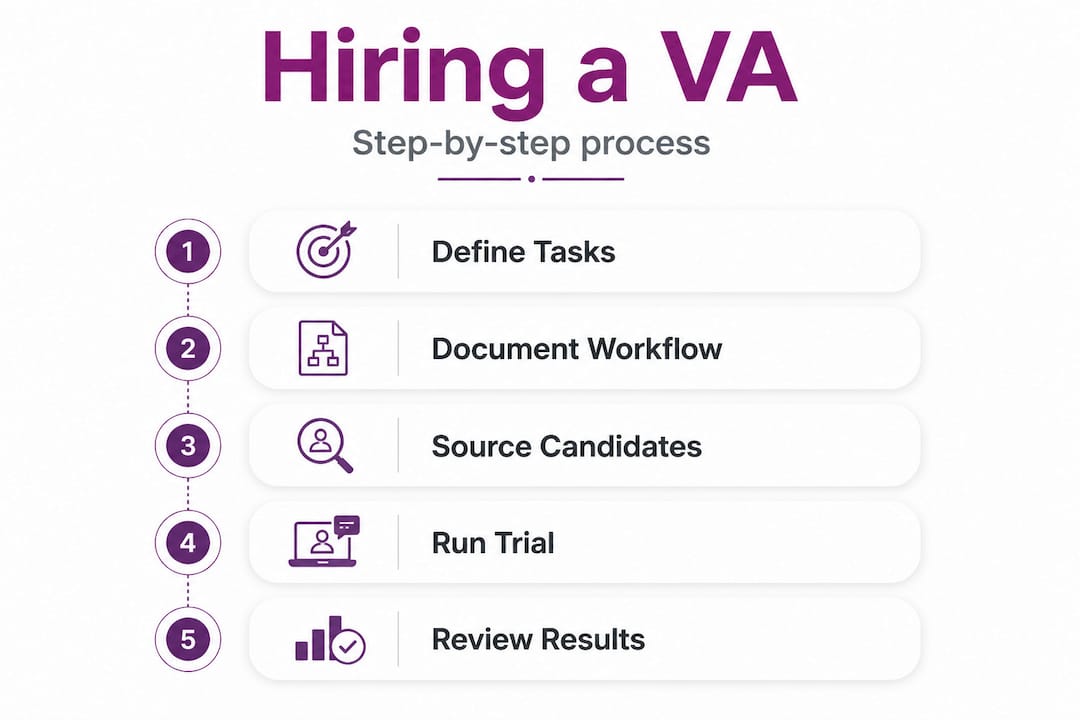
Structure a paid trial period of one to two weeks. Keep it focused on the actual tasks they’ll be doing in the role. The goal is not to see if they’re nice or enthusiastic. The goal is to see if they can follow your documented processes consistently, communicate proactively when something is unclear, and deliver work at the standard you’ve set.
Here’s a sample framework for structuring trial tasks:
Trial task | Objective | Pass criteria | Fail criteria |
Email triage using your template | Test process-following | Correct categorization, timely responses | Missed emails, wrong templates used |
CRM data entry from a lead list | Test accuracy and attention to detail | Zero data errors, correct fields populated | Missing data, wrong format |
Research task with defined output | Test instruction comprehension | Output matches the format and scope requested | Off-topic, incomplete, or wrong format |
Scheduling a week of meetings | Test calendar and communication skills | All meetings confirmed, no conflicts | Double bookings, missed confirmations |
Use this numbered process to run the trial effectively:
Brief the candidate clearly. Share your process documents and walk them through expectations before the trial begins. You’re testing execution, not guesswork.
Set daily or mid-week check-ins. Short five to ten minute calls keep communication open and let you catch issues early.
Give structured feedback. After each task, provide specific feedback. Note whether they apply it in subsequent tasks. This tells you a lot about their learning curve.
Document your observations. Keep notes on response times, accuracy, communication quality, and how they handle corrections.
Make your decision based on patterns, not one-off performance. One great day doesn’t confirm reliability. Look for consistent execution across the full trial period.
As the entrepreneurial community has noted, many failures happen when businesses don’t first prove the VA can consistently execute specific workflows before committing to a long-term arrangement.
Pro Tip: Run trials with two candidates simultaneously when your budget allows. It gives you a direct comparison and a backup option. You’ll also learn more about what “good” looks like when you have a reference point.
For a closer look at what this looks like in practice, exploring real-world remote VA success stories can help you set realistic benchmarks for your own trial process.
Set accountability, feedback, and ongoing success routines
Hiring a great VA is only the beginning. Keeping one long-term requires ongoing structure. Many business owners assume that once someone is onboarded and performing well, the work is done. But without consistent check-ins and clear performance expectations, even the best VA can drift, disengage, or lose clarity on priorities.
Build a simple accountability system from the start. You don’t need complex software or lengthy review processes. What you need is consistency.
Here are the essential management habits that support long-term VA success:
Weekly check-ins: A short 15 to 30 minute call each week to review completed work, discuss upcoming priorities, and address any blockers. This keeps alignment strong and prevents small issues from becoming big problems.
Clear KPIs: Define two to four measurable outcomes for your VA’s role. Examples include response time targets, number of leads entered per week, or scheduling accuracy rates. Review these monthly.
Written feedback loops: After major tasks or projects, send a brief written summary of what went well and what to improve. This creates a record and gives your VA something concrete to work from.
Recognition and encouragement: Acknowledge good work directly and specifically. Remote professionals perform better when they feel seen and valued. A short message saying “great job on the inbox this week, the turnaround was exactly what we needed” goes a long way.
Quarterly performance reviews: A more structured conversation every three months to discuss growth, role evolution, and any adjustments to responsibilities or compensation.
As the team at R3source emphasizes, ongoing feedback and check-ins help remote professionals grow and stay engaged over time. This isn’t just a management nicety. It’s a retention strategy.
Tools like Asana, Trello, or ClickUp work well for task tracking. Slack or a similar messaging platform keeps daily communication organized. Time-tracking tools like Clockify or Hubstaff add transparency without micromanaging. The right combination depends on your business, but having at least one task management tool and one communication channel is non-negotiable for remote work.
Reading through client reviews from businesses that have built long-term remote teams can also give you a realistic picture of what consistent management looks like and what results it produces.
“Structure is not about control. It’s about giving your VA the clarity they need to do their best work every single day.”
Our take: Why most business owners get the VA process backwards
Here’s the honest truth that most hiring guides won’t tell you. Business owners spend the majority of their energy trying to find the right person, when the bigger problem is that they haven’t built the right environment for anyone to succeed in.
We’ve seen this pattern repeatedly. A business owner interviews five candidates, picks the one who seems most impressive, and then hands them a vague list of responsibilities. Two months later, they’re frustrated because the VA “just doesn’t get it.” But when you look closely, the VA was never given a clear standard to meet. They were hired for a role that only existed in the owner’s head.
The most common failures happen when businesses don’t first prove the VA can consistently execute specific, documented workflows. Process-building is not something you do after hiring. It’s what you do before. The interview tells you about personality and communication style. The documented workflow tells you whether the work will actually get done.
When we place remote professionals with businesses through R3source, the clients who see the fastest results are always the ones who came prepared. They had their task list ready. They had their processes documented. They knew exactly what success looked like in the first 30 days. The VA didn’t have to guess, and neither did the client.
The businesses that struggle are the ones who hire first and plan later. They expect the VA to figure it out, and when the VA makes assumptions that don’t match the owner’s expectations, both sides end up frustrated.
Building a remote support team success story starts with the business owner doing the preparation work. The right VA, placed into a well-structured role, will almost always succeed. The wrong structure will undermine even the most talented person you hire.
Flip the process. Build first. Hire second. Then watch how much easier everything becomes.
Ready to find your ideal long-term virtual assistant?
You now have a clear, step-by-step path to hiring a VA who will actually stick around and deliver consistent results. The process works, but it works even faster when you start with pre-vetted professionals who are already trained for long-term remote roles.
At R3source, we specialize in connecting U.S. business owners with dedicated remote professionals from the Philippines who are ready to integrate into your operations from day one. Whether you’re just getting started or ready to build a full team, we make the process straightforward and dependable. You can win a free remote professional through our current promotion, explore how to build your team with dedicated support, or get your questions answered in our remote professionals FAQ. Your next great hire is closer than you think.
Frequently asked questions
What tasks can a long-term virtual assistant handle reliably?
With clear workflows in place, VAs can reliably handle admin tasks, scheduling, email management, CRM updates, and other repeatable business processes. As the research shows, consistent workflow execution is the key factor that determines what a VA can sustain over time.
How do I know a VA will stay long-term?
Hire through agencies with strong vetting processes and run a structured trial to test consistency before making any long-term commitment. Vetted agencies improve reliability by connecting you with pre-screened professionals who are looking for stable, ongoing roles.
What’s the biggest mistake when hiring a VA?
Hiring without documenting clear, repeatable tasks and workflows is the most common and costly mistake business owners make. Hiring without operationalizing processes almost always leads to inconsistent results and early turnover.
Should I hire directly or through a platform or agency?
Agencies generally offer more reliability with pre-vetted candidates and built-in support structures, while direct hiring through job boards tends to carry a higher turnover risk. Dedicated professionals through agencies are typically better suited for long-term, integrated roles within your business.
Recommended
Comments