

How to Hire Offshore Employees: 2026 Guide


Hiring offshore employees means building a workforce across international borders to reduce labor costs, access specialized talent, and scale operations faster than domestic hiring allows. The practice is formally known as international remote staffing or offshore employment, and it has become a core growth strategy for US businesses competing in tight labor markets. You have three primary models to choose from: direct hire, third-party agency staffing, and Employer of Record (EOR). Getting the model right from day one determines whether your offshore team becomes a competitive advantage or a compliance liability. This guide walks you through every step, from model selection to managing offshore employees at scale.
What are the common offshore hiring models and how do they differ?
Offshore hiring approaches include independent contractor arrangements, agency staff augmentation, dedicated offshore teams, EOR full-time hires, and captive subsidiaries. Each model sits at a different point on the control-versus-complexity spectrum, and choosing the wrong one for your situation is one of the most expensive mistakes a growing business can make.
Direct hire
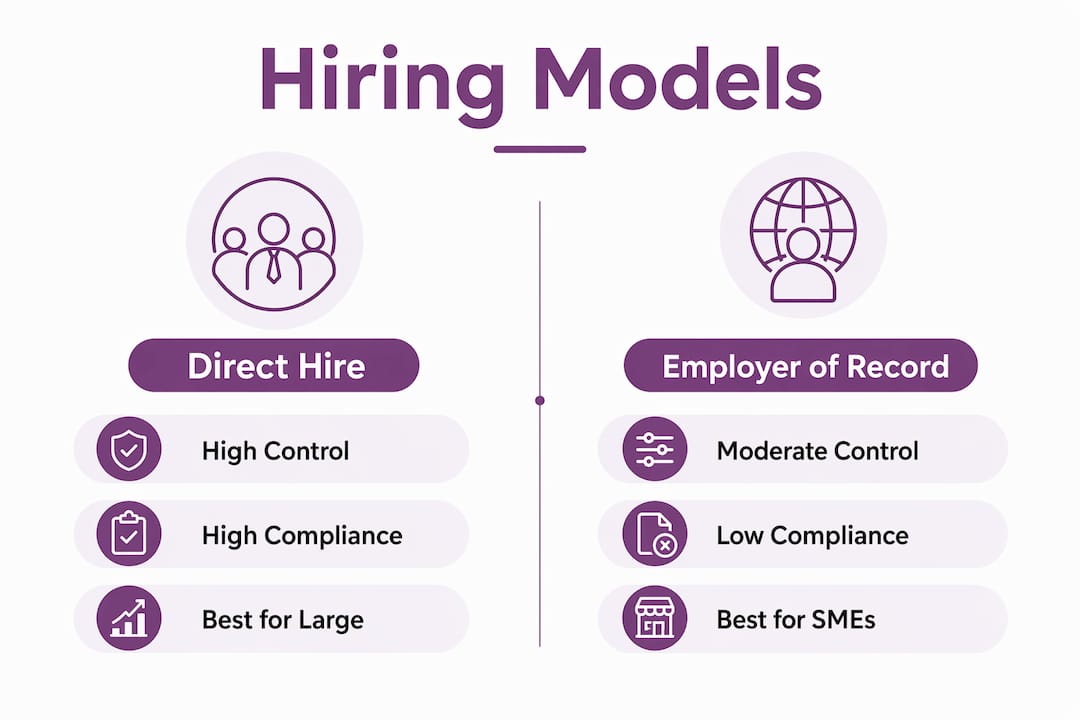
Direct hire means your company acts as the legal employer in the offshore country. You handle payroll, benefits, tax filings, and compliance with local labor law. This model gives you the most control over your team and the lowest per-head cost over time, but it requires you to either establish a legal entity in that country or accept significant legal exposure. It works best for businesses that plan to hire ten or more people in a single country and have the HR infrastructure to manage it.

Third-party agency staffing
Agency staffing places pre-vetted professionals on your team while the agency retains the employment relationship. R3source operates in this space, providing vetted remote professionals from the Philippines who integrate directly into your operations. You get speed, reduced administrative burden, and access to talent that has already been screened for reliability and skill. The tradeoff is less direct control over compensation structures and a per-head fee built into the service.
Employer of Record (EOR)
An EOR acts as the legal employer on your behalf in the offshore country, handling payroll, local contracts, tax compliance, and benefits. EOR pricing averages $599 to $699 per employee per month, with providers like Remofirst starting as low as $199. That number means EOR is cost-effective for small teams but can become expensive as headcount grows. Providers like Deel start their EOR plans around $599 per employee monthly, covering onboarding, payroll, and compliance management.
Model | Control level | Compliance burden | Best for |
Direct hire | High | High | Large, long-term offshore teams |
Agency staffing | Medium | Low | Fast deployment, SMBs |
Employer of Record | Medium-high | Low | Compliant full-time hires, any size |
Independent contractor | High | Medium | Project-based, short-term work |
Pro Tip: Request itemized cost worksheets from any EOR provider before signing. EOR headline fees are starting points. Actual total cost varies with employer contributions, foreign exchange spreads, deposits, and onboarding fees.
What legal and compliance considerations must you address?
Compliance is where offshore hiring most often goes wrong. US businesses face obligations under both domestic law and the labor laws of the country where the employee works. Ignoring either side creates real financial and legal risk.
The single most important decision you make is worker classification. Worker status depends on control and economic reality factors, and the Department of Labor’s updated economic reality test emphasizes degree of control and profit opportunity as the primary criteria. Misclassifying a full-time offshore worker as an independent contractor exposes you to back taxes, penalties, and potential lawsuits in both countries. If you expect day-to-day control and full team integration, an employee or EOR model is the safer path.
Permanent establishment (PE) risk is the second major compliance concern. OECD guidance clarifies that a fixed place of business creating PE risk generally requires 50% or more of work time spent in one overseas location with a commercial reason for presence. Remote workers operating from home for personal reasons, below that threshold, may not trigger PE. That said, active documentation of working locations and commercial rationale is still required.
“Even with EOR usage, permanent establishment risk requires active management of working locations and commercial rationale documentation.” — OECD guidance on offshore work and PE creation
Key compliance steps every business must take:
Confirm the correct employment classification before making any offer
Verify local labor law requirements for the specific country, including mandatory benefits and notice periods
Use locally compliant employment contracts, not US-standard agreements
Document working location arrangements and commercial rationale for PE risk management
Consult a local employment attorney or use an EOR for countries with complex labor regulations
How to plan and execute the offshore hiring process step-by-step
A structured offshore hiring process reduces time-to-hire, limits compliance exposure, and sets your new team member up to contribute quickly. Here is the sequence that works.
Define the role clearly. Write a role description that specifies required skills, tools, working hours, and performance expectations. Vague job descriptions attract mismatched candidates and slow down screening.
Select your offshore location. The Philippines is a top choice for US businesses because of strong English proficiency, cultural alignment with American work norms, and a large pool of professionals trained in customer service, administration, and digital marketing. R3source specializes in connecting US businesses with Philippine remote professionals for exactly this reason.
Choose your hiring model. Use the comparison table above to match your headcount, budget, and compliance capacity to the right model.
Source and screen candidates. Agencies and EORs handle sourcing and initial vetting. If hiring directly, platforms like LinkedIn, JobStreet, and OnlineJobs.ph are the primary sourcing channels in the Philippines. Conduct structured interviews with skills assessments, not just conversational calls.
Complete legal documentation. This includes locally compliant employment contracts, tax identification collection, and benefits enrollment. EOR providers handle this automatically. Direct hires require you to manage it manually or through a local HR partner.
Onboard with intention. A structured onboarding process is the difference between a new hire who contributes in week two and one who is still confused in month two. Use a virtual assistant onboarding checklist to cover tools access, communication norms, role expectations, and cultural context.
Step | Key action | Common mistake |
Role definition | Specify tools, hours, and KPIs | Writing vague or US-centric job descriptions |
Location selection | Match talent pool to role requirements | Choosing location based on cost alone |
Model selection | Align model to compliance capacity | Defaulting to contractor to save money |
Sourcing | Use vetted agencies or targeted platforms | Relying on generic job boards |
Documentation | Use locally compliant contracts | Applying US employment agreements offshore |
Onboarding | Structured process with clear milestones | Skipping cultural and operational context |
Pro Tip: The fastest compliant path is to decide upfront on employee vs. contractor status. Changing classification after the relationship starts is far more disruptive and costly than getting it right from the beginning.
What are best practices for managing offshore and remote employees?
Offshore teams frequently fail due to inadequate operational models, not poor hires. Communication frameworks, onboarding processes, and KPI structures matter more than talent quality alone. Building the operating system before scaling headcount is the single most important management principle.
Effective offshore management requires documented communication policies that outline which channels to use and what response times are expected. Without this, time zone differences create ambiguity, missed handoffs, and frustration on both sides. Over-communication is always preferable to under-communication in distributed teams.
Communication charters that assign message types to specific channels and define response times reduce US-centric meeting overload and cultural misinterpretations. For example: Slack for real-time questions, email for formal requests, Zoom for weekly check-ins, and Asana or ClickUp for task tracking. Defining this upfront removes the guesswork that slows teams down.
Additional best practices for managing remote teams:
Set explicit, measurable goals with weekly or biweekly check-ins to track progress
Combine synchronous and asynchronous communication adapted to the time zone gap between your US office and your offshore team
Use collaboration tools like Google Workspace, Notion, or Trello to keep work visible and organized
Invest in security tools including VPNs, password managers like 1Password, and role-based access controls to protect business data
Build company culture deliberately by including offshore staff in team meetings, recognizing achievements publicly, and creating space for informal connection
Pro Tip: Schedule at least one overlapping hour per day between your US team and your offshore team. Even a single shared hour dramatically improves alignment and reduces the back-and-forth that piles up overnight.
You can find more on how remote professionals handle business ops in practice, including frameworks that growing businesses use to keep distributed teams productive and accountable.
Key takeaways
Hiring offshore employees successfully requires choosing the right employment model, addressing compliance before the first hire, and building a documented operating system that supports your team from day one.
Point | Details |
Choose the right model | Match direct hire, agency, or EOR to your headcount, budget, and compliance capacity. |
Classify workers correctly | Use the DOL economic reality test to avoid misclassification penalties in both countries. |
Manage PE risk actively | Document working locations and commercial rationale even when using an EOR. |
Build the operating system first | Define communication channels, KPIs, and onboarding before scaling headcount. |
Use structured onboarding | A clear onboarding process determines how fast a new hire contributes to your business. |
What I’ve learned after watching offshore teams succeed and fail
The businesses that struggle most with offshore hiring share one pattern: they treat it as a cost-cutting exercise rather than a talent strategy. They rush the model selection, skip the compliance groundwork, and then wonder why the team underperforms. The businesses that thrive do the opposite. They spend time upfront defining the role, choosing the right employment structure, and building the communication systems that make remote collaboration feel natural.
The compliance piece is where I see the most avoidable damage. Worker misclassification is not a technicality. It is a real financial risk that can unwind months of work and cost far more than the savings you were chasing. Getting an EOR or a local employment attorney involved early is not an overhead expense. It is risk management that pays for itself.
The other thing I would tell any business owner starting this process: do not wait until you have a compliance-perfect setup to hire your first offshore team member. Use an agency or EOR to get started, learn how your business integrates with a remote professional, and then optimize the model as you scale. Waiting for perfect conditions is how businesses stay stuck. The benefits of scaling with remote staff are real, and the sooner you build that capacity, the sooner you reclaim your time and grow with intention.
— Ellis
Build your offshore team with R3source
R3source helps US business owners and HR professionals build dedicated offshore teams without the compliance complexity or hiring guesswork. Every remote professional placed by R3source is vetted, trained, and ready to integrate directly into your operations, whether you need administrative support, customer service, lead generation, or CRM management. R3source specializes in long-term remote staffing from the Philippines, giving you consistent performance and real accountability rather than one-off freelancers. If you are ready to expand your team and reduce overhead, explore dedicated remote professionals or learn more about outsourcing virtual assistant services to find the right fit for your business.
FAQ
What is the cheapest way to hire offshore employees?
Agency staffing and independent contractor arrangements carry the lowest upfront cost, but EOR providers like Remofirst offer compliant full-time hires starting at $199 per employee monthly. Always compare total cost, including employer contributions and onboarding fees, not just the headline rate.
How do I avoid misclassifying offshore workers?
Apply the DOL economic reality test: if you control the worker’s schedule, tools, and daily tasks, they are likely an employee, not a contractor. Using an EOR removes this risk entirely by making the provider the legal employer of record.
What countries are best for offshore hiring?
The Philippines is the top choice for US businesses needing English-speaking professionals in customer service, administration, and digital roles. The country offers strong cultural alignment with American business norms and a large, educated workforce.
How do I manage offshore employees across time zones?
Document a communication charter that assigns message types to specific channels and sets response time expectations. Schedule at least one overlapping work hour daily and use asynchronous tools like Asana, Notion, or Loom to keep work moving outside shared hours.
Do I need a local entity to hire offshore employees legally?
No. An EOR acts as the legal employer in the offshore country on your behalf, removing the need to establish a local entity. This is the fastest and most compliant path for businesses hiring fewer than ten people in a single country.
Recommended
Comments