

For $300K–$2M Founders: 5 Step Delegation Framework to End Burnout


If you’re exhausted and can’t step away from your business, it’s probably because you’re still making decisions that belong to someone else. Retaining every task and every decision creates structural cognitive overload, not just a long to-do list. The result is constant crisis mode and zero leverage. The fix isn’t rest. It’s a framework for handing off decisions, not just tasks.
TL;DR:
Most founders retain decisions that are better delegated, leading to mental overload, constant crisis mode, and ultimately burnout.
Delegation failures often stem from passing tasks without empowering decision-making, or returning decisions when outcomes differ from personal standards.
Tiering decisions into three levels—founder-only, founder-informed, and team-owned—can significantly reduce decision fatigue and free up founder time.
An immediate step involves logging tasks, sorting by value and resentment, creating brief SOPs, and setting a 30-day check-in to evaluate progress.
Long-term relief is best achieved with dedicated remote staff or operators who understand the tiered decision structure and integrate into workflows over 30 to 90 days.
Table of Contents
Why Retaining Tasks and Decisions Produces Founder Burnout
Founders who stay operationally involved as their business grows tend to trap themselves. This pattern shows up so often in companies doing roughly $300,000 to $2 million in revenue that it has a name: the founder freedom trap. You built the business to gain freedom, and instead you built a job that only you can do.
The math behind burnout for entrepreneurs is simpler than people think. Every unresolved decision, whether it’s approving a refund or picking a vendor, consumes mental bandwidth that doesn’t reset when you clock out. Stack dozens of these decisions daily, and your brain treats each one as a small threat to be resolved, not a task to complete.
This is why vacations rarely fix anything. The business still routes every choice back to the founder even during time off, so stepping away doesn’t reduce the load. It just delays it.
Two structural gaps compound the problem:
Business decisions: pricing, hiring, client escalations, all funneled through one person.
Home decisions: the unpaid operations job founders run alongside the business, from scheduling to household logistics, which Inc. identifies as a major hidden driver of exhaustion.
Time management tweaks won’t touch either gap. Only redistributing decision rights will.
Common Delegation Traps Founders Fall Into
Most founders don’t fail to delegate. They fail to delegate the right thing. Gallup’s research on entrepreneurship found that a large share of employer-entrepreneurs lack strong delegator instincts, which shows up in a few predictable patterns.
Delegating the task, keeping the decision. You hand off the email inbox but still approve every response. The work moved; the load didn’t.
Hiring without training. You bring someone on, skip the documentation, and then get frustrated when they ask you questions all day.
Hero mode. Your identity is wrapped up in being the one who solves everything, so you unconsciously sabotage anyone trying to take work off your plate.
Taking it back. Something goes 80% right instead of 100%, and you grab the task back rather than coaching through the gap.
Pro Tip: Before you take a task back, ask yourself if the outcome was actually wrong, or just different from how you’d have done it. Those are not the same problem.
Decision Architecture: A Simple Tiered Framework Founders Can Use
Fixing this starts with tiering decisions, not tasks. A coaching case study tracked a founder whose daily decision count dropped from 67 to 19 after implementing exactly this kind of structure, with revenue growth following once the team gained real ownership.
Here’s the breakdown:
Tier 1: Founder-only. Strategic direction, major hires, anything that changes the business model. These stay with you.
Tier 2: Founder-informed. Decisions your team makes but flags to you, at first. Pricing exceptions, client escalations above a set dollar threshold.
Tier 3: Team-owned. Routine operational calls: scheduling, standard customer responses, vendor reorders under a defined limit. No founder involvement, ever.
Run a quick mapping exercise on your last 20 decisions. Write down what each one was, who currently makes it, and which tier it actually belongs in. Most founders find that a majority of their daily decisions belong in Tier 3.
Set a hard rule before you transfer authority: if a decision falls below a certain financial impact threshold or doesn’t touch legal or brand risk, it moves to Tier 3 immediately, and you don’t override it.
Expect a rocky three weeks. A short, enforced adaptation window where you refuse to retake delegated decisions is what actually cements the shift. Check in at day 7, day 14, and day 21. If your team is still asking permission for Tier 3 calls by week three, the documentation needs work, not more oversight from you.
Step-by-Step Plan to Start Delegating This Week
You don’t need a reorganization to start. You need one week and an honest audit.
Log every task and decision for five business days. Write down what you did, how long it took, and whether it required your judgment or just your time.
Sort by ROI and resentment. Anything low-value that you also dread doing goes first. This list moves faster than a pure profitability ranking because resentment predicts burnout better than time spent.
Match tasks to a role, not a person. Some items need a virtual assistant; others need someone with authority to make calls.
Write a minimum viable SOP. One page, five to ten steps, screenshots if needed. This is what gets a new hire productive in two to four weeks instead of two to four months.
Set a 30-day check-in. Measure time reclaimed, response times on delegated work, and your own stress level on a simple 1 to 10 scale.
Pro Tip: Track your own sleep and irritability alongside business metrics for the first month. Founder stress indicators shift before revenue numbers do, and they’re your earliest warning system.
For a deeper look at sequencing this without losing your grip on quality, this delegation framework walks through the handoff mechanics in more detail.
Roles and Staffing Options That Actually Absorb Founder Load
Not every hire solves the same problem, so match the role to the load you’re trying to remove.
Virtual assistant: handles recurring administrative work, scheduling, and customer follow-up. Onboarding typically runs one to two weeks with clear documentation, and the U.S. Chamber of Commerce notes that clear expectations and monitoring early on are what make the relationship stick long-term.
Operator or COO: takes on Tier 2 decisions and reports outcomes rather than asking permission. Expect a longer ramp, often 60 to 90 days, before they’re making calls independently.
Part-time specialist: covers a defined skill gap (bookkeeping, ad management) without full-time overhead.
A rotating cast of freelancers rarely builds the institutional memory a growing business needs. Long-term dedicated staff, integrated into your actual workflows, tend to retain context and reduce the retraining cycle that eats up founder time. Real relief usually shows up by day 30, with measurable schedule changes by day 90.
Why Shifting From Operator to Founder Matters
The hardest part of delegation isn’t logistics. It’s identity. Founders often build their sense of worth around being indispensable, so every task you hand off can feel like losing a piece of yourself.

One pattern worth watching: the founders who recover fastest are the ones who pick a single decision category, like client refunds, and refuse to touch it for three full weeks, mistakes and all. The discomfort is real. So is the outcome. Businesses that make it through that window consistently report their founder finally taking a weekend off without checking their phone every hour.
Try the framework on one decision tier before you judge whether it works.
— Ellis
How a Long-Term Remote Staffing Partner Can Help
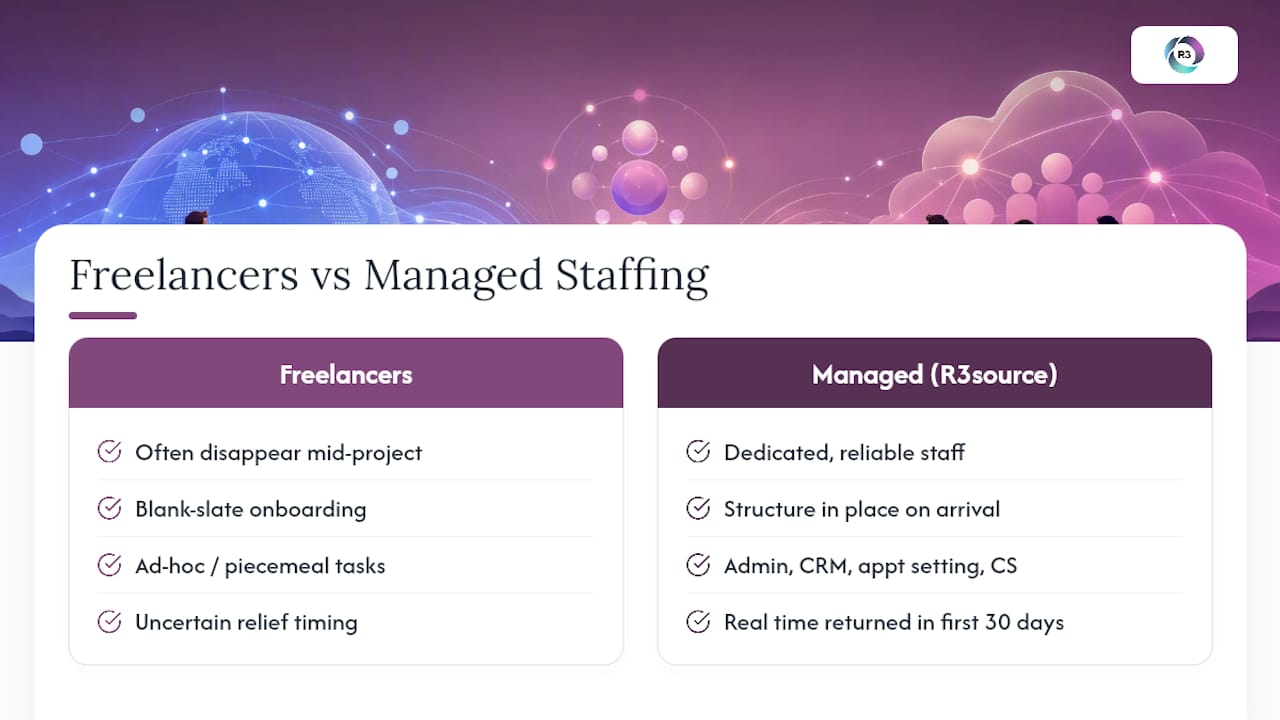
R3source exists for founders who’ve mapped their Tier 3 decisions and are ready to hand them to someone reliable, not just available. Instead of piecing together freelancers who disappear mid-project, you get dedicated virtual assistants and remote professionals trained to handle administrative support, CRM management, appointment setting, and customer service as long-term staff embedded in your actual operations.
A managed staffing model shortens the gap between “I need help” and “I have relief” because your remote team member arrives with structure already in place, not a blank slate you have to build from scratch. That matters most in the first 30 days, when most founders either see real time returned or quietly give up and take the work back.
If you’ve run the delegation audit and identified what needs to move off your plate, the next step is a conversation, not another spreadsheet. Book an introductory consultation with R3source and find out which role fits the load you’re ready to release.
Sources
The Forbes reporting frames the founder freedom trap; Gallup quantifies the delegation skills gap; Inc. covers the hidden home-operations burden; the U.S. Chamber of Commerce offers practical VA onboarding guidance.
Recommended
Comments