

Why Entrepreneurs Need Consistent Support Staff


Author: Ellis Jackson
Consistent support staff are defined as dedicated, long-term team members who handle recurring operational tasks so entrepreneurs can focus on growth. The case for building this kind of reliable team is not just about convenience. Research shows that outsourcing operational support cuts total operating costs by 30–60% compared to in-house hiring. That is not a marginal gain. It is a structural shift in how a business operates. Understanding why entrepreneurs need consistent support staff starts with recognizing that your time is your most limited resource, and every hour spent on administrative work is an hour not spent on revenue.
Why entrepreneurs need consistent support staff to grow faster
Entrepreneurs frequently misidentify themselves as their own assistant. Matthew Metros describes this pattern directly: founders spend the majority of their day on tasks that do not require their expertise, while the work that actually drives growth sits untouched. The result is a business that stays small not because of market conditions, but because the founder has no bandwidth left.
The solution is what Metros calls a force multiplier: a support person or team that handles the 80% of non-financially critical tasks so you can focus entirely on the 20% that drives business growth. This is not a luxury for large companies. It is the operating model that allows small businesses to punch above their weight.
Consistent support staff free up your cognitive capacity, not just your calendar. When someone else owns your inbox, your scheduling, your CRM updates, and your customer follow-ups, you stop context-switching every 20 minutes. That mental clarity directly improves the quality of your decisions.

Pro Tip: Track every task you complete in a single week. Anything that repeats, does not require your specific judgment, or takes more than 30 minutes of your day is a candidate for delegation.
Here is what a well-supported entrepreneur can hand off immediately:
Email management and inbox triage
Calendar scheduling and appointment setting
Customer service responses and follow-ups
Data entry and CRM management
Lead generation and research
Social media posting and basic content coordination
Invoice tracking and basic bookkeeping support
Each of these tasks is real work. Each one pulls you away from the conversations, decisions, and relationships that only you can handle.
What are the financial benefits of hiring a support team?
The financial case for consistent support staff is direct and well-documented. Outsourcing support functions reduces operating costs by 30–60% compared to hiring in-house. That gap exists because in-house employees carry hidden costs: recruiting fees, benefits, office space, equipment, onboarding time, and management overhead.
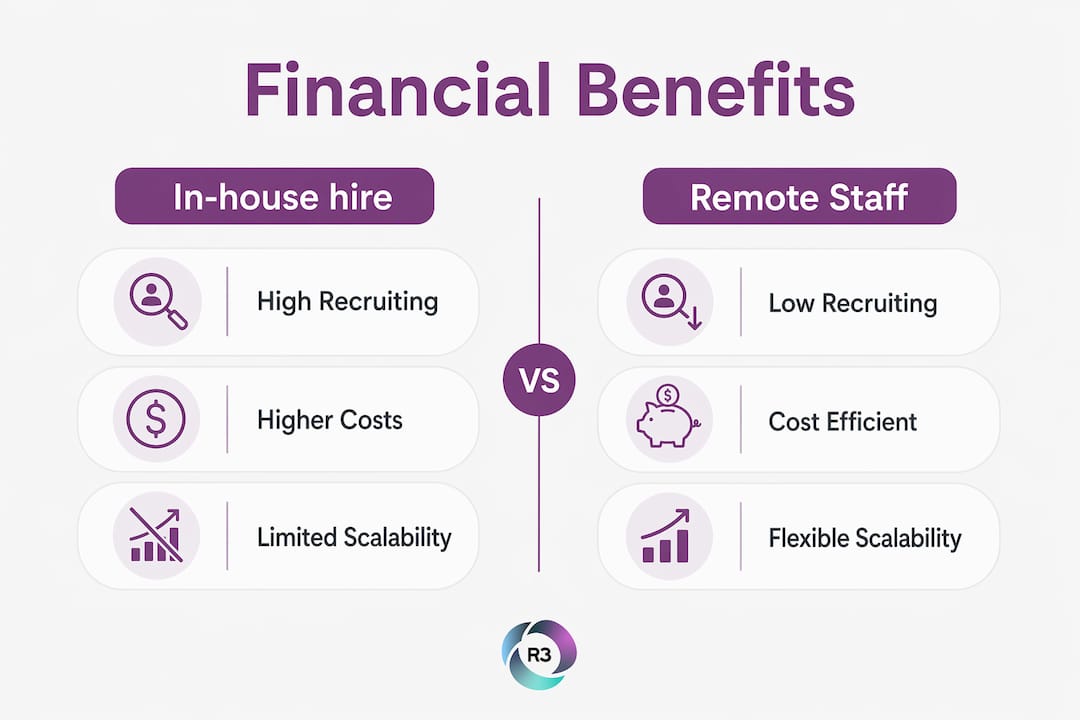
When you work with a dedicated remote staffing model, most of those costs disappear. You pay for the work, not the infrastructure around it. For a growing business watching every dollar, that difference is significant.
Cost Factor | In-house hire | Dedicated remote staff |
Recruiting and onboarding | High | Low to none |
Benefits and payroll taxes | Required | Not applicable |
Office space and equipment | Required | Not required |
Management overhead | Significant | Reduced |
Scalability during peak periods | Slow and costly | Fast and flexible |
Coverage hours | Standard business hours | Extended or 24/7 possible |
Scalability is the second financial advantage. BPO-style support partnerships allow businesses to handle peak demand and global coverage without internal hiring delays. A real estate company closing a high-volume quarter, or an e-commerce brand running a seasonal promotion, can scale support capacity up without committing to permanent headcount. That flexibility protects your margins while keeping your customers served.
The third financial benefit is retention. Consistent staff who know your business, your clients, and your processes reduce the cost of constant retraining. Every time you lose a support person and hire a replacement, you pay in time, money, and customer experience. Stability in your support team is a financial asset, not just an operational one.
How have support roles evolved into strategic assets?
Support roles are no longer just administrative. Research from Bain and Gray shows that modern support staff reduce cognitive load by filtering and structuring information so entrepreneurs can focus on judgment and high-impact decisions. The phrase that captures this best: support staff turn data “noise” into “signal.”
Think about what that means in practice. Your inbox contains 200 messages. Your support person reads them, flags the three that need your attention today, and drafts responses to the rest. You spend 15 minutes instead of two hours. Your decision quality goes up because you are not exhausted from triaging.
A strong executive assistant or operations coordinator does more than manage tasks. According to Metros, a skilled EA acts as a gatekeeper who manages information flow and priorities, enabling entrepreneurs to make better, faster decisions. That is a strategic function, not a clerical one.
The ripple effects of this kind of support extend further than most founders expect:
Staff retention improves because your team sees a well-run operation with clear communication.
Customer experience improves because support staff respond faster and more consistently than an overwhelmed founder.
Financial sustainability improves because fewer things fall through the cracks.
Regulatory readiness improves because someone is actually tracking compliance deadlines and documentation.
Research confirms that strategic support services impact staff retention, customer experience, and financial sustainability across industries. Support is not a cost center. It is a performance driver.
When should you hire consistent support staff?
The clearest hiring signal is the 8–10 hour rule. If you are spending more than 8–10 hours per week on tasks that do not directly generate revenue, you need support staff. That threshold is not arbitrary. It represents roughly 25% of a standard workweek lost to work that someone else could handle.
Most founders cross that threshold within the first six months of running a business. The problem is that they do not recognize it as a hiring trigger. They see it as “just how it is.” That mindset is where growth stalls.
Here is a practical framework for deciding what to delegate first:
List every task you completed last week. Be specific. “Checked email” is not specific enough. “Responded to 14 customer inquiries about order status” is.
Mark every task that repeats weekly. Recurring tasks are the highest-value delegation targets because the time savings compound every week.
Mark every task that does not require your specific expertise. If someone with training could do it, it should not be on your plate.
Estimate the hours. If the total exceeds 8 hours, you have your hiring case.
Start with one role. A single dedicated support person handling your top recurring tasks can reclaim 10 or more hours per week immediately.
Pro Tip: Founders often underestimate the hidden cost of burnout. Fatigue reduces decision quality, slows response times, and increases mistakes. The cost of not hiring support staff shows up in your business performance long before it shows up in your bank account.
One common misconception is that support staff are a cost you take on when business is good. The reality is the opposite. Hiring support earlier frees you to generate more revenue. The benefits of a virtual assistant show up fastest when you bring them on before you are already overwhelmed, not after.
Key Takeaways
Consistent support staff are a direct driver of entrepreneur productivity, cost efficiency, and business growth, not an optional overhead expense.
Point | Details |
Support staff as force multipliers | Delegating 80% of non-core tasks lets you focus on the 20% that drives real revenue. |
Cost savings through outsourcing | Remote support reduces operating costs by 30–60% compared to in-house hiring. |
Strategic role of support staff | Modern support roles filter information and reduce cognitive load, improving decision quality. |
The 8–10 hour hiring rule | Spending more than 8–10 hours weekly on non-core tasks is a clear signal to hire support. |
Scalability without headcount risk | Dedicated remote staff let you scale up during peak periods without permanent hiring commitments. |
The thing most founders get wrong about delegation
I have talked with a lot of entrepreneurs who say they cannot afford support staff. What they actually mean is they have not yet calculated what it costs them not to have it. The math is rarely close.
When a founder spends three hours a day on email, scheduling, and follow-ups, that is 15 hours a week. At any reasonable valuation of a founder’s time, that is an enormous loss. The question is never “can I afford to hire someone?” The question is “can I afford to keep doing this myself?”
The second mistake I see is partial delegation. A founder hires a support person but keeps checking in on every task, re-doing work, or holding onto decisions that should be handed off completely. That is not delegation. That is just adding a layer of communication overhead. Real delegation means you hand off the task and the outcome. You set the standard, train the person, and then get out of the way.
The entrepreneurs I have seen grow fastest are the ones who treat their support team as partners, not subordinates. They invest in onboarding, they communicate clearly, and they trust the process. That trust is what makes the whole system work. If you want to scale your remote team effectively, the mindset shift matters as much as the hiring decision.
— Ellis
Build a support team that grows with your business
Running a business alone is carrying more than you ever expected. R3source helps entrepreneurs build dedicated remote teams from the Philippines, trained to integrate directly into your operations from day one.
R3source provides offshore virtual assistant services covering administrative support, customer service, CRM management, lead generation, appointment setting, and more. Every team member is a long-term professional, not a freelancer cycling between clients. You get consistent performance, real accountability, and a team that learns your business over time. If you are ready to reclaim your time and build your capacity for growth, explore dedicated remote professionals at R3source and find the right fit for your team.
FAQ
Why do entrepreneurs need consistent support staff?
Consistent support staff free entrepreneurs from recurring operational tasks, allowing them to focus on revenue-generating activities. Research shows this delegation model can reduce operating costs by 30–60% while significantly improving productivity.
What is the 8–10 hour rule for hiring support staff?
The 8–10 hour rule states that if you spend more than 8–10 hours per week on non-core tasks, it is time to hire support staff. That threshold signals that administrative work is actively limiting your growth capacity.
How do support staff improve business decision-making?
Support staff filter and structure information so entrepreneurs receive only what requires their judgment. This reduction in cognitive load leads to faster, better decisions across the business.
What tasks should entrepreneurs delegate first?
The highest-priority tasks to delegate are recurring ones: email management, scheduling, customer follow-ups, CRM updates, and lead research. These repeat weekly, compound in time savings, and rarely require founder-level expertise.
Is outsourced support staff cost-effective for small businesses?
Outsourced support reduces costs by eliminating recruiting fees, benefits, office space, and management overhead. For small businesses, this makes dedicated remote staff significantly more affordable than in-house hiring.
Recommended
Comments