

How Outsourcing Accelerates Business Momentum in 2026


Outsourcing accelerates business momentum by converting fixed operational constraints into flexible capacity for growth. The industry term for this approach is Business Process Outsourcing, or BPO, and it has moved well beyond cost reduction. Outcome-based outsourcing models now represent 67% of organizational adoption, up from 45% in 2024. That shift signals something important: business owners are no longer outsourcing to cut expenses. They are outsourcing to build speed, access talent, and compete at a higher level. If you are a decision-maker looking to grow without the friction of constant hiring, this is the framework worth understanding.
How outsourcing accelerates business momentum: the core mechanisms
Outsourcing drives growth through several concrete, measurable channels. Each one addresses a specific constraint that slows businesses down.
Access to specialized talent. Skilled professionals in areas like CRM management, digital marketing, and customer service are difficult and expensive to hire full-time. Outsourcing gives you immediate access to people who are already trained and ready to contribute.
Faster market entry. Building an internal team from scratch takes months. An outsourced team can be operational in weeks, cutting your ramp-up time significantly.
Scalability without hiring friction. You can scale up during a busy season and scale back without layoffs. Business Process Outsourcing converts fixed staffing costs into flexible, adjustable expenses.
Cost optimization with realistic expectations. Advertised savings often reach 60–70%, but net savings typically land at 30–45% once management, quality assurance, and coordination overhead are factored in. Plan for that gap from day one.
Innovation through external knowledge. Outsourcing partners bring fresh processes, tools, and perspectives your internal team may not have encountered. That external input accelerates product and process improvement.
Outcome-based models over cost-focused ones. The most effective outsourcing relationships are built around KPIs tied to growth, not just invoices. Leading firms treat outsourcing as a core capability for multidimensional agility, not a line item to minimize.
Pro Tip: Before you sign any outsourcing agreement, define three to five KPIs that directly connect to your revenue or growth goals. If a provider cannot align their deliverables to those metrics, they are the wrong partner.
Understanding what you can outsource in your business is the first practical step. Administrative tasks, lead generation, appointment setting, and customer support are among the highest-impact functions to delegate early.

How does AI integration change outsourcing for business growth?
Artificial intelligence is reshaping what outsourcing can deliver. 92% of organizations are now adopting AI in service delivery, merging human and digital workforce models. That number reflects a fundamental shift in how outsourcing partners operate.
Modern outsourcing providers do not just supply labor. They deploy AI-assisted workflows that handle data entry, customer query routing, compliance checks, and financial reporting with greater speed and accuracy than manual processes alone. The result is a “digital workforce” model where human professionals focus on judgment-intensive tasks while automation handles volume and repetition.
Finance and compliance: AI tools flag anomalies and generate reports in real time, reducing error rates and audit preparation time.
Customer service: AI-assisted agents resolve routine queries instantly, while human team members handle complex or sensitive interactions.
Lead generation and CRM: Automated data enrichment keeps contact records current, so your sales team always works with accurate information.
The challenge for most growing businesses is that building this AI infrastructure internally requires significant investment in tools, training, and integration. Outsourcing partners who have already built these systems give you the benefits without the build cost.
Pro Tip: When evaluating an outsourcing partner, ask specifically which AI tools are embedded in their workflows and how those tools are measured. A provider who cannot answer that question clearly is not yet operating at the level you need.
AI integration in outsourcing also plays a growing role in talent retention. Employees increasingly expect AI-powered tools in their daily work. Providers who embed those tools attract and keep better people, which means better output for your business.
What strategic frameworks help you evaluate and implement outsourcing?
A structured approach to outsourcing prevents the most common failures: misaligned expectations, hidden costs, and partners who deliver activity instead of results.
Step 1: Identify the right processes to outsource
Start with non-core, resource-intensive tasks that consume your team’s time without directly generating revenue. Administrative support, data entry, scheduling, and customer follow-up are classic examples. Use an outsourcing checklist to map these functions before you begin provider conversations.
Step 2: Select providers on four criteria
Evaluate every candidate on expertise, technology capability, cultural fit, and total cost. Cultural fit matters more than most business owners expect, especially for customer-facing roles. A provider whose team communicates clearly and professionally in your customers’ context will outperform a technically capable but culturally misaligned one.
Step 3: Build outcome-based service agreements
Outcome-based service models require mature KPI frameworks that measure growth drivers like talent pipeline strength, AI application, and business agility, not just cost metrics. Write these into your contract from the start.
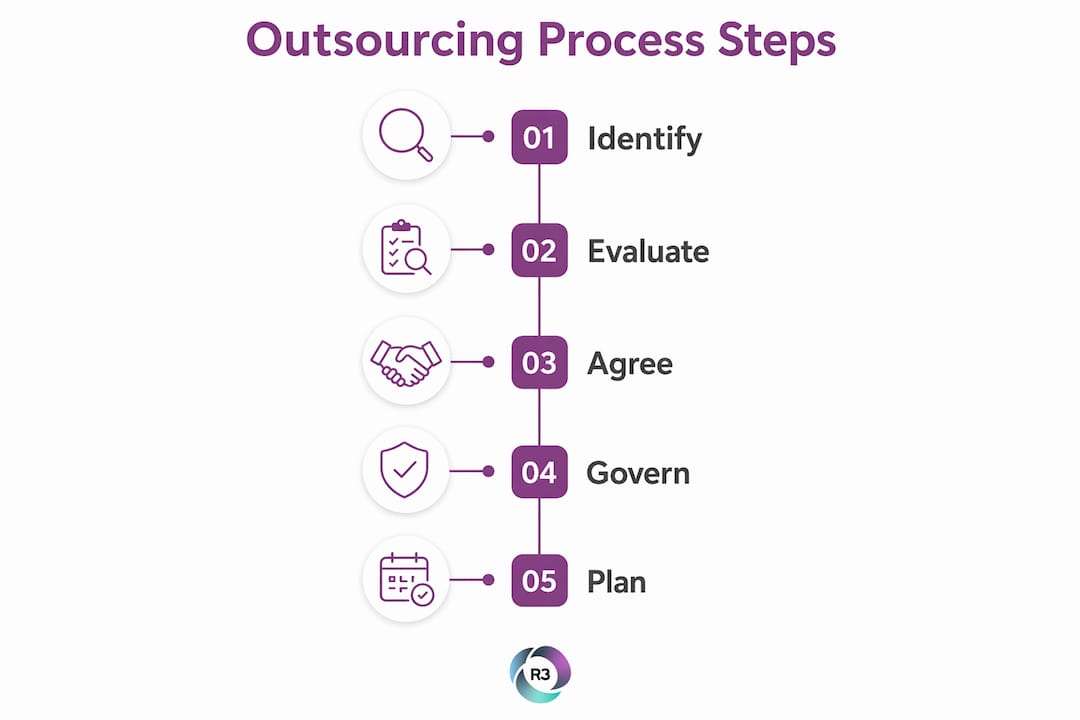
Step 4: Govern for shared accountability
Redesigning governance for shared accountability fosters the kind of trust that produces real innovation. Involve your provider in early-stage planning, not just execution. The traditional “vendor” mindset produces transactional results. A collaborative partner relationship produces growth.
Step 5: Plan for the full cost picture
Management and QA overhead typically consumes 20–35% of gross cost savings. Budget for coordination time, tooling, and onboarding. Organizations typically see initial cost reductions within 3–6 months, with full ROI realized between 12–18 months as the relationship matures.
Pro Tip: Treat the first 90 days of any outsourcing relationship as a calibration period. Set weekly check-ins, review KPIs monthly, and adjust scope based on what the data shows, not assumptions.
Learning how to outsource without losing control is a skill in itself. The business owners who do it well stay closely involved in governance while fully delegating execution.
How does outsourcing drive innovation and competitive advantage?
The connection between outsourcing and innovation is research-backed and stronger than most business owners realize. Access to foreign knowledge-intensive services raises firm innovation output and increases domestic R&D expenditure. That finding from the Journal of Technology Transfer challenges the assumption that outsourcing replaces internal capability. It actually amplifies it.
The mechanism works like this: when your internal team is freed from repetitive operational tasks, they redirect cognitive energy toward product development, customer experience design, and process improvement. External partners simultaneously bring specialized knowledge your team does not have. The two inputs compound each other.
Innovation driver | Internal-only approach | Outsourcing-enabled approach |
Talent access | Limited to local hiring pool | Immediate access to specialized global talent |
Speed to market | Slowed by onboarding and training | Accelerated by ready-to-deploy expertise |
R&D capacity | Constrained by operational workload | Freed up as outsourced teams handle operations |
Technology adoption | Dependent on internal IT budget | Leveraged through provider’s existing infrastructure |
81% of companies now treat outsourcing partners as strategic collaborators to scale innovation and relieve internal R&D constraints. That is not a marginal trend. It represents a fundamental rethinking of where competitive advantage comes from.
Lower trade costs and global access have made this model more practical than ever. For U.S. businesses working with remote professionals in the Philippines, for example, the combination of English proficiency, professional training, and cost efficiency creates a genuine competitive edge, not just a cost reduction.
Key Takeaways
Outsourcing accelerates business momentum when it is treated as a strategic growth capability, not a cost-cutting tactic, with outcome-based KPIs, collaborative governance, and realistic cost planning from day one.
Point | Details |
Outcome-based models drive results | Tie outsourcing agreements to growth KPIs, not just cost metrics, for measurable impact. |
AI integration multiplies output | Partners with embedded AI workflows deliver speed and accuracy that manual teams cannot match alone. |
Hidden costs require planning | Net savings run 30–45% after overhead; budget for management, QA, and coordination from the start. |
Innovation compounds with outsourcing | Freeing internal teams from operations increases R&D capacity and accelerates product development. |
Governance determines long-term success | Collaborative, trust-based partnerships with shared accountability outperform transactional vendor relationships. |
The outsourcing mindset shift most business owners miss
I have watched business owners approach outsourcing with the wrong frame, and it costs them. They treat it as a way to reduce a payroll line. They measure success by what they saved, not by what they built. That mindset produces mediocre results and eventually a failed engagement.
The business owners who get real momentum from outsourcing treat it as a capability investment. They ask: “What can this partnership make possible that I could not do alone?” That question leads to better provider selection, better contracts, and better outcomes.
The hidden cost problem is real, and it catches people off guard. When you factor in the time you spend managing a provider, reviewing quality, and coordinating handoffs, the savings shrink. That is not a reason to avoid outsourcing. It is a reason to plan honestly and measure the right things.
The future of outsourcing is increasingly AI-assisted, and that raises the bar for provider selection. A provider who is not actively integrating AI tools into their workflows will fall behind within 18 months. Ask hard questions about technology adoption before you commit.
The entrepreneurial freedom that outsourcing creates is real, but it requires discipline to capture. Build the governance structure first. Then delegate with confidence.
— Ellis
R3source: build your remote team and reclaim your time
Growing your business does not require growing your overhead. R3source connects U.S. business owners with trained, dedicated remote professionals from the Philippines who integrate directly into your daily operations.
Whether you need administrative support, customer service, lead generation, or CRM management, R3source provides reliable, long-term team members, not task-based freelancers. Every professional is matched to your specific business needs and held accountable to your standards. The result is a support system that frees you to focus on the work that actually grows your revenue. Explore offshore virtual assistant services from R3source, or book a consultation to find the right fit for your team.
FAQ
What is the primary benefit of outsourcing for business growth?
Outsourcing converts fixed operational costs into flexible capacity, giving businesses immediate access to specialized talent and freeing internal teams to focus on revenue-generating work.
How quickly do businesses see results from outsourcing?
Organizations typically see initial cost reductions within 3–6 months, with full ROI realized between 12–18 months as the outsourcing relationship matures and processes are refined.
What are outcome-based outsourcing models?
Outcome-based models tie provider performance to measurable business results, such as lead volume, customer satisfaction scores, or processing speed, rather than simply paying for hours worked.
How does outsourcing support innovation?
Access to external knowledge services increases a firm’s innovation output and complements internal R&D efforts, according to research published in the Journal of Technology Transfer.
What hidden costs should business owners plan for when outsourcing?
Management, quality assurance, and coordination overhead typically consume 20–35% of gross cost savings, so net savings usually land between 30–45% of the advertised figure.
Recommended
Comments