

Outsourcing and Entrepreneurial Freedom: A 2026 Guide


Outsourcing is defined as the delegation of non-core business tasks to external professionals, and its role in entrepreneurial freedom is to give you back the time and focus needed to build something meaningful. 83% of small businesses plan to continue or increase their outsourcing spend, according to the US Chamber of Commerce. That number reflects a fundamental shift in how founders think about growth. You do not scale by doing more yourself. You scale by deciding what only you can do, and handing everything else to someone better positioned to handle it. Virtual assistants, remote professionals, and offshore staffing solutions from companies like R3source have made that handoff faster and more affordable than ever before.
How outsourcing shapes entrepreneurial freedom
The role of outsourcing in entrepreneurial freedom is not simply about saving money. It is about reclaiming your capacity to think, create, and lead. When you spend your mornings answering emails, updating spreadsheets, or chasing invoices, you are not running a business. You are working inside one. Outsourcing breaks that cycle by shifting operational tasks to people trained specifically to handle them.
Common tasks entrepreneurs outsource include:
Administrative support: calendar management, inbox handling, data entry
Customer service: live chat, email responses, appointment setting
Bookkeeping: invoicing, expense tracking, reconciliation
Social media management: scheduling, engagement, reporting
Lead generation: prospecting, CRM updates, outreach sequences
Each of these tasks is real work. But none of them require your specific expertise or vision. Entrepreneurs often realize 3 to 10x ROI on outsourcing within the first 90 days by reallocating time from low-value tasks to strategic growth activities. That return is not hypothetical. It reflects what happens when a founder stops doing $15-per-hour work and starts doing $500-per-hour work.
Pro Tip: Start by auditing one week of your calendar. Highlight every task that does not require your direct judgment or expertise. That list is your first outsourcing priority.

What does outsourcing actually cost compared to hiring locally?
Cost is the most common reason entrepreneurs hesitate to hire, and it is also the strongest argument for outsourcing. Outsourcing can reduce staffing costs by 50 to 80% compared to local full-time hires. For a startup or solo operator, that difference is the gap between staying stuck and actually scaling.
Consider what a local full-time hire actually costs. Beyond salary, you are paying payroll taxes, health benefits, paid time off, equipment, and office space. A remote professional from the Philippines, placed through a company like R3source, eliminates most of those fixed costs entirely. You pay for the work, not the overhead.
Cost factor | In-house hire | Outsourced professional |
Monthly salary | $4,000 to $6,000 | $800 to $1,500 |
Benefits and taxes | $1,000 to $2,000 | None |
Equipment and software | $500 to $1,000 | Minimal |
Office space | $300 to $800 | None |
Total monthly estimate | $5,800 to $9,800 | $800 to $1,500 |
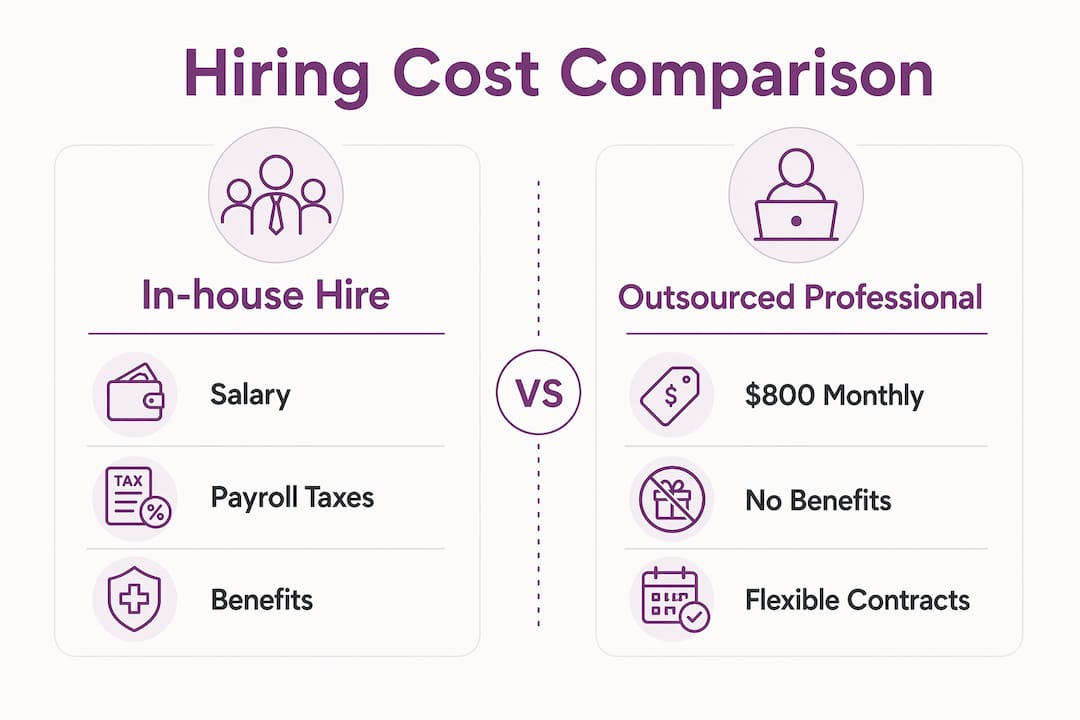
Sole traders increasingly outsource administrative and operational tasks to offshore professionals in Southeast Asia, gaining skilled talent at a fraction of local rates. The scalability is equally important. You can start with a part-time virtual assistant, expand to a full remote team as revenue grows, and adjust without the legal and financial complexity of traditional employment.
Pro Tip: Budget for a “delegation tax” upfront. The first two to four weeks of working with a new outsourced team member will require your time for onboarding and training. Plan for it, and the long-term return will far outweigh the initial investment.
Common outsourcing myths that hold entrepreneurs back
Many founders resist outsourcing because of beliefs that do not hold up under scrutiny. Understanding where these myths come from, and why they are wrong, is what separates entrepreneurs who stay stuck from those who grow.
Here are the most common misconceptions, and the reality behind each:
“Outsourcing means losing control.” Control comes from clear systems and defined outcomes, not from doing tasks yourself. When you document what you need and communicate expectations clearly, outsourced professionals deliver consistent results without requiring your constant oversight.
“It’s only worth it for large companies.” The advantages of outsourcing for startups are often greater than for large companies. Solo operators and early-stage founders have the most to gain because every hour they reclaim goes directly toward revenue-generating work.
“Delegation is a time management problem.” The real issue is delegation, not time management. Founders who feel perpetually behind are usually doing work that belongs to someone else. Outsourcing solves the root cause, not just the symptom.
“Remote teams cannot be trusted.” High-performing global teams now operate on radical trust and clear outcomes rather than micromanagement. The stigma around offshore hiring has largely disappeared. What matters is whether your team member understands the goal, not whether they are sitting in the same building.
“I don’t have time to train someone.” This is where minimum viable documentation becomes your best tool. A short standard operating procedure, a Loom screen recording, or a simple checklist is enough to hand off most recurring tasks. You create it once and it pays dividends indefinitely.
The delegation tax is real. Training takes time upfront. But it is a one-time cost that unlocks ongoing freedom, and that trade is almost always worth making.
How to choose what to outsource for maximum impact
Not every task belongs on your outsourcing list. Choosing the right work to delegate is what determines whether outsourcing actually gives you freedom or just creates a new management burden. A practical framework used by experienced founders breaks tasks into four categories.
High value, only you can do it: Strategy, key client relationships, product vision. Keep these. They are your leverage point.
High value, someone else can do it: Sales outreach, content creation, project management. These are strong candidates for delegation to skilled remote professionals.
Low value, someone else can do it: Data entry, scheduling, inbox management, social media posting. Outsource these first.
Low value, only you do it out of habit: Anything you do because you always have, not because you must. Audit these honestly and let them go.
Offshore virtual assistants are particularly well suited for the third category and often the second. Tasks that are process-driven, repeatable, and clearly documented transfer well to remote professionals. Tasks involving sensitive legal decisions, high-stakes negotiations, or deep institutional knowledge are better kept in-house or assigned to a trusted local hire.
Fractional and project-based outsourcing is also worth considering. You do not need to hire a full-time virtual assistant on day one. Many entrepreneurs outsource side business operations on a part-time basis first, test the relationship, and scale from there. This approach limits risk and builds confidence in the process before you commit to a larger arrangement.
Successful entrepreneurs use a three-tier model: automate repetitive tasks with software, outsource specialized non-core jobs to remote professionals, and hire full-time only for roles requiring deep institutional knowledge. That structure keeps costs low, flexibility high, and your attention where it creates the most value.
Key takeaways
Outsourcing delivers entrepreneurial freedom by removing operational tasks from your plate, reducing costs by up to 80%, and allowing you to focus exclusively on the work that grows your business.
Point | Details |
Freedom through delegation | Outsourcing non-core tasks directly reclaims your time for strategic, revenue-generating work. |
Significant cost savings | Remote professionals cost 50 to 80% less than local full-time hires when total employment costs are factored in. |
Mindset shift required | Delegation is the root challenge, not time management. Systems and clear outcomes replace the need for micromanagement. |
Document before you delegate | Minimum viable documentation such as SOPs or Loom videos prevents rework and speeds up onboarding. |
Start small, scale smart | Begin with low-value, repeatable tasks and expand outsourcing gradually as trust and processes are established. |
Why I think most entrepreneurs wait too long to outsource
I have worked with hundreds of business owners over the years, and the pattern is almost always the same. They wait until they are completely overwhelmed before they consider outsourcing. By that point, they are too exhausted to onboard someone properly, so the first attempt goes poorly, and they conclude that outsourcing does not work for them.
The truth is that outsourcing works best when you implement it before you desperately need it. The founders who get the most out of delegation are the ones who build the habit early, document their processes while they still have the mental bandwidth to do it well, and treat their first outsourced hire as an investment in their own capacity.
There is also a deeper mindset issue worth naming. Many entrepreneurs tie their identity to doing everything themselves. Letting go of a task feels like losing control, or admitting they cannot handle it. That belief is expensive. Every hour you spend on work someone else could do is an hour you are not spending on the work only you can do.
The offshore team productivity strategies that actually work are built on trust and clarity, not surveillance. When you give a remote professional a clear outcome, the right tools, and consistent feedback, the results are often better than what you would produce yourself because they are not distracted by everything else on your plate.
Outsourcing is not a shortcut. It is a structural decision to build a business that does not depend entirely on you. That is what entrepreneurial independence through outsourcing actually looks like in practice.
— Ellis
Build your team with R3source
R3source connects U.S. business owners with trained, dedicated virtual assistants and remote professionals based in the Philippines. Whether you need support with administrative tasks, customer service, CRM management, lead generation, or appointment setting, R3source provides reliable long-term staff who integrate directly into your operations. This is not a freelance marketplace. It is a staffing solution built for entrepreneurs who are ready to stop doing everything themselves and start building something that scales. If you are ready to reclaim your time and grow with confidence, explore offshore virtual assistant services from R3source and take the first step toward real operational freedom.
FAQ
What is the role of outsourcing in entrepreneurial freedom?
Outsourcing gives entrepreneurs freedom by removing non-core operational tasks from their workload, allowing them to focus on high-value activities like strategy, sales, and product development. 83% of small businesses continue or increase outsourcing specifically to manage operations and scale more efficiently.
How much can outsourcing reduce business costs?
Outsourcing can reduce staffing costs by 50 to 80% compared to hiring locally, primarily by eliminating benefits, payroll taxes, office space, and equipment expenses associated with full-time employees.
What tasks should entrepreneurs outsource first?
Start with low-value, repeatable tasks such as inbox management, data entry, scheduling, and social media posting. These transfer easily to remote professionals and free up the most time with the least risk.
How do you manage outsourced team members effectively?
Radical trust and outcome-focused communication replace micromanagement in high-performing remote teams. Define the result you need, provide clear documentation, and give consistent feedback rather than monitoring every step.
Do I need to document processes before outsourcing?
Yes. Creating minimum viable documentation such as a short SOP or a screen recording before handing off a task prevents rework, reduces training time, and sets your outsourced professional up to deliver quality results from the start.
Recommended
Comments