

How to Launch a Business With a Remote Team in 2026


The fastest path to launching a business with a remote team starts with five decisions: your business structure, your state of registration, your compliance setup, your hiring process, and your communication framework. Get those right from day one, and you avoid the costly scramble that trips up most new remote founders. Skip any one of them, and you’re likely looking at back-payments, compliance gaps, or a team that never quite gels.
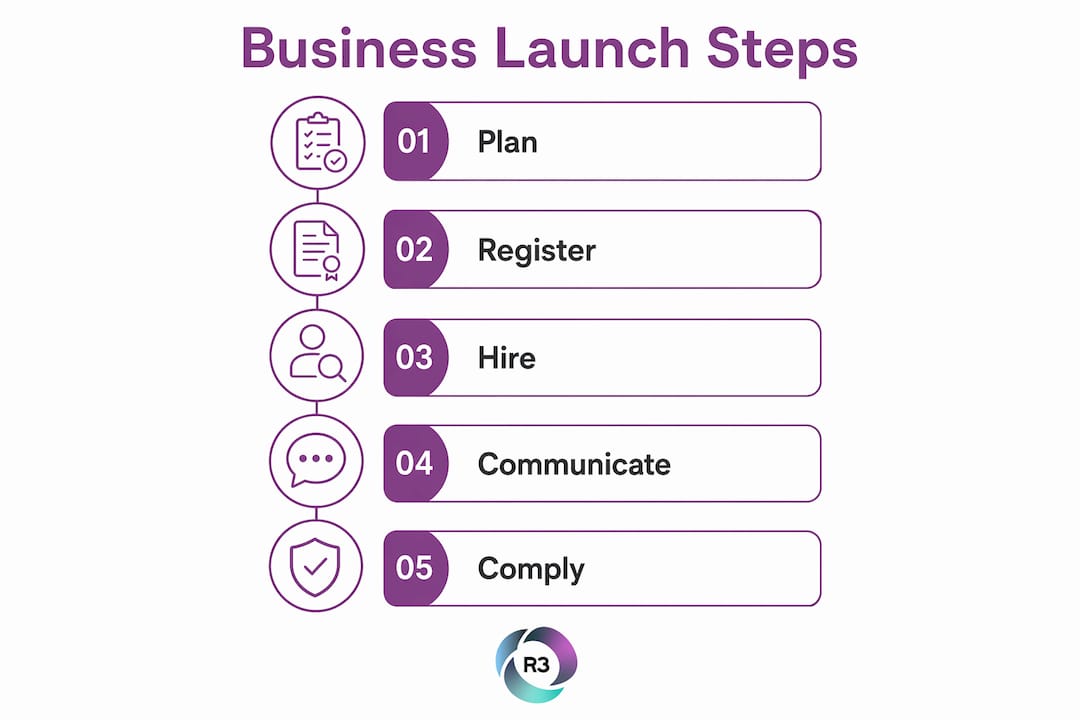
Here’s the core roadmap at a glance:
Develop your remote business plan with remote-specific operations in mind
Choose your business structure and register in the right state
Obtain your EIN and open a business bank account
Set up remote work policies before your first hire
Build your hiring and onboarding process for distributed teams
Implement communication tools and frameworks from day one
Audit your multi-state compliance obligations as your team grows
Establish security and data privacy protocols for all remote access
Pro Tip: The single most common mistake new remote founders make is hiring their first employee before registering in that employee’s state. That one oversight triggers payroll tax penalties, workers’ compensation gaps, and back-payments that can cost thousands.
How do you develop and register a remote business in the US?
Your business plan for a remote operation needs to address things a traditional plan often skips: where your team members will physically work, how you’ll handle multi-state payroll, and what tools will keep operations running without a central office. Think through your revenue model, your core services, and the roles you’ll need to fill remotely before you touch a single registration form.
Choosing the right structure shapes everything from taxes to liability. The U.S. Small Business Administration lays out the main options clearly. An LLC is the most popular choice for remote startups because it protects personal assets, allows pass-through taxation, and carries fewer administrative requirements than a corporation. If you’re planning to raise venture capital, a C corp gives you more flexibility with equity. Sole proprietorships are the simplest to set up but offer no liability protection.
Picking your state of incorporation matters more than most founders realize. Wyoming and Delaware are the most common choices for remote businesses without a physical presence, largely because of low fees, business-friendly courts, and minimal ongoing requirements. Avoid registering in California or New York unless you have employees or offices there. Both states impose high taxes and fees even if your operations never touch them.
Once you’ve chosen your structure and state, here’s the registration sequence:
File your Articles of Organization or Incorporation with the Secretary of State. Filing fees range from $50 to $300 depending on the state.
Appoint a registered agent with a physical address in your state of incorporation. Registered agent services typically cost $50–$200 per year.
Draft an Operating Agreement or Bylaws to define ownership, profit distribution, and decision-making rights.
Obtain your EIN from the IRS. Non-residents can apply via IRS Form SS-4 by fax or mail, though the process takes 4–6 weeks without an SSN or ITIN.
Open a business bank account. Fintech options like Mercury and Wise Business support remote applications and accept non-resident founders, while traditional banks often require an in-person visit.
For funding, remote businesses have real options: SBA microloans, revenue-based financing, angel investors, and bootstrapping are all viable depending on your stage. Because you’re not paying for office space, your overhead is lower from the start, which makes bootstrapping more achievable than it would be for a brick-and-mortar operation.
How do you hire the right people for a remote team?
Remote hiring rewards specificity. Vague job descriptions attract generalist applicants who may struggle without the structure of an office. Write role descriptions that spell out expected working hours, time zone requirements, communication tools you use, and how performance will be measured. That clarity filters out poor fits before the first interview.

The qualities that predict success in remote roles go beyond technical skills. Self-direction, written communication ability, and comfort with asynchronous workflows matter as much as any hard skill. During screening, clear role definitions and skills testing help you evaluate candidates on the actual demands of the job, not just their resume. Structured skills assessments, like those offered through platforms built for evaluating part-time applicants quickly, give you objective data before you commit to a hire.
Cultural fit takes on a different shape in remote teams. You’re not evaluating whether someone will enjoy the office lunch culture. You’re assessing whether they communicate proactively, ask for help when stuck, and take ownership of their work without daily check-ins. Behavioral interview questions that surface past examples of remote work, independent problem-solving, and written communication give you the clearest signal.
Best practices for remote hiring:
Write job descriptions that specify time zone overlap requirements and communication expectations
Use asynchronous video interviews (tools like Loom work well) to assess communication style before a live call
Assign a paid skills test relevant to the actual role, not a generic aptitude quiz
Check references with specific questions about the candidate’s remote work habits
Test freelancers before hiring full-time to reduce risk on key roles
Onboarding for remote employees requires more structure, not less. Without the natural osmosis of an office, new hires need documented processes, a clear first-week schedule, and a designated point of contact for questions. Build a digital onboarding kit that includes your company handbook, tool access instructions, role-specific training materials, and a 30-60-90 day plan. Assign a buddy or mentor for the first month. The goal is to make a new remote hire feel connected and capable within their first two weeks.
Diversity in remote teams happens by design. When you hire across geographies, you gain access to talent pools that local hiring never reaches. Be intentional about inclusive job postings, structured interviews that reduce bias, and onboarding materials that work across cultural contexts.
How do you manage and communicate effectively with a remote team?
The biggest communication mistake remote leaders make is defaulting to meetings when documentation would serve better. Every recurring question your team brings to a call is a signal that something needs to be written down. Strong remote teams run on a foundation of clear, accessible documentation: process guides, decision logs, project briefs, and role expectations that anyone can reference without asking.

That said, synchronous time still matters. Weekly team check-ins, one-on-one meetings, and occasional all-hands sessions build the relationships that hold a distributed team together. The key is being intentional about which conversations need to happen live and which can be handled asynchronously through tools like Slack, Notion, or project management platforms like Asana or ClickUp.
Building virtual culture enhances engagement and reduces turnover. That means creating space for non-work connection: virtual coffee chats, team recognition channels, and celebrating wins publicly. It also means being transparent about company direction, challenges, and decisions so remote employees don’t feel like they’re operating in the dark.
Performance management in a remote setup works best when it’s output-focused rather than activity-focused. Define clear deliverables, set measurable goals, and review progress in regular one-on-ones. Avoid the trap of tracking hours or online status as a proxy for productivity. What matters is whether the work gets done well and on time.
Communication best practices for remote teams:
Hold a weekly team sync with a shared agenda, kept to 30 minutes or less
Use asynchronous video updates for complex topics that don’t need a live discussion
Document every major decision and store it somewhere the whole team can find it
Create a shared team calendar that shows availability across time zones
Give feedback in writing as well as verbally so there’s a record and clarity
Pro Tip: Set a “communication charter” in your first month. It’s a one-page document that defines which tool to use for which type of message, expected response times, and meeting norms. Teams that establish this early spend far less time on miscommunication later.
What are the compliance challenges of running a remote business in the US?
Multi-state compliance is where most remote businesses get caught off guard. The moment you hire an employee who works from a different state than your registered business, you’ve likely triggered a set of obligations that require immediate action. Employers must withhold state income tax based on where the employee physically performs work, not where the company is headquartered.
Hiring a remote employee in a new state creates nexus, which triggers registration requirements for state income tax withholding, unemployment insurance, workers’ compensation, and foreign qualification of your business entity. Failure to register before issuing the first paycheck leads to back-payments and penalties. This is not a technicality. It’s a real financial exposure that catches new remote founders by surprise regularly.
The “convenience of the employer” test adds another layer of complexity. States like New York, Connecticut, Delaware, Nebraska, New Jersey, and Pennsylvania apply this rule, which can require employers to withhold taxes for the employer’s home state even when the employee works remotely from another state. If the remote arrangement exists for the employee’s convenience rather than a documented business necessity, double-taxation risks for the employee become real. Documenting the business rationale for remote work arrangements is a practical defense.
State-level labor laws add further obligations. Over 35 states have “ban-the-box” laws restricting when employers can ask about criminal history. Many states mandate paid sick leave programs. Pay transparency laws in states like Colorado, California, and New York require salary ranges in job postings. These laws apply based on where your employee works, not where your company is registered.
Key compliance steps for remote businesses:
Register for payroll tax withholding in every state where an employee works before the first paycheck
Obtain workers’ compensation coverage in each applicable state
File for foreign qualification if your business entity operates in a state other than its state of incorporation
Track employee work locations and update registrations promptly when employees relocate
Review state-specific labor laws for each new hire’s location, including paid leave, pay transparency, and non-compete restrictions
Most payroll providers require employers to obtain state registrations themselves before they can process payroll in that state. Assuming your payroll software handles registration automatically is a costly mistake. State unemployment tax (SUTA) follows work location rules distinct from income tax, generally requiring payment to one state per employee. Getting the wage allocation right from the start keeps you clean.
Compliance monitoring is ongoing work, not a one-time setup. State-level labor law developments, including pay transparency requirements and non-compete restrictions, are evolving rapidly. Build a quarterly compliance review into your operations calendar and work with an employment attorney or HR consultant who tracks multi-state law changes.
How can remote staffing solutions help you scale your business?
Scaling a business with remote workers becomes far more manageable when you work with a staffing model built for it. Rather than posting jobs, screening hundreds of applicants, and managing onboarding from scratch every time you need to grow, a dedicated remote staffing partner handles the sourcing and vetting so you can focus on the work itself.
Dedicated remote professionals, as opposed to task-based freelancers, integrate directly into your operations. They learn your systems, your clients, and your workflows. Over time, they carry real institutional knowledge that a rotating roster of contractors never builds. That continuity shows up in customer experience, operational consistency, and your own capacity for growth.
R3source provides offshore virtual assistant services and dedicated remote professionals from the Philippines to growing US businesses. The service covers administrative support, customer service, lead generation, CRM management, appointment setting, and marketing support. Each team member is trained to work inside your existing systems, not alongside them.
Tips for selecting and managing outsourced remote staff:
Define the role clearly before engaging a staffing partner, including tools, hours, and deliverables
Start with a defined trial period to evaluate fit before committing to a long-term arrangement
Assign an internal point of contact who manages the relationship and provides feedback
Build a shared documentation system so outsourced staff can work independently
Review performance monthly using the same output-focused metrics you apply to internal hires
The businesses that get the most from remote staffing solutions treat their outsourced team members as genuine extensions of the business. That means including them in team meetings, giving them access to the tools they need, and investing in their development. The return on that investment is a team that stays, performs, and grows with you.
What security and data privacy practices should remote teams follow?
Remote work expands your attack surface. Every home network, personal device, and public Wi-Fi connection your team uses is a potential entry point for a breach. The businesses that handle this well don’t rely on trust. They build systems that make secure behavior the default.
Start with access controls. Every team member should have role-based access to only the systems and data they need for their specific job. Use a password manager like 1Password or Bitwarden to generate and store unique credentials for every platform. Enable multi-factor authentication (MFA) on every tool that supports it, especially email, cloud storage, and any system that touches customer data.
A virtual private network (VPN) is a baseline requirement for any remote team handling sensitive client or business data. Pair it with endpoint protection software on all devices used for work, whether company-issued or personal. If your team uses personal devices, a bring-your-own-device (BYOD) policy that defines minimum security requirements protects the business without requiring you to purchase hardware for everyone.
Data privacy compliance depends on where your customers are located, not just where your team works. If you serve customers in California, the California Consumer Privacy Act (CCPA) applies. If you handle health data, HIPAA governs how that information is stored and shared. Remote teams need clear written policies on data handling, storage, and what to do in the event of a suspected breach. Run a brief security training session during onboarding and repeat it annually. Most breaches trace back to human error, not technical failures.
Key Takeaways
Launching and running a business with a remote team in 2026 requires deliberate planning across legal, operational, and people dimensions from the very first hire.
Point | Details |
Register before you hire | Hiring in a new state triggers payroll tax, workers’ comp, and foreign qualification obligations before the first paycheck. |
Structure shapes everything | An LLC offers the best combination of liability protection and tax flexibility for most remote startups. |
Document your communication | Remote teams run on written processes; a communication charter in month one prevents costly miscommunication later. |
Compliance is ongoing | Multi-state labor laws evolve rapidly; build a quarterly review into your operations calendar. |
Dedicated staff outperforms freelancers | Long-term remote professionals build institutional knowledge that drives consistent operational performance. |
Ready to build your remote team?
Building something meaningful takes the right people behind you. R3source helps US business owners build dedicated remote teams from the Philippines, covering everything from administrative support to customer service and lead generation. You get consistent, trained professionals who integrate directly into your operations.
Whether you’re just getting started or ready to scale, book a free consultation to explore how R3source can help you grow faster without the overhead. Or, if you want to experience the difference firsthand, check out the opportunity to win a free remote professional for 90 days.
Recommended
Comments