

Offshore Virtual Assistant: Hire, Manage & Scale


An offshore virtual assistant is a remote professional based outside your country who handles administrative, operational, and specialized tasks at a fraction of the cost of a local hire. Business owners across the United States are turning to this model to reclaim their time and reduce overhead without sacrificing quality. Platforms and providers like R3source, Wishup, and task management tools like Asana have made it easier than ever to build a productive remote support system. If you are running lean and need reliable help, this guide covers everything from hiring to security to daily task management.
What are the main benefits of an offshore virtual assistant?
An offshore virtual assistant delivers cost savings that are difficult to match with any domestic staffing option. Hourly rates range from $4–$10 depending on location and expertise. That means full-time dedicated support can cost as little as $500 per month, a fraction of what you would pay a local employee.
Beyond cost, the benefits compound quickly:
Access to global talent. You are not limited to your local job market. Offshore talent pools, particularly in the Philippines, include professionals skilled in CRM management, customer service, lead generation, appointment setting, and marketing support.
Around-the-clock coverage. Staggered work hours across time zones allow businesses to maintain continuous operations. A VA working Philippine Standard Time can handle tasks while you sleep.
Faster scaling. Adding an offshore VA takes days, not months. You skip the overhead of benefits, office space, and equipment that comes with a full-time local hire.
Operational focus. When your VA handles inbox management, scheduling, data entry, and research, you spend your hours on revenue-generating work.
Pro Tip: Start with one clearly defined role before hiring multiple VAs. A single well-onboarded assistant who owns a specific function delivers more value than three assistants with overlapping, undefined responsibilities.
The flexibility of affordable virtual assistant services is especially valuable for startups and small businesses that need to move fast without overcommitting on payroll.
How do you find and hire a reliable offshore VA?
Finding a reliable offshore virtual assistant requires a structured process, not just a job post. The quality of your hire depends almost entirely on how well you define the role before you start looking.
Follow these steps to hire with confidence:
Define the role precisely. List every task the VA will own, the tools they need to use, and the outcomes you expect. Vague job descriptions attract vague candidates.
Choose the right sourcing channel. Specialized providers like R3source pre-vet candidates for communication skills, reliability, and relevant experience. This saves weeks of screening time compared to general freelance marketplaces.
Evaluate communication ability early. Send a short written task during the screening phase. How a candidate follows instructions on a test task predicts how they will perform on real work.
Check references and run background checks. Background checks and IP clauses in contracts reduce risk significantly. Verify employment history and confirm the candidate has no history of data mishandling.
Run a paid trial period. A two-week paid trial on real tasks tells you more than any interview. Evaluate output quality, responsiveness, and how the candidate handles unclear instructions.
Pro Tip: Use a structured vetting process that includes a skills test, a video interview, and at least two reference calls. Skipping any of these steps is where most bad hires begin.
Cultural fit matters more than most business owners expect. Providers like R3source specialize in placing long-term remote professionals, not short-term freelancers, which means the candidates are already oriented toward accountability and consistent performance.

What are best practices for managing offshore vas effectively?
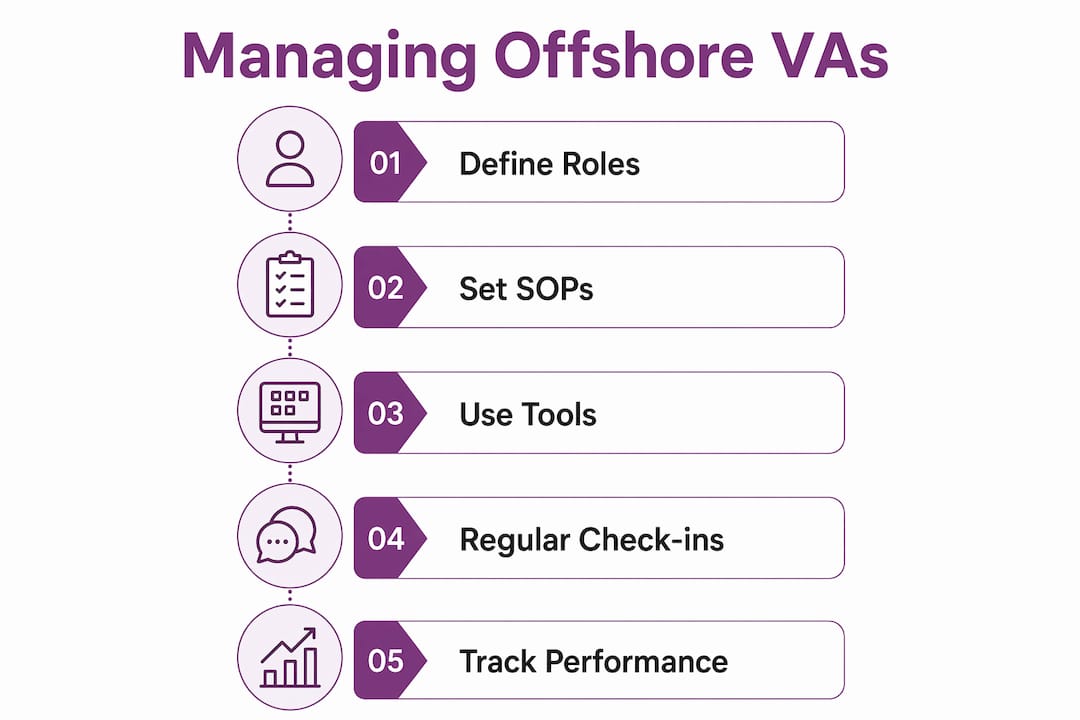
The most common reason offshore VA relationships fail is not skill. It is unclear task delegation. Assignments must include goals, background, deadlines, and SOPs with step-by-step instructions and expected outcomes. When your VA knows exactly what “done” looks like, quality problems drop sharply.
Here is what strong task management looks like in practice:
Write standard operating procedures (SOPs) for every recurring task. An SOP does not need to be long. A one-page document with numbered steps, screenshots, and a checklist is enough to produce consistent results.
Define “done” with examples. Providing output samples and checklists reduces misunderstandings more effectively than focusing on English proficiency alone. Show your VA a completed example of the deliverable before they start.
Use centralized task management tools. Platforms like Asana and Trello keep tasks visible, trackable, and organized. Slack handles real-time communication. Using all three together creates a clear workflow your VA can operate within independently.
Set weekly check-ins. A 20-minute video call each week keeps alignment strong and gives your VA a chance to flag blockers before they become problems.
Give feedback consistently. Specific, timely feedback accelerates your VA’s autonomy. Vague feedback like “good job” or “fix this” teaches nothing.
“Transforming an offshore VA from dependent to autonomous hinges on providing detailed context, defined tasks, and documented procedures.” — VA From Europe
Strong offshore team productivity comes from systems, not supervision. Build the process once, and your VA runs it without you needing to check in constantly. That is the real payoff.
How do you protect data security with an offshore VA?
Data security is the concern most business owners raise before hiring offshore, and it deserves a direct answer. The risk is real but manageable with the right controls in place.
The table below outlines the core security measures every business should implement:
Security Control | Purpose | Implementation |
Multi-factor authentication (MFA) | Prevents unauthorized account access | Require MFA on all business tools and email |
Single sign-on (SSO) | Centralizes access management | Use SSO platforms like Okta or Google Workspace |
Quarterly access reviews | Removes stale permissions | Audit who has access to systems every 90 days |
No local data storage policy | Prevents data leaks via personal devices | Require all work to happen in cloud-based tools |
VPN or zero trust network access | Secures remote connections | Enforce VPN use or deploy a zero trust solution |
IP and NDA clauses in contracts | Protects intellectual property legally | Include in every VA contract before work begins |
SOC 2 Type II and ISO 27001 certifications are the gold standard for offshore providers. Providers with these certifications undergo independent annual audits. If you are working with a provider rather than hiring directly, ask for their certification documentation before signing.
Pro Tip: Cloud-based collaboration tools eliminate local data risks entirely. If your VA never downloads files to a personal device, the exposure window shrinks to near zero.
Pairing strong contracts with proper business documentation practices creates a paper trail that protects you legally and operationally if a dispute ever arises.
Key takeaways
Hiring and managing an offshore virtual assistant successfully depends on clear task documentation, structured hiring, and consistent security controls.
Point | Details |
Cost advantage is significant | Offshore VA rates of $4–$10 per hour make full-time support accessible for small businesses. |
Hiring requires a process | Define the role, vet candidates with test tasks, and always run background checks before committing. |
SOPs drive quality | Detailed procedures and output examples produce consistent results without constant supervision. |
Security is non-negotiable | MFA, quarterly access reviews, and no local data storage policies protect your business from day one. |
Provider choice matters | Long-term staffing providers like R3source deliver accountability that general freelance platforms cannot match. |
What i have learned from working with offshore vas
The biggest mistake I see business owners make is treating their offshore VA like a search engine. They send a task with no context, no example output, and no deadline, then wonder why the result misses the mark. The VA is not the problem. The process is.
When I started documenting every recurring task before handing it off, the quality of work changed immediately. Not because the VA got better overnight, but because they finally had a clear target to hit. That shift from “figure it out” to “here is exactly what done looks like” is where the real productivity gains live.
I have also seen business owners give up too early. The first two weeks of working with any new VA involve calibration. You will need to correct things, refine your SOPs, and repeat yourself more than feels comfortable. Push through that period. By week four, a well-onboarded VA is running tasks you have not thought about in days.
One more thing worth saying: do not underestimate the value of a long-term relationship. The best offshore VA arrangements I have observed are ones where the business owner invested in the person, not just the task list. Regular feedback, clear growth expectations, and genuine respect for the working relationship produce a level of loyalty and initiative that no freelance marketplace can replicate.
— Ellis
How R3source helps you build your offshore team
If you are ready to stop doing everything yourself, R3source makes it straightforward to get started with offshore virtual assistant services backed by real vetting and long-term accountability. R3source places trained remote professionals from the Philippines directly into your operations, covering everything from administrative support and CRM management to customer service and lead generation.
Every R3source placement is built for consistency, not just convenience. You get a dedicated team member who integrates into your workflow, not a rotating pool of freelancers. And right now, R3source is running a free 90-day remote professional raffle where one business owner wins a fully supported remote staff member at no cost. It is worth two minutes of your time to enter.
FAQ
What does an offshore virtual assistant do?
An offshore virtual assistant handles administrative, operational, and specialized tasks remotely from another country. Common responsibilities include inbox management, scheduling, CRM updates, customer service, lead generation, and marketing support.
How much does it cost to hire an offshore VA?
Offshore virtual assistant rates typically range from $4–$10 per hour depending on location and skill level. Full-time dedicated support can cost as little as $500 per month through specialized providers.
How do i manage an offshore VA effectively?
Effective management requires clear SOPs, defined “definition of done” standards, and task management tools like Asana or Trello. Weekly check-ins and consistent feedback accelerate your VA’s ability to work independently.
Is it safe to share business data with an offshore VA?
Yes, when proper controls are in place. Require multi-factor authentication, enforce a no local data storage policy, conduct quarterly access reviews, and include IP and NDA clauses in every contract.
What is the best way to find a reliable offshore VA?
Work with a specialized provider like R3source that pre-vets candidates for communication skills and reliability. Always run a paid trial period and check references before making a long-term commitment.
Recommended
Comments