

Virtual Assistant for Startup Operations: 2026 Guide


You started your company to build something meaningful. Instead, you’re spending half your week on inbox management, scheduling, data entry, and tasks that have nothing to do with growth. If that sounds familiar, hiring a virtual assistant for startup operations may be the most important decision you make this year. In the remote staffing industry, this role is formally known as a remote executive assistant or remote operations assistant. By either name, the goal is the same: get the right person handling the right tasks so you can focus on what only you can do. This guide walks you through every step.
Table of Contents
Key takeaways
Point | Details |
Map your workload first | Write down every recurring task and its time cost before posting a job description. |
Write a specific job description | List required tools, hours, and concrete deliverables to attract qualified candidates. |
Use paid trial projects | A short test assignment reveals real skills and reliability before you commit long-term. |
Onboard with SOPs and check-ins | Document workflows and hold regular calls to keep quality consistent from day one. |
Avoid vague delegation | Unclear tasks create more work for you, not less. Define outcomes before handing anything off. |
Virtual assistant for startup operations: defining what you actually need
Before you post a job listing, you need to know exactly what you are hiring for. Mapping your workload before hiring is the step most founders skip, and it is the one that causes the most problems later. Spend one week writing down every task you handle, how long each one takes, and how often it repeats. That list becomes your hiring blueprint.
Once you have your list, separate tasks into two categories.
Tasks for a generalist VA:
Email triage and inbox management
Calendar scheduling and meeting coordination
Travel booking and expense tracking
CRM data entry and contact updates
Basic research and report formatting
Social media scheduling from pre-approved content
Tasks for a specialist VA:
Bookkeeping and financial reconciliation (QuickBooks experience required)
Graphic design and content creation (Canva or Adobe proficiency)
Lead generation and outreach campaign management
Customer support with technical product knowledge
Generalist assistants handle the repetitive coordination work that consumes your mornings, while specialists bring a defined skill set to a narrower scope. Most early-stage startups benefit most from a generalist who can cover multiple operational areas, then layer in specialists as the business grows.
Pro Tip: Prioritize tasks that eat your first two hours every morning. Those are the highest-value hours of your day, and they are usually the ones buried under admin.

How to write a job description that attracts the right candidates
A vague job description attracts vague candidates. The founders who hire well write postings that read like a checklist. Detailed job descriptions that name specific software, availability windows, and communication expectations filter out unqualified applicants before you ever speak to them.
Here is a structure that works:
Write a two-sentence role summary. State what the company does and what the VA will own. Be direct: “You will manage our founder’s calendar, handle customer inquiry responses, and maintain our CRM records.”
List required tools by name. If the role requires Slack, Notion, HubSpot, Google Workspace, or QuickBooks, say so. Candidates who do not know those tools will self-select out.
Define availability and time zone overlap. Specify whether you need four hours of daily overlap, U.S. business hours, or full-time presence. Ambiguity here creates friction later.
Include three to five concrete task examples. Descriptions like “handle communications” mean nothing. “Respond to all inbound customer emails within two hours using our template library” means everything.
State your communication expectations. Do you use Loom for async video updates? Do you expect a daily check-in message? Put it in the posting.
List any red flags that disqualify candidates. If you need someone available for early morning calls, say so upfront. Saving that conversation for the interview wastes everyone’s time.
When it comes to sourcing, agencies that specialize in outsourcing startup tasks often provide pre-vetted candidates with verified skills and references. Direct platforms give you more control but require more screening time on your end. Many founders find that a hybrid approach works well: use an agency for the initial shortlist, then conduct your own interviews.
Pro Tip: Add a small task to the application itself, such as asking candidates to respond to a sample customer email using a brief you provide. Anyone who skips it reveals something important about their attention to detail.
Screening and testing candidates before you commit
A polished resume tells you very little about how someone performs under real working conditions. The screening process for a remote assistant for startups needs to test three things: communication clarity, ability to follow written instructions, and the quality of actual work output.
Start with these screening criteria before scheduling any interview:
Written communication quality. Their application email or message is your first sample. Grammar, tone, and structure matter.
Response time. How quickly did they reply to your posting? A slow or inconsistent response at the eager-to-impress stage is a signal.
Relevant tool experience. Cross-reference the tools listed in your posting against what they claim. Ask for specific examples, not general familiarity.
Longevity in previous roles. Frequent short-term engagements are not automatically disqualifying, but they warrant a direct conversation.
For interviews, behavioral questions reveal more than hypothetical ones. Ask: “Tell me about a time a client changed priorities mid-week. How did you handle it?” rather than “How do you handle changing priorities?” Real answers include specific details. Generic answers do not.
The single most reliable evaluation tool is a paid trial project. Assign a realistic task, pay fairly for the time, and assess responsiveness, instruction-following, and output quality. Paid trial projects reveal far more about a candidate’s actual reliability than any interview question ever will.
Watch for these green flags: they ask clarifying questions before starting, they deliver ahead of schedule, and their work requires minimal correction. Red flags include submitting work without reading the brief, missing the deadline without notice, and producing output that ignores your stated format or requirements. You can find a detailed approach to vetting VA candidates that covers the full evaluation process.
Onboarding and managing your VA for long-term success
Hiring well is only half the work. The founders who get the most from their operational support for startups are the ones who invest in a structured onboarding process from day one.
Here is how structured onboarding compares to an ad hoc approach:
Area | Ad hoc onboarding | Structured onboarding |
Task clarity | Tasks assigned verbally as needed | Tasks documented in SOPs with examples |
Tool access | Shared piecemeal over first weeks | Full access granted via password manager on day one |
Communication cadence | Reactive, as issues arise | Weekly video call plus daily async check-in |
Performance feedback | Given when problems occur | Scheduled at 30 and 60 days with clear metrics |
Scalability | Difficult to hand off to other team members | Documented processes transfer easily |
Communicating expectations clearly and documenting workflows in standard operating procedures leads to repeatable, scalable performance. Use a tool like Notion or ClickUp for task management, a password manager like 1Password or LastPass for secure access sharing, and Loom for recording video walkthroughs of recurring processes. An onboarding checklist built specifically for virtual assistants can save you several hours in your first week.
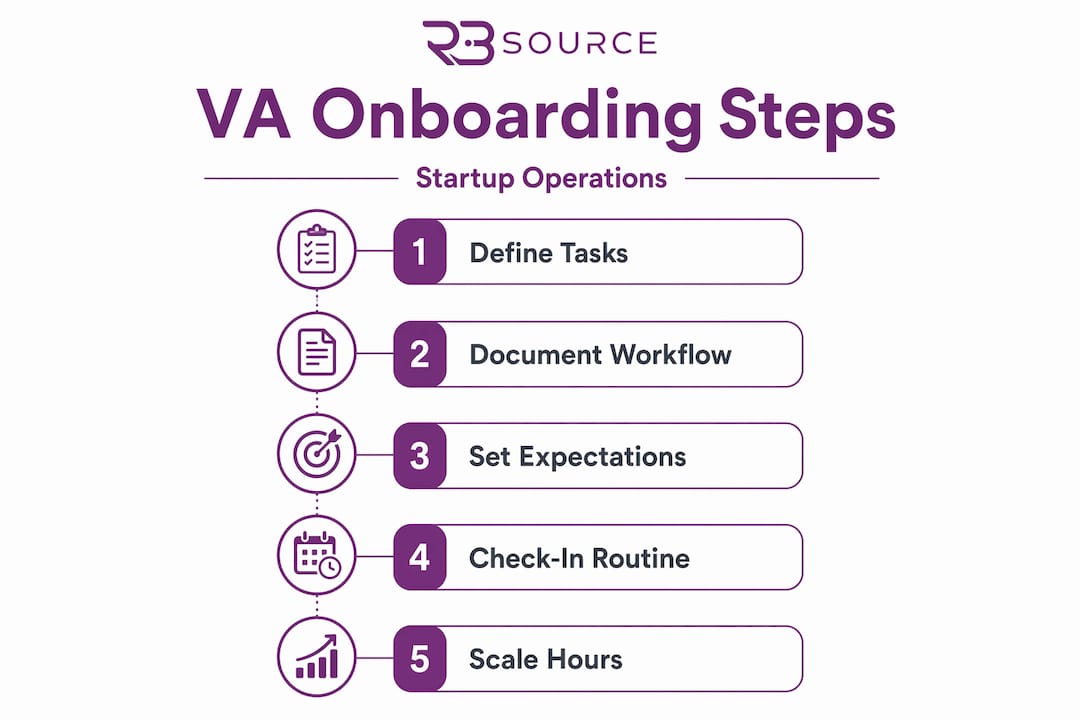
Regular check-ins and consistent communication routines prevent small issues from compounding into larger ones. A 20-minute weekly call and a brief daily async message is usually enough to keep priorities aligned without micromanaging.
Many startups begin with part-time VA hours, which lets you test the working relationship before scaling. Start with 15 to 20 hours per week, expand as trust and process maturity grow, and add responsibilities in defined stages rather than all at once.
Pro Tip: Record a Loom video for every recurring task during the first two weeks. Even if your VA already knows the process, your version creates a reference point that eliminates most back-and-forth questions.
Common mistakes that undermine VA relationships
Most VA arrangements that fail do not fail because the assistant was unqualified. They fail because of avoidable founder-side mistakes.
Delegating without documentation. Handing over a task with a one-line description and no context forces your VA to guess. Vague delegation creates more work for you, not less. Always attach an SOP or a recorded walkthrough.
Skipping the trial period. Moving directly from interview to full-time engagement without a test project removes your most reliable filter. It also makes it harder to end the relationship early if the fit is wrong.
Expecting strategic thinking without strategic input. A VA is an execution partner. They carry out defined tasks at a high level. They are not a co-founder, and asking them to make decisions they lack context for sets both of you up to fail.
Giving feedback only when something goes wrong. Silence is not affirmation in a remote working relationship. Regular positive reinforcement builds confidence and reduces mistakes.
Inconsistent communication. Going quiet for days and then flooding your VA with urgent requests is a pattern that erodes reliability on both sides. Predictable communication produces predictable results.
My perspective on what actually makes this work
I’ve watched a lot of startup founders hire a virtual assistant and feel disappointed within 60 days. In my experience, the problem is almost never the assistant. It’s that the founder treated hiring a VA like ordering a service rather than building a working relationship.
What I’ve found makes the biggest difference is workload mapping done honestly before the hire. Most founders underestimate how much of their workload is undocumented tribal knowledge. They know how to do things. They just cannot explain it clearly enough for someone else to replicate it. That gap is where VA relationships break down.
I’ve also seen founders treat the job description as a formality, then wonder why they are interviewing the wrong people. The description is your first filter. Make it specific enough to disqualify candidates who are not the right fit, and you will save yourself weeks of wasted interviews.
The founders who build successful VA relationships treat the hire with the same rigor as any full-time role. They write clear job descriptions, run structured interviews, use paid trial projects, and onboard with real documentation. The payoff is a remote partner who operates with increasing independence over time. That is where the real capacity for growth comes from.
— Ellis
How R3source helps startups build operations they can scale
If you’ve been putting off hiring because you are not sure where to start, R3source makes it straightforward. R3source provides startup founders with dedicated remote professionals from the Philippines who specialize in virtual operations support. These are not task-based freelancers you manage through a platform. They are long-term team members trained to integrate directly into your business.
R3source’s model covers everything from administrative and CRM support to lead generation, customer service, and marketing coordination. You can start part-time and scale as your needs grow, with each team member supported by R3source’s onboarding and performance structure. If you are ready to build your remote team and reclaim the time you have been losing to daily operations, R3source is built for exactly that.
FAQ
What tasks can a virtual assistant handle for a startup?
A generalist VA can handle email management, calendar scheduling, CRM updates, travel booking, research, and social media scheduling. Specialist VAs cover areas like bookkeeping, graphic design, lead generation, and customer support.
How do I hire a virtual assistant for the first time?
Start by mapping your recurring tasks and estimating the weekly hours each requires. Write a detailed job description with specific tools, availability requirements, and task examples, then use a paid trial project to evaluate candidates before committing.
How many hours per week should I start with?
Most startups begin with 15 to 20 hours per week. This gives you enough coverage to see real impact while allowing time to refine processes and assess the working relationship before expanding hours.
What is the difference between a freelance startup assistant and a dedicated VA?
A freelance assistant typically works across multiple clients on a task basis with no long-term commitment. A dedicated VA is assigned specifically to your business, builds context over time, and operates more like a remote team member than a contractor.
How do I know if my VA is performing well?
Set clear metrics from the start, such as response time targets, task completion rates, and error frequency. Schedule formal feedback sessions at 30 and 60 days, and use your weekly check-in to address small issues before they grow.
Recommended
Comments