

The Real Role of Virtual Assistants in Operations


Most business owners think of virtual assistants as calendar managers or inbox cleaners. That framing undersells what they actually do. The role of virtual assistant in operations has expanded well beyond scheduling and data entry. Today, a well-integrated virtual assistant can manage vendor relationships, track inventory, oversee workflows, handle customer inquiry triage, and feed you real-time operational updates without you lifting a finger. If you are still treating your virtual assistant as a glorified to-do list, you are leaving significant capacity on the table.
Table of Contents
Key Takeaways
Point | Details |
Beyond administrative tasks | Virtual assistants manage workflows, vendors, and inventory, not just schedules and emails. |
Measurable cost savings | Businesses can reduce operational costs by 30 to 50% by delegating routine tasks to virtual assistants. |
Time reclaimed weekly | Knowledge workers gain a median of 6.4 hours per week when virtual assistants handle recurring tasks. |
Hybrid models work best | Combining AI tools with human virtual assistants delivers better results than full automation alone. |
Strategy requires structure | Effective virtual assistant workflow management depends on clear processes, not just task delegation. |
The role of virtual assistants in operations
When people hear “virtual assistant,” they often picture someone answering emails from a home office. The reality is much broader. A skilled virtual assistant working inside your operations can touch nearly every functional area of your business.
Here is a closer look at the core operational tasks virtual assistants handle well:
Workflow coordination: Tracking project milestones, following up with team members, and keeping processes moving without constant owner oversight
Scheduling and communication: Managing meetings, coordinating cross-team communication, and maintaining calendars across time zones
Vendor and supplier management: Sending purchase orders, following up on deliveries, and maintaining vendor contact records
Inventory monitoring: Flagging low stock levels, initiating reorder requests, and updating inventory logs
CRM and data management: Logging customer interactions, updating pipelines, and generating activity reports
Customer inquiry support: Sorting incoming inquiries, routing them appropriately, and handling routine responses
What this list tells you is that the efficiency of virtual assistants comes from their ability to absorb the operational friction that slows you down every single day. These are not glamorous tasks. But they are the ones that eat hours out of your week and pull you away from decisions that actually require your judgment. Learning more about what virtual admin support includes in 2026 can help you calibrate your expectations before you hire.
The numbers behind the efficiency gains
Let’s talk about what the data actually shows, because the numbers here are worth paying attention to.
Metric | Result | Source |
Operational cost reduction | 30 to 50% for outsourced routine tasks | The Agent Bureau |
Labor cost comparison | Digital agents at ~$12K/year vs. $40K+ for junior hires | The Agent Bureau |
Time saved per week | Median 6.4 hours for knowledge workers | Digital Applied |
Productivity gains | Median 71% in agentic AI deployments | Digital Applied |
Routine inquiry resolution | 40 to 70% handled autonomously by AI virtual assistants | OnDial |
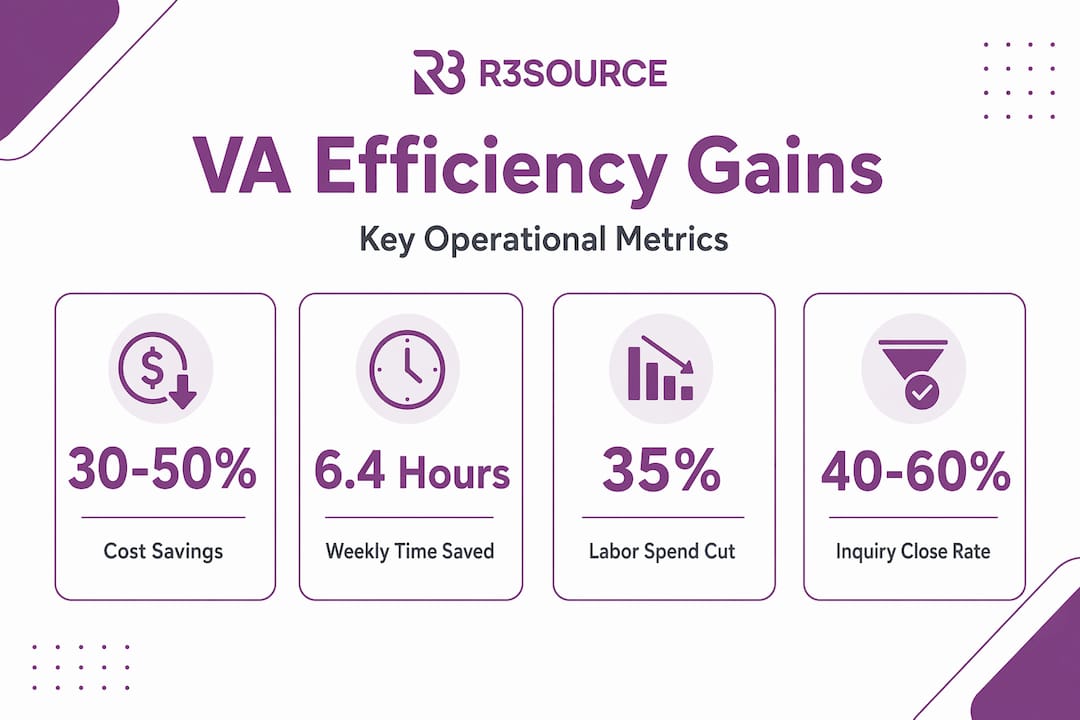
These figures represent real business decisions. Businesses cutting labor costs by 35% are not doing it through layoffs. They are reallocating work to virtual professionals who cost a fraction of a full-time employee while handling comparable task volume.
The time savings figure deserves its own attention. Reclaiming 6.4 hours weekly sounds modest until you multiply it across a year. That is roughly 330 hours returned to you. You could build an entire product, develop a new market, or simply lead your business with more intention. That is the real payoff.
Pro Tip: Before hiring a virtual assistant, map out where your actual time goes for two weeks. Most business owners are surprised to discover that 40 to 60 percent of their day is spent on tasks a skilled virtual assistant could handle within the first month.
The hybrid model question also matters here. Full automation of customer service leads to measurable satisfaction decline and customer churn. The businesses getting the best return are combining AI tools for volume tasks with human virtual assistants for nuanced interactions. That balance is not just good practice. It is where the real ROI lives.
Virtual assistants as operations management support
Here is a perspective shift worth making. Operations is not a back-office function. It is a leadership function. And when you start treating it that way, the role of virtual assistant in operations takes on a different weight.
Sustainable operational performance requires more than efficiency. It requires discipline, transparent decision-making, and the kind of institutional judgment that keeps a business functioning even when things go sideways. A virtual assistant embedded in your operations contributes to all three, provided you build the right structure around them.
“Operations provides the spine of any growing business. When that spine is supported by reliable, accountable people, the whole organization moves with more confidence.”
Real-time visibility is one of the most underrated benefits here. When your virtual assistant is tracking workflows, updating project statuses, and flagging bottlenecks as they emerge, you get an accurate picture of your business without micromanaging anyone. Centralized workflow tools reduce handoffs, shorten feedback loops, and keep everyone aligned, and a virtual assistant is the person who actually maintains those tools consistently.
This is also where the Microsoft Work Trend Index 2026 makes a sharp point. Marginal productivity improvements without structural change do not move the needle long-term. A virtual assistant does not replace the need for operational redesign. They support it. Used well, they give you the bandwidth to actually do that redesign work instead of just surviving the week.

Pro Tip: Assign your virtual assistant a weekly operations report. Even a simple summary of completed tasks, pending items, and flagged issues gives you the kind of visibility that would otherwise require a full-time operations coordinator.
Virtual assistant workflow management best practices
Getting results from a virtual assistant is not automatic. The way you onboard, structure, and communicate with them determines the outcome. Here are the practices that separate high-performing virtual assistant relationships from frustrating ones.
Define the right tasks first. Start by listing every recurring task you do that does not require your specific expertise or final judgment. Those tasks are your starting point. Handing off ambiguous or high-stakes decisions too early leads to errors and erosion of trust.
Choose a single workflow hub. Whether you use Asana, Trello, ClickUp, or Monday.com, your virtual assistant needs one place to see priorities, deadlines, and communication. Scattered instructions across email, Slack, and text will produce scattered results.
Set clear performance metrics from day one. Vague expectations produce vague outcomes. Define what success looks like for each assigned area. For example, “all vendor emails acknowledged within 24 hours” or “weekly inventory report delivered every Friday by 9 a.m.”
Build in a feedback rhythm. A weekly 20-minute check-in does more for your virtual assistant relationship than any amount of written instruction. It catches misalignments early and keeps communication open.
Avoid over-automating too quickly. This is where many businesses stumble. They use AI to automate tasks before understanding the underlying process. Start with human-managed workflows, then layer in automation once the process is stable and documented.
Finding a reliable long-term virtual assistant is not just about skills. It is about alignment, accountability, and the systems you build together. The businesses that get the most from virtual assistant workflow management treat it as an ongoing operational relationship, not a one-time hire.
Real-world use cases across operational areas
Understanding how virtual assistants work in theory is useful. Seeing it in practice is better. Here are specific operational areas where the impact is concrete and measurable.
Inventory and vendor management is one of the highest-value areas. Virtual assistants handling inventory can monitor stock levels, set reorder triggers, generate purchase orders, and track inbound shipments without you touching the process. For e-commerce businesses in particular, this eliminates one of the most time-consuming daily responsibilities.
Customer inquiry triage is another area where the hybrid model shines. AI-assisted virtual assistants can resolve 40 to 70% of routine inquiries autonomously, while human virtual assistants handle the cases that need nuance, empathy, or escalation. The result is faster response times, lower costs, and customers who feel heard when it matters most.
Operational Area | What the VA Handles | Business Impact |
Inventory management | Monitoring, reorders, purchase orders | Fewer stockouts, less owner time |
Vendor relations | Communication, invoices, follow-ups | Stronger vendor relationships |
Customer support | Inquiry triage, routing, responses | Faster resolution, lower cost |
Scheduling | Meetings, reminders, calendar management | More focused owner workdays |
CRM updates | Data entry, pipeline tracking, reporting | Cleaner data, better decisions |
Real estate businesses use virtual assistants to manage listing coordination, follow-up sequences, and transaction timelines. If you want to see how that applies specifically to your industry, R3source has covered virtual assistants for real estate in depth. The operational patterns translate directly to service-based businesses of all kinds.
My take on where this is all heading
I have worked with enough businesses to say this with confidence: the owners who resist delegating operations are not protecting quality. They are protecting their own discomfort with letting go. That distinction matters.
In my experience, the single biggest reason virtual assistant deployments underperform is not a skills gap. It is a structure gap. The business owner hands off tasks without documenting the process, without setting expectations, and without creating any feedback mechanism. Then they conclude that virtual assistants do not work. They are wrong. Their process did not work.
What I have seen work consistently is treating your virtual assistant as an operational partner from day one. That means sharing context, not just tasks. It means explaining why a workflow exists, not just how to execute it. When your virtual assistant understands the business goal behind a task, they make better decisions independently. And that is when you start to feel the real shift.
The hybrid AI-human model is not a trend to watch. It is the operating standard right now. Businesses that combine smart automation with skilled human virtual assistants are not just cutting costs. They are building operational capacity that scales with them. That is a meaningful advantage for any growing business.
— Ellis
Ready to build a stronger operations team?
If this article gave you a clearer picture of how virtual assistants can change the way your business operates, the next step is practical. R3source specializes in placing skilled, dedicated virtual assistants from the Philippines with growing U.S. businesses across industries.

R3source does not place freelancers on one-off tasks. Every virtual assistant is trained to integrate directly into your workflows, tools, and culture. Whether you need operations management support, customer service coordination, CRM management, or administrative oversight, R3source builds the support system around your specific business. Explore virtual assistant outsourcing services to see what a dedicated remote professional can take off your plate. You can also visit the remote professionals FAQ to understand exactly how the team-building process works before you commit.
FAQ
What is the role of a virtual assistant in operations?
A virtual assistant in operations manages recurring workflows, vendor communications, inventory tracking, scheduling, and customer inquiry support. Their role frees up business owners to focus on decisions that require direct leadership.
How do virtual assistants improve operational efficiency?
Virtual assistants reduce the volume of routine tasks that consume owner time, often saving knowledge workers over 6 hours per week while cutting operational costs by up to 50% compared to traditional hires.
What tasks should I delegate to a virtual assistant first?
Start with recurring tasks that do not require your final judgment, such as scheduling, vendor follow-ups, data entry, and CRM updates. These are high-frequency, low-complexity tasks where a virtual assistant can deliver immediate value.
Is a hybrid AI-human virtual assistant model worth it?
Yes. Hybrid models handling routine inquiries with AI while routing complex cases to human virtual assistants consistently outperform fully automated approaches in both cost savings and customer satisfaction.
How do I measure virtual assistant performance in operations?
Set specific, measurable benchmarks tied to each operational area, such as response times, report delivery schedules, and task completion rates. Review these weekly to stay aligned and catch issues early.
Recommended
Comments