

The role of virtual assistants in SaaS businesses

Most SaaS founders assume virtual assistants are just inbox managers or calendar wranglers. That assumption costs them real growth. The role of virtual assistants in SaaS businesses has expanded well beyond basic admin, and the owners who recognize that early are building leaner, faster, and more profitable companies. Whether you are running a five-person startup or scaling past a hundred users, the right combination of AI-powered tools and skilled human assistants can reshape how your entire operation runs. This guide breaks down exactly how that works and what it means for your business.
Table of Contents
Understanding virtual assistants in SaaS: AI versus human roles
How virtual assistants improve SaaS onboarding and reduce churn
Enhancing SaaS customer support and engagement with virtual assistants
Securing sensitive data when working with virtual assistants in SaaS
Building and scaling your virtual assistant team to support SaaS growth
Why treating virtual assistants as strategic partners transforms your SaaS business
How R3source helps SaaS businesses build remote teams with virtual assistants
Key Takeaways
Point | Details |
Hybrid roles maximize impact | Combining AI and human virtual assistants balances automation speed with essential human judgment for SaaS success. |
Virtual assistants improve onboarding | AI-powered assistants can boost onboarding completion and reduce churn significantly by providing proactive support. |
Secure access is crucial | Implementing strict access controls and monitoring protects sensitive SaaS data when leveraging remote assistants. |
Scaling requires planning | Human virtual assistants take weeks to onboard fully, so plan recruitment and training carefully for growth. |
Assistants enhance customer support | Virtual assistants provide scalable, 24/7 support and proactive engagement that improve customer satisfaction and retention. |
Understanding virtual assistants in SaaS: AI versus human roles
Not all virtual assistants are the same, and confusing the two main types leads to poor decisions about where to invest your time and money. The term covers both AI-powered software tools and human professionals working remotely. Each brings something different to the table, and knowing the difference helps you build a system that actually works.
AI virtual assistants in SaaS environments are built for volume. They handle repetitive CRM (customer relationship management) tasks like data entry, lead scoring, and email sequencing without fatigue or error. They respond instantly, never take sick days, and scale without additional cost per transaction. But they cannot read tone, handle nuance, or build genuine rapport with a frustrated customer.
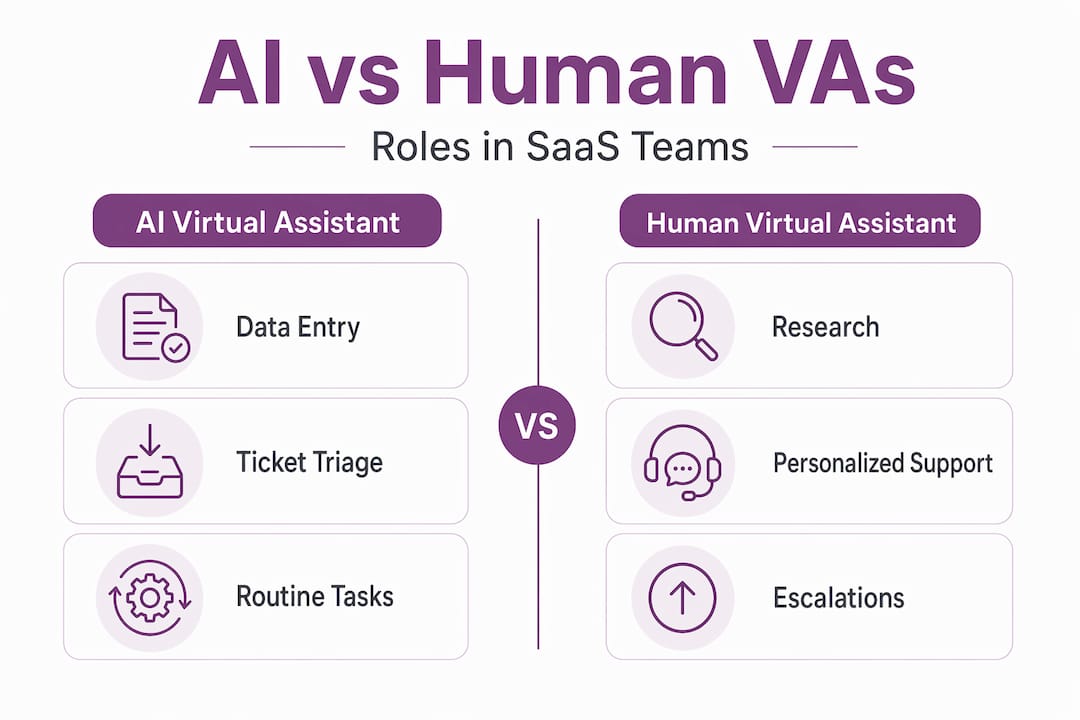
Human virtual assistants fill that gap. They conduct complex research, write personalized outreach, manage escalating support tickets, and represent your brand in ways that feel real to customers. As AI and human assistants each excel at different tasks, AI handles high-volume repetitive CRM work while human assistants manage complex, nuanced interactions requiring judgment and relationship-building.
The most effective SaaS teams use both. A hybrid model lets AI handle the intake and sorting, then hands off to a human when context and care are needed. This is not a trend. It is a practical decision that protects customer experience at scale.
Feature | AI virtual assistant | Human virtual assistant |
Best tasks | Data entry, lead scoring, ticket triage | Research, outreach, relationship management |
Onboarding time | Hours to configure | 2 to 4 weeks |
Flexibility | Rule-based | Highly adaptable |
Scalability | Instant | Requires hiring and training |
Customer empathy | Limited | High |
Pro Tip: When setting up your hybrid model, map every recurring customer-facing task and tag it as either “rule-based” or “judgment-required.” AI takes the first category. A trusted human VA handles the second. Start with finding reliable virtual assistants who can work alongside your existing tools, then layer automation in over time.
For SaaS companies ready to move beyond hiring guesswork, outsourcing virtual assistants through a dedicated provider gives you vetted human talent without the recruiting overhead.
How virtual assistants improve SaaS onboarding and reduce churn
Onboarding is where most SaaS companies silently bleed revenue. Users sign up, get confused, and quietly cancel before they ever experience the product’s real value. Virtual assistants, both AI-driven and human, are changing that outcome with measurable results.
The core problem is that onboarding completion rates are often alarmingly low without active support. Users left to navigate a product alone tend to abandon it at the first point of friction. Virtual assistants step in to guide users step by step, answer common questions in real time, and flag when someone is falling behind.
The numbers back this up. Onboarding completion rates doubled from 34% to 61% when automation was applied to the onboarding workflow, while 60-day churn dropped by 25%. That is not a marginal improvement. That is a business transformation.
The results from more targeted deployments are just as striking. Deploying AI agents for personalized onboarding lifted 90-day retention from 71% to 84% and preserved $520,000 in annual recurring revenue (ARR) that would have otherwise churned.
Metric | Before virtual assistant deployment | After virtual assistant deployment |
Onboarding completion rate | 34% | 61% |
60-day churn rate | Baseline | Reduced by 25% |
90-day retention rate | 71% | 84% |
ARR preserved | N/A | $520,000 |
Beyond the numbers, here is what changes operationally:
Users reach “time to first value” (the moment they experience the product working for them) faster
Integration success rates improve because users get real-time troubleshooting guidance
Human support teams spend less time on repetitive onboarding questions and more time on high-value conversations
Net Promoter Scores (NPS) improve because users feel supported from day one
When you pair AI automation with a dedicated human VA who handles escalations and personal follow-ups, you give users the confidence that someone is actually looking out for them. That feeling is what drives long-term retention.
Enhancing SaaS customer support and engagement with virtual assistants
Onboarding is just the beginning. Keeping users engaged, satisfied, and renewing month after month requires a support system that is always on and always responsive. Virtual assistants make that possible without burning out your internal team.

Virtual assistants manage support queues, triage tickets by priority, and provide 24/7 coverage that improves resolution times and customer satisfaction across global user bases. For SaaS companies with customers in multiple time zones, that kind of always-on availability used to require expensive overnight staffing. Now it does not.
Here is what a well-configured virtual assistant support operation looks like in practice:
Ticket triage: AI assistants sort incoming requests by urgency, category, and complexity before a human ever sees them
Basic query handling: Common questions about billing, feature access, and account settings are answered instantly without waiting for a human response
Proactive re-engagement: Virtual assistants monitor user activity and trigger outreach when a user has not logged in or has stopped using a key feature
Feedback collection: Automated and human-assisted check-ins gather product feedback at scale, which feeds directly into your product roadmap
That last point is often overlooked. Your virtual assistants are in constant contact with your users. When set up correctly, they become one of your best sources of product intelligence.
Pro Tip: Build personalized communication workflows into your VA’s playbook from day one. A generic “We noticed you haven’t logged in” message gets ignored. A message that references a user’s specific setup, goal, or last action gets a response. Human VAs excel at crafting these touchpoints when given the right context and templates.
Securing sensitive data when working with virtual assistants in SaaS
The operational benefits of virtual assistants are real. So is the risk if you do not set up proper security from the start. SaaS businesses handle sensitive customer data, payment information, and proprietary systems. Bringing any external team member into that environment requires deliberate safeguards.
Data protection must be part of your operating model, not an afterthought when granting access to virtual assistants. That means thinking about security before your first VA ever logs into a company tool.
Follow these steps to onboard and offboard virtual assistants securely:
Define access scope first. Before creating any credentials, document exactly which tools and data the VA needs and nothing more. This is called “least privilege access.”
Set up role-based accounts. Never share your primary admin credentials. Create individual accounts with specific permission levels tied to job function.
Require multi-factor authentication (MFA). Every VA account should require a second form of verification to log in.
Use encrypted communication channels. Any data shared between your team and a VA should travel through encrypted platforms, not personal email.
Monitor activity logs. Set up automated alerts for unusual access patterns, such as logins at odd hours or bulk data exports.
Establish an incident response plan. Know in advance what steps to take and who to notify if a security event occurs.
Automate offboarding. When a VA relationship ends, revoke access to every system immediately using an automated deprovisioning checklist.
Secure access controls include encryption, monitoring, and breach notification processes that must be in place before a problem ever occurs.
Pro Tip: The most common security mistake SaaS owners make is not overly technical. It is sharing a master password in a Slack message because it felt faster in the moment. Use a password manager with shared vault access and audit logs instead. Small habits prevent large breaches.
Building secure virtual assistant workflows into your operations from the start protects your customers and your reputation simultaneously.
Building and scaling your virtual assistant team to support SaaS growth
Knowing the benefits is one thing. Building the team that delivers them is another. Here is how to do it in a way that keeps quality high as you grow.
The first decision is timing. AI tools can be configured and deployed within hours. Human virtual assistants require 2 to 4 weeks from recruitment to full productivity, including skill assessment, onboarding, and task familiarization. Plan accordingly, especially if you are launching a product update or scaling into a new market.
Here is a practical approach for building your VA team:
Start with a task audit. List every recurring task your team performs. Tag each by skill level and whether it can be automated or needs human judgment.
Recruit for specific roles. Avoid hiring a “general” VA and assigning everything to them. Define the role first: CRM support, onboarding specialist, customer engagement, or content coordination.
Vet for reliability and communication. Technical skills matter, but consistency and clear communication matter more for long-term remote work.
Build onboarding documentation. Your VA’s success depends on the quality of your handoff. SOPs (standard operating procedures), video walkthroughs, and tool access guides cut ramp-up time significantly.
Once your team is running, scale with intention:
Track performance weekly using clear KPIs (key performance indicators) such as ticket resolution time, onboarding completion rates, or outreach response rates.
Run monthly check-ins to identify blockers, training gaps, and new task opportunities.
Add capacity in response to data, not stress. When your metrics show a bottleneck, that is when to expand the team.
Cross-train VAs on adjacent tasks so coverage gaps do not stall operations.
Revisit your AI versus human task map quarterly as your product and customer base evolve.
When you are ready to hire virtual assistants for your SaaS business or scale your remote team intentionally, having this structure already in place makes every addition faster and smoother.
Why treating virtual assistants as strategic partners transforms your SaaS business
Here is an uncomfortable truth most articles about outsourcing avoid: the SaaS owners who see the weakest results from virtual assistants are the ones who hired them to “just handle the small stuff.”
They delegate inbox management. They assign basic data entry. Then they wonder why nothing meaningfully changed. The problem was never the assistant. It was the mindset.
The hybrid AI-human approach is a practical decision that can greatly enhance customer experience quality, but only if you treat your VA team as an integrated part of your operation, not a peripheral one.
Think about what your best internal employee does for your SaaS business. They understand your users, they communicate your product’s value, and they catch problems before those problems cost you a customer. A well-supported, well-briefed human VA can do all of that too. The difference is not the person’s capability. It is whether you gave them the context and trust to operate at that level.
“Data protection is best treated as part of the operating model, not an afterthought when granting access to virtual assistants.” 4Remote, 2026
That quote applies to more than security. Building your entire VA operation as part of your core model, rather than an add-on, is what separates companies that scale with confidence from those that stay stuck in the same bottlenecks.
The most strategic SaaS founders we work with use their VAs to gather user insights, personalize retention outreach, and free up engineers and product managers for higher-leverage work. That is not cost-cutting. That is strategic delegation that creates compounding returns.
Pro Tip: Reframe how you think about your VA budget. You are not paying for task completion. You are investing in capacity for growth. Ask yourself: what could my core team accomplish if this entire category of work was fully handled? That answer reveals where a great VA creates the most value.
How R3source helps SaaS businesses build remote teams with virtual assistants
If this article has made one thing clear, it is that the right virtual assistant team changes what is possible for your SaaS business. More supported users. Fewer churned accounts. A core team that can finally focus on building rather than firefighting.
R3source provides dedicated virtual assistants and remote professionals from the Philippines, specifically matched to the operational needs of growing SaaS businesses across the United States. Our team members are vetted for reliability, trained to integrate directly into your workflows, and supported for the long term, not just a single project. Whether you need outsourced virtual assistant services to handle CRM management and customer support, or you are ready to build a dedicated remote professional team, we make the process straightforward. Start by finding your first reliable virtual assistant and build from there.
Frequently asked questions
What tasks can virtual assistants handle for SaaS businesses?
Virtual assistants handle tasks ranging from CRM data entry and lead scoring to personalized customer outreach, onboarding support, and post-sale engagement. AI manages high-volume CRM tasks while human assistants handle complex communication and research.
How do virtual assistants help reduce SaaS customer churn?
By automating and personalizing onboarding, promptly addressing user issues, and proactively engaging inactive users, virtual assistants improve retention and reduce churn. Onboarding automation cut 60-day churn by 25% and increased completion rates significantly in documented SaaS deployments.
What security measures should SaaS companies use when working with virtual assistants?
Implement least-privilege access controls, use multi-factor authentication, enforce confidentiality, monitor activity logs, and maintain an incident response plan. Secure models require access controls, encryption, monitoring, and timely breach notification processes.
How quickly can I get productivity from a virtual assistant?
AI virtual assistants can be configured within hours, while human assistants typically require 2 to 4 weeks for recruiting, onboarding, and ramping to full output. AI CRM assistants configure in hours, while human assistants need a few weeks to reach full productivity.
Can virtual assistants provide 24/7 support for global SaaS customers?
Yes, virtual assistants can be scheduled across time zones or combined with AI automation to ensure continuous customer support without the cost of full in-house overnight staffing. Virtual assistants enable scalable 24/7 coverage, improving responsiveness and satisfaction across global user bases.
Recommended
Comments