

Why entrepreneurs value pre-trained virtual staff

Updated: May 28

You might assume that hiring traditional employees is the “safe” route, but the numbers tell a very different story. A full-time administrative hire costs well beyond $70,000 per year when you factor in benefits, payroll taxes, office space, and management time. That’s why entrepreneurs value pre-trained virtual staff not as a budget shortcut, but as a genuine growth strategy. This guide breaks down the real financial and operational case for choosing trained virtual professionals, and shows you how to make the transition work for your business.
Table of Contents
Understanding the real cost of hiring traditional employees vs. pre-trained virtual staff
How pre-trained virtual staff accelerate business scalability and reduce management headaches
The role of AI training and technology in enhancing the value of virtual staff
Best practices for onboarding and integrating pre-trained virtual staff into your business
Summary: why entrepreneurs consistently choose pre-trained virtual staff
Why relying on just freelancers or untrained hires often backfires
Build your team efficiently with pre-trained virtual assistants from R3source
Key Takeaways
Point | Details |
Hidden hiring costs | Traditional employees often cost much more than their salary due to benefits, taxes, and turnover expenses. |
Fast onboarding | Pre-trained virtual staff are productive within days, bypassing typical lengthy ramp-up periods. |
AI enhances quality | AI training equips virtual assistants to deliver output comparable to onshore staff with ongoing human oversight. |
Operational flexibility | Managed services allow entrepreneurs to scale staff quickly without long-term commitments or bottlenecks. |
Effective onboarding matters | Investing in onboarding improves retention, performance, and cultural alignment for virtual staff. |
Understanding the real cost of hiring traditional employees vs. pre-trained virtual staff
Most business owners calculate the cost of a hire by looking at salary alone. That’s a mistake. The true cost of a full-time employee includes employer payroll taxes, health insurance, paid time off, equipment, office space, and the hours you personally spend managing that person. When you add it all up, the gap between a traditional hire and a pre-trained virtual staff member becomes hard to ignore.
Consider a few of the hidden costs that rarely appear in job offer letters:
Employer payroll taxes: Typically 7.65% on top of gross salary
Health and dental benefits: Often $6,000 to $12,000 per employee annually
Paid leave: Two weeks of vacation plus sick days equals roughly 4 to 5% of annual salary lost to non-productive time
Onboarding and training time: Managers spend an average of 40 to 60 hours per new hire in the first 90 days
Office overhead: Desk space, utilities, hardware, and software licenses add thousands more per year
Turnover costs: Replacing an employee can cost anywhere from 50% to 200% of their annual salary
Turnover is the hidden cost most entrepreneurs underestimate. When a trained employee leaves, you are not just losing a body. You are losing institutional knowledge, client relationships, and the investment you made in getting them up to speed.
Pre-trained virtual staff flip this equation. Because they arrive already familiar with standard business tools and workflows, the onboarding burden falls away. And each placement with AI-trained staff can save up to $70,000 compared to local hires. That is a number worth pausing on.
“The question is not whether you can afford to hire a virtual staff member. The question is whether you can afford not to.”
One practical way to think about this: if your virtual staff member costs $15,000 to $25,000 per year, and your equivalent local hire costs $70,000 or more, those savings fund a marketing campaign, a product improvement, or another hire. Understanding why U.S. businesses hire from the Philippines helps clarify why this model works so well for American entrepreneurs looking to scale without blowing their budget.
There is also an important distinction between freelancers and managed virtual staffing services. Freelancers are self-directed contractors. Managed services vet, train, and support your virtual staff, providing quality assurance and replacement coverage when needed. That distinction is what separates a reliable operation from a constant hiring headache.
Cost factor | Traditional employee | Pre-trained virtual staff |
Base salary / service fee | $50,000 to $80,000+ | $12,000 to $30,000 |
Benefits and taxes | $10,000 to $20,000 | Included or minimal |
Onboarding time (hours) | 40 to 60 hours | 5 to 10 hours |
Turnover risk | High | Low with managed services |
Replacement support | None | Provided by managed service |
Office overhead | Significant | None |
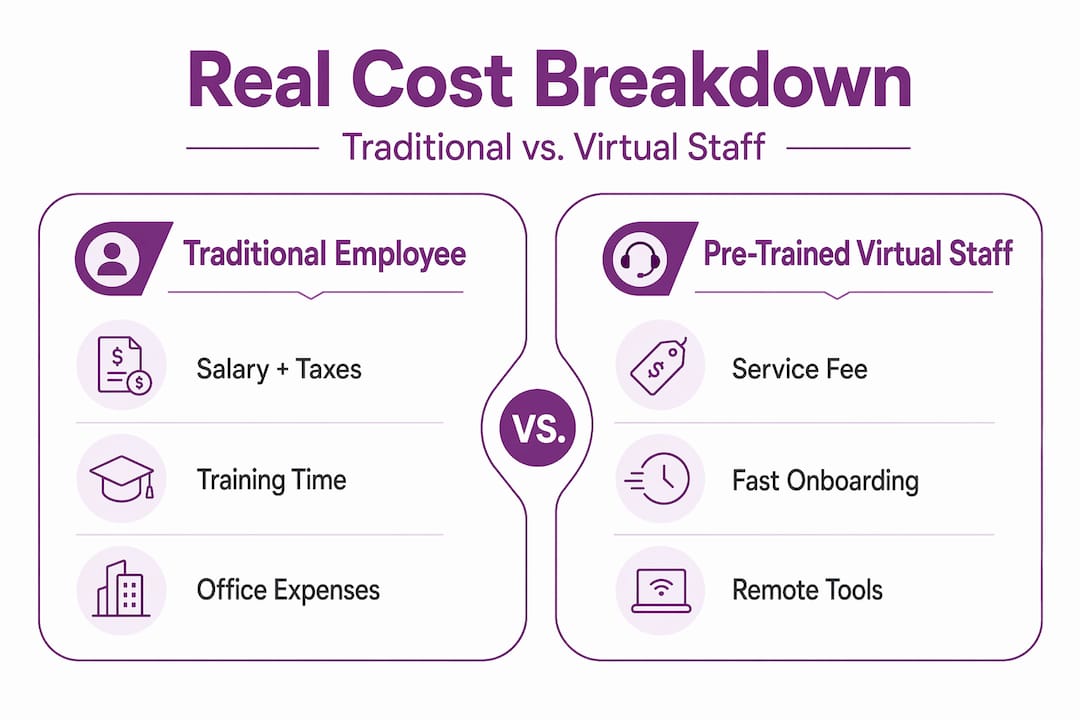
Pro Tip: Before you post your next job listing, calculate your total cost of employment. Add salary, taxes, benefits, and a conservative estimate of your management time. You may find that number is 40 to 50% higher than the base salary alone.
Now that you understand the true cost differences, let’s explore the operational advantages of pre-trained virtual staff beyond just financial savings.
How pre-trained virtual staff accelerate business scalability and reduce management headaches
Scalability is the word every entrepreneur wants to achieve, but the traditional staffing model makes it painfully slow. Each new hire requires weeks of job posting, interviewing, background checking, and training before they contribute meaningfully. Pre-trained virtual staff remove most of that friction entirely.
Here is what makes managed virtual staffing so different in practice:
Virtual staff arrive familiar with CRM platforms, project management tools, and communication apps like Slack, HubSpot, and Google Workspace
They understand standard business workflows such as inbox management, appointment setting, and lead tracking
Managed service providers have already done the vetting, so you skip the 30-hour interview process
Clients are matched to pre-vetted talent in 3 to 7 days, with operations often fully running within 2 to 4 weeks
Compare that to the typical 90-day ramp-up period for a traditional hire. In real business terms, that 60-day advantage could mean dozens of customer inquiries handled, hundreds of leads followed up, or weeks of content scheduled.
For entrepreneurs who are scaling, the flexibility matters just as much as the speed. Need to add a customer service rep for a product launch? Done in days. Need to scale back after a slow quarter? Managed services make that possible without severance packages or difficult conversations.

Managed services absorb the overhead of training and supervision, unlike freelancers, ensuring reliable quality from day one. That is not a small benefit. It means you are not spending your Sunday nights reviewing work quality or chasing deadlines.
How to think about integrating pre-trained staff for maximum effect:
Identify your highest-volume, repeatable tasks first (inbox management, scheduling, data entry)
Assign those tasks before moving to more complex work like client communication or CRM management
Use the time you reclaim to focus on relationships, revenue, and decisions only you can make
Review performance weekly at first, then shift to monthly check-ins once workflows stabilize
Expand responsibilities gradually as trust and familiarity build
Pro Tip: The first two weeks with any virtual staff member are critical. Invest time in clear documentation upfront, and you will rarely need to repeat yourself. Think of it as a one-time investment that pays out every day after.
Finding a reliable long-term virtual assistant is about more than skills. It is about fit, communication style, and the support structure behind them. Understanding why growing businesses need remote staff to reach their goals helps put this model in the right context.
With scalability and efficiency benefits clear, let’s consider how AI-powered training is bridging quality gaps with onshore staff.
The role of AI training and technology in enhancing the value of virtual staff
One of the most common concerns entrepreneurs raise about virtual staff is quality. Will they perform at the same level as someone sitting in your office? The answer, increasingly, is yes, and in some cases better.
AI training has fundamentally changed what virtual assistants can do. Today’s pre-trained virtual professionals are not just handling email and scheduling. They are running automated workflows, generating reports, managing CRM pipelines, and even supporting content creation using AI tools integrated into their daily operations.
Here is where technology is making the biggest difference:
AI-assisted communication: Virtual staff use tools that help prioritize inboxes, draft responses, and flag urgent items
Workflow automation: Platforms like Zapier and Make allow virtual assistants to trigger multi-step processes without manual input
CRM proficiency: Pre-trained staff are often fluent in HubSpot, Salesforce, and GoHighLevel before their first day
Data reporting: AI tools help virtual staff compile clean, accurate reports faster than most in-house employees
AI and communication platforms enable virtual staff to match or exceed onshore output quality, though accuracy still requires human oversight. That combination of AI capability and human judgment is what makes the modern virtual staff model so effective.
“Executive assistants trained with AI tools remove friction by handling routine tasks, allowing founders to focus on growth.”
What this means for you as an entrepreneur is real. Every hour your virtual staff member spends on inbox management, data entry, or appointment setting is an hour you spend on strategy, sales, or building client relationships. That trade is where your business actually grows.
If you are curious what this looks like in practice, virtual admin support in 2026 covers exactly what trained virtual staff are handling for businesses like yours today.
Understanding how technology boosts virtual staff effectiveness helps us see why onboarding and integration practices matter for long-term success.
Best practices for onboarding and integrating pre-trained virtual staff into your business
Even the most skilled virtual staff member will underperform without a thoughtful onboarding process. Pre-trained does not mean mind-reader. Your team, your systems, and your way of doing things are unique. Onboarding is where general skills become specific value for your business.
Effective onboarding establishes culture, sets expectations, and improves retention, preventing bad habits early on. This holds true whether you are hiring a hospitalist or a virtual customer service rep.
Follow these steps to make onboarding count:
Share your brand voice and communication standards in a simple one-page document before day one
Record short walkthrough videos of your key tools and processes using Loom or a similar tool
Assign a dedicated point of contact on your team so the virtual staff member always knows who to ask
Set 30, 60, and 90-day milestones with clear deliverables and review dates
Schedule weekly check-ins for the first month to catch misalignments early
Beyond the formal steps, the following habits will keep your virtual staff performing at a high level long-term:
Acknowledge good work specifically, not just generally
Create a shared task management board so expectations are always visible
Build a short FAQ or knowledge base your virtual staff can reference without interrupting you
Revisit role expectations every quarter as your business evolves
Pro Tip: If you are hiring your first virtual assistant, start with one clearly defined role rather than a general assistant. Clarity of scope produces faster results and makes performance much easier to measure.
Managed services add another layer of support here. When your staffing provider handles HR issues, scheduling conflicts, and replacements, you can stay focused on what your business needs rather than managing the management of your staff. Understanding how integrating remote staff to scale works helps you approach this with the right framework from the start.
Having explored onboarding, next is a clear summary of why entrepreneurs consistently choose pre-trained virtual staff.
Summary: why entrepreneurs consistently choose pre-trained virtual staff
If you have been on the fence about making this move, here is the clearest way to look at it. Pre-trained virtual staff offer advantages across every dimension that matters to a growing business. Cost. Speed. Quality. Flexibility. And when you choose a managed service over a solo freelancer, you also get accountability and continuity.
Highly skilled virtual assistants can reduce labor costs by up to 70% while maintaining productivity. That kind of savings does not just protect your margins. It creates real capacity for growth.
Here is a quick summary of the core reasons entrepreneurs keep choosing this model:
Cost efficiency: Savings of $40,000 to $70,000 per year compared to equivalent local hires
Speed to value: Operational within 2 to 4 weeks versus 90-day ramp-up for traditional hires
Technology readiness: Pre-trained staff bring AI tool proficiency and workflow knowledge on day one
Flexibility: Scale up or down without long-term employment commitments
Managed support: Quality assurance, replacement coverage, and HR handled for you
Criteria | Freelancer | Untrained hire | Pre-trained managed staff |
Onboarding time | Variable, often long | 60 to 90 days | 2 to 4 weeks |
Quality assurance | Self-managed | Your responsibility | Provided |
Replacement support | None | Full rehire process | Immediate |
Cost predictability | Inconsistent | High with hidden costs | Consistent |
Technology readiness | Varies widely | Requires training | Built-in |
Exploring your outsourcing virtual assistant services options is a logical next step once you see how well this model aligns with where you want to take your business.
Why relying on just freelancers or untrained hires often backfires
Here is something most articles on virtual staffing will not tell you directly: the biggest mistakes entrepreneurs make in this space are not about whether to hire remotely. They are about how they hire remotely.
Freelancers get a lot of positive attention because they feel low-commitment. You pay for a task, no strings attached. But the reality of managing freelancers day to day is messier than the pitch. Many entrepreneurs underestimate the time and hidden costs of onboarding freelancers, leading to burnout and poor results.
When you manage five different freelancers across five platforms, you are spending real time on coordination, quality checks, and re-dos. That time comes directly out of what you could be doing to grow your business. It is a slow leak that adds up fast.
Untrained hires have a similar problem. Even if the person is talented, getting them up to speed in your specific systems and workflows takes months. And if they leave at the four-month mark, you start over. This cycle is exhausting, and it is more common than most business owners want to admit.
Managed, pre-trained virtual staff solve both problems at once. The training is done before they arrive. The oversight infrastructure exists so you are not carrying it all yourself. And if something goes wrong, your provider handles it rather than leaving you scrambling.
Choosing pre-trained managed staff is not just a short-term cost-cutting move. It is a long-term investment in operational stability. Finding reliable virtual assistants through a trusted provider changes what your day looks like, and what your business can become.
Build your team efficiently with pre-trained virtual assistants from R3source
Running a business should feel like building something meaningful, not like carrying an endless list of tasks alone. If you are ready to reclaim your time and grow with confidence, R3source is here to help.
R3source provides fully vetted, pre-trained virtual assistants and remote professionals from the Philippines, ready to integrate into your business within days. Whether you need outsource virtual assistant services for admin support, customer service, CRM management, or lead generation, our team is prepared to deliver from day one. Flexible month-to-month plans reduce your financial risk, and our dedicated support team handles replacements and quality assurance so you never have to manage that alone. Ready to explore building a remote team that grows with you? You can also enter our free remote professional raffle for a chance to win dedicated remote support at no cost.
Frequently asked questions
What does “pre-trained virtual staff” mean?
Pre-trained virtual staff have completed specialized training in relevant industry tools and workflows before starting work, enabling them to be productive from day one without a lengthy onboarding period.
How quickly can I start working with a pre-trained virtual assistant?
Most managed services match clients with qualified staff in 3 to 7 days, and businesses are often fully operational with their virtual team within 2 to 4 weeks.
Are AI-trained virtual assistants reliable compared to onshore hires?
When trained with AI tools and supported by human oversight, virtual assistants can match or even exceed onshore staff productivity, making them a genuinely competitive and cost-effective alternative.
What are the benefits of onboarding for virtual staff?
Effective onboarding builds connections, sets clear expectations, and significantly improves retention, which prevents costly mistakes and reduces the risk of early turnover.
Why should I choose managed virtual staffing services over freelancers?
Managed services provide vetting, training, ongoing support, quality assurance, and immediate replacements, eliminating the hidden costs and supervision burden that come with managing freelancers on your own.
Recommended
Comments