

How to Hire Offshore Employees for U.S. Businesses


Yes, you should hire offshore employees if the role is repeatable, measurable, and doesn’t require in-person customer contact. The fastest way to start: write a brief outlining key outcomes for the role for one priority role, choose your hiring model (contractor, Employer of Record, or managed staffing), and run a 30-day paid pilot. That single decision can cut your labor costs significantly while giving you access to a global talent pool your local market simply can’t match.
Three quick decision criteria before you move forward:
Complexity: Can you define success with clear KPIs? If yes, offshore works.
IP sensitivity: Does the role touch core product architecture or regulated client data? If yes, add access controls before hiring.
Time overlap: Does the role need real-time collaboration with your U.S. team? If yes, plan for a 2–4 hour daily sync window.
If you check those boxes, you’re ready to build.
Table of Contents
What are the real benefits of hiring offshore employees?
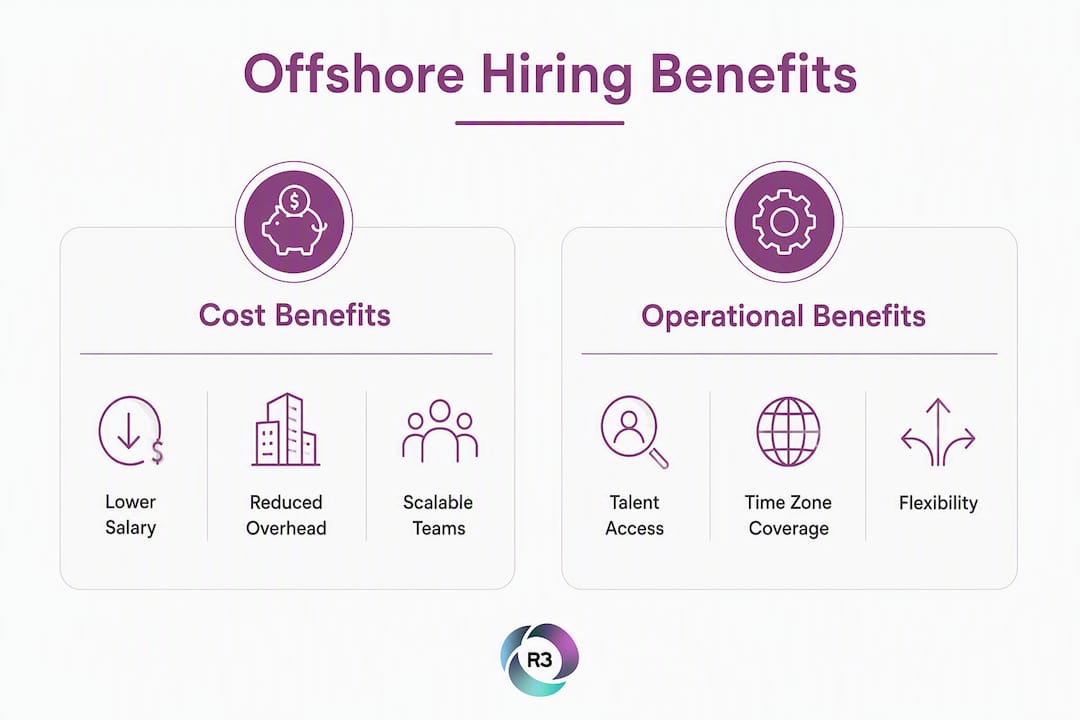
The headline benefit is lower labor costs, but that’s only part of the picture. The deeper value comes from what those savings let you do: hire faster, cover more hours, and scale without the overhead of full-time U.S. headcount.
Here’s what the operational upside actually looks like:
Lower base labor costs: Roles filled in the Philippines typically cost a fraction of their U.S. equivalent, even when you account for benefits and management time.
Access to specialized skills: The Philippine talent market has deep pools in admin, customer service, bookkeeping, and digital marketing, with strong English proficiency and cultural alignment with U.S. business norms.
Time-zone extension: A team working Philippine Standard Time (UTC+8) can handle customer inquiries, data processing, or content ops while your U.S. office is closed, giving you near-24/7 coverage without a night-shift premium.
Headcount elasticity: You can scale up or down faster than with local hires, which matters when your business has seasonal demand or project-based workloads.
The catch is total cost of ownership (TCO), not hourly rate. Onboarding time, management overhead, churn, and rework can quietly erode your savings. Cheapshoring — chasing the lowest hourly rate rather than the quality talent — is one of the most common and costly mistakes U.S. companies make. A partner-managed model that owns onboarding and retention often saves more than the cheapest contractor arrangement.
Pro Tip: Measure cost-per-outcome, not cost-per-hour. Track what a role actually produces in the first 90 days before judging whether the hire is working.
Offshore vs. overseas vs. remote: what’s the practical difference?
These terms get used interchangeably, but they carry different legal and operational meanings that affect your hiring choices.
Term | What it means | Hiring implication |
Offshore | Workers in another country operating as an extension of your team | Triggers foreign employment law, payroll obligations, and potential PE risk |
Remote | Work-from-anywhere arrangement, any geography | Could be domestic or international; compliance depends on worker location |
Overseas | A geographic descriptor, not a legal category | No specific legal meaning; always clarify the actual country and engagement type |
The distinction that matters most for compliance is whether you’re treating the worker as an employee or a contractor. Philippine labor law applies a four-fold control test: selection and engagement, payment of wages, power of dismissal, and control over the means and methods of work. Control is the dominant factor. If you direct daily tasks, set hours, and manage performance directly, a Philippine court may treat that worker as an employee regardless of what your contract says. That misclassification risk is real and material for U.S. companies.
Which roles are strong candidates to hire offshore?
The best offshore roles share three traits: outcomes are measurable, IP exposure is limited, and the work doesn’t require physical presence with your customers.

Strong offshore fit | Keep local or hybrid |
Administrative support | C-suite and strategic leadership |
Customer service (non-regulatory) | Core product architects |
Bookkeeping and data entry | Roles requiring in-person client contact |
Lead generation and CRM management | High-sensitivity legal or regulated work |
Content operations and QA | Roles with significant decision-making autonomy |
Appointment setting and marketing support | Compliance officers (without local counsel clearance) |
When evaluating a role, ask four questions: Can you write a KPI for it? Does it touch your core IP? Does it need real-time U.S. collaboration? And does it require judgment calls your team hasn’t documented yet? If the answers are yes, no, no, and no, the role is a strong candidate. You can find practical guidance on offshore virtual assistant hiring and scaling to see how this plays out across common business functions.
How do you hire offshore employees step by step?
This is the system that works. Follow it in order and you’ll avoid the most common failure points.
Write an outcomes-based job brief. List 5–7 measurable deliverables, not just duties. Define what “good” looks like at 30, 60, and 90 days.
Source and shortlist candidates. Use a vetted partner like R3source, direct sourcing platforms, or a managed staffing arrangement. Combine a practical skills test with culture-fit questions in your screening process.
Draft the contract. Include IP assignment, confidentiality, data protection obligations, termination terms, and governing law or arbitration clause. Add misclassification safeguards that reflect the actual engagement type.
Set up payroll and collect tax documents. For Philippine contractors, collect a W-8BEN and confirm BIR registration; the contractor issues an Official Receipt for each payment. Foreign-source service income is generally not subject to U.S. withholding, but confirm with your CPA. If you’re using an EOR, the EOR handles local payroll registration and statutory filings.
Run a 30-day paid trial. Treat it as a structured onboarding investment, not a probationary filter. Then extend to a formal 60–90 day plan with defined deliverables for each period.
Key contract clauses to never skip:
IP assignment covering all work product created during the engagement
Confidentiality and data handling obligations
Termination provisions with clear notice periods
Governing law and dispute resolution (arbitration is often preferable for cross-border arrangements)
How do you choose the right hiring model?
There are three primary models for U.S. companies hiring in the Philippines: open a local legal entity, use an Employer of Record (EOR), or engage workers as contractors. A fourth option, managed staffing via a partner like R3source, sits between EOR and contractor and is often the most practical path for small and mid-sized U.S. businesses.

Model | Best for | Trade-off |
Independent contractor | 1–3 roles, project-based work | Misclassification risk if you direct daily work |
EOR (Employer of Record) | Full-time hires, high compliance needs | Higher per-seat cost, less direct control |
Managed staffing partner | Dedicated long-term staff, operational integration | Partner quality determines outcome |
Own legal entity | Long-term market presence | High setup cost and ongoing compliance burden |
U.S.-side compliance checklist before you pay anyone:
Confirm worker classification (employee vs. contractor) under both U.S. and Philippine tests
Collect W-8BEN for contractors; verify BIR registration
Confirm no U.S. withholding obligation applies (consult your CPA)
Assess permanent establishment (PE) risk if the worker has authority to contract on your behalf
Implement IP assignment and data protection clauses before work begins
Confirm the provider can show local statutory filings and payroll records
Red flags to watch for: providers who avoid written audit trails, can’t show statutory benefit filings, or insist on vague governing law clauses.
Note that Philippine resident employees are taxable on their worldwide income, and a U.S. company without a Philippine permanent establishment is generally not required to withhold Philippine taxes on compensation. That said, the worker’s own registration and filing obligations remain, and your contract should acknowledge them.
What do offshore hires actually cost, and how long does it take?
Plan for a total timeline of 8–18 weeks from role definition to a fully productive hire. Here’s how that breaks down:
Phase | Typical duration | Notes |
Role definition and sourcing | 1–3 weeks | Faster with a managed partner |
Screening and contracting | 1–3 weeks | Skills test + contract review adds time |
Onboarding | 2–4 weeks | Systems access, training, process documentation |
Productive ramp | 4–8 weeks | Full output typically reached by week 12 |
Hidden costs to budget for:
Rework during the learning curve (plan for reduced output in weeks 1–4)
Payment-rail fees: banks report single inward remittances above USD 10,000 to the Bangko Sentral ng Pilipinas (BSP), so KYC documentation matters for larger payments
Local statutory benefits if you hire as an employee (13th month pay, SSS, PhilHealth, Pag-IBIG in the Philippines)
Security remediation if access controls aren’t set correctly from day one
Provider setup fees, which vary by model and headcount
Salary ranges vary by role, seniority, and country. A managed staffing partner will give you current benchmarks for the specific role you’re filling.
How do you onboard and manage offshore employees well?
Structure is what separates a productive offshore hire from a frustrating one. Use this 30/60/90 framework:
Days 1–30: Complete systems access setup, role-based permissions, tool training, and process documentation review. Deliver one small, measurable project to build confidence and calibrate expectations.
Days 31–60: Assign recurring responsibilities with weekly KPI check-ins. Introduce the escalation path and communication norms. Identify any skill gaps and address them directly.
Days 61–90: Transfer full ownership of defined workflows. Set 90-day performance targets and schedule a formal review.
Pro Tip: Set a mandatory 2–4 hour daily synchronous overlap window during the first 90 days. This single practice does more to prevent cultural drift and coordination lag than any other management habit.
Suggested tool stack:
Collaboration: Slack or Microsoft Teams for daily communication
Project management: Asana, ClickUp, or Trello for task visibility
Time tracking: Time Doctor or Hubstaff for accountability without micromanagement
Secure file sharing: Google Workspace or Microsoft 365 with role-based permissions
Access management: Enforce role-based access tiers from day one and limit admin rights to essential personnel
Once your offshore team reaches 5–7 people, hire a local team lead. Below that threshold, the overhead of a lead doesn’t pay off. Above it, the absence of one compounds coordination problems fast. You can find more on offshore team productivity strategies that reduce churn and improve output at scale.
What are the biggest risks when hiring offshore, and how do you fix them?
Most offshore arrangements fail for predictable reasons. Here’s what to watch for and what to do about it:
Cheapshoring: Prioritizing the lowest hourly rate leads to high churn, rework, and hidden costs. Budget for quality talent and a structured onboarding period.
Misclassification: Directing daily work while paying contractor rates creates legal exposure under Philippine labor law. Match the engagement model to the actual working relationship.
Cultural drift: Without structured overlap and regular communication, offshore teams gradually lose alignment with your business priorities. The sync window and local team lead are your main defenses.
Timezone mismatch: Asynchronous-only arrangements work for some roles but fail for others. Map the role’s collaboration requirements before hiring.
Security gaps: Retroactively tightening permissions is harder and riskier than setting them correctly at onboarding. Role-based access tiers from day one are non-negotiable.
Quick audit checklist for an existing offshore arrangement:
Are KPIs defined and tracked weekly?
Is there a documented escalation path?
Are access permissions role-appropriate and reviewed quarterly?
Is the worker’s classification consistent with how work is actually directed?
Is there a local team lead if headcount exceeds 7?
If you answer “no” to two or more of these, fix the arrangement before scaling it.
Why a managed partner like R3source reduces risk and speeds results
R3source handles the operational complexity that slows most U.S. companies down when they try to build offshore teams on their own. Instead of managing local payroll registration, statutory benefits, equipment provisioning, and HR compliance yourself, you direct the work while R3source handles everything behind it.
What that looks like in practice:
Local payroll processing and statutory filings (SSS, PhilHealth, Pag-IBIG, 13th month pay)
Structured onboarding with defined 30/60/90 milestones built in
Retention programs that reduce churn and protect your investment in training
Dedicated account management so you have a single point of contact for performance issues
Pro Tip: When you engage a managed partner, ask specifically how they handle worker reclassification risk and what their process is for statutory benefit filings. A provider who can’t answer those questions clearly is a provider who hasn’t solved them.
Typical outcomes for businesses using a managed model: faster time-to-productivity compared to direct contractor arrangements, lower first-year churn, and cleaner compliance documentation. The tradeoff is a higher per-seat cost than a raw contractor rate, which is worth it for most businesses that value consistency over short-term savings.
Key Takeaways
Hiring offshore employees works best when you define the role clearly, choose the right engagement model, and treat the first 90 days as a structured investment rather than a trial.
Point | Details |
Start with one role | Pick a repeatable, measurable role and run a 30-day paid pilot before scaling. |
Match model to risk | Contractor works for 1–3 roles; EOR or managed staffing reduces compliance exposure for ongoing hires. |
Budget the full timeline | Expect 8–18 weeks from role definition to full productivity, including onboarding ramp. |
Hire a local lead at scale | Once your offshore team reaches 5–7 people, a local team lead prevents coordination problems. |
R3source manages the complexity | R3source handles payroll, statutory benefits, onboarding, and retention so you direct the work. |
What most guides on offshore hiring get wrong
Most articles about hiring offshore employees focus almost entirely on cost. That framing sets businesses up for disappointment.
The companies that get the most out of offshore staffing aren’t the ones who found the cheapest talent. They’re the ones who invested in structure: a clear job brief, a real onboarding plan, defined KPIs, and a communication rhythm that keeps the offshore team genuinely connected to the business. Cost is a byproduct of that structure, not a substitute for it.
The other thing most guides underplay is misclassification risk. It’s easy to read a checklist of contract clauses and assume you’re covered. But if you’re directing daily work, setting hours, and managing performance, the engagement looks like employment under Philippine labor law regardless of what the contract says. The control test is the one that matters, and it’s the one most U.S. businesses don’t think about until there’s a problem.
The practical lesson: treat offshore hiring as a management challenge, not a procurement exercise. The talent is there. The savings are real. What determines whether you capture them is how well you build the team, not how low you set the rate.
R3source: your next step toward a dedicated offshore team
Building an offshore team doesn’t have to mean months of compliance research and trial-and-error hiring. R3source gives U.S. businesses a faster, more reliable path: dedicated remote professionals from the Philippines, fully integrated into your operations, with local payroll, statutory benefits, and HR compliance handled for you.

Whether you need one virtual assistant or a full remote team, R3source manages the backend so you can focus on growth. Services cover administrative support, customer service, lead generation, CRM management, appointment setting, bookkeeping, and more. Every placement is a long-term, dedicated hire, not a freelancer marketplace match.
The next step is straightforward: book an introductory consultation to discuss your role requirements and get a clear picture of timeline and cost. Or, if you’re ready to see the full service offering, visit the offshore virtual assistant services page to review what’s included before you commit.
Useful sources for U.S. employers hiring offshore
These resources cover the tax, labor, and compliance questions that come up most often for U.S. companies building offshore teams:
Philippine Tax Compliance for Remote Employees Paid by U.S. Companies — registration, withholding obligations, and penalties under Philippine tax law
Legal Framework and Compliance for U.S. Companies Hiring Philippine Staff — the four-fold employment test and misclassification risk
For country-specific tax and permanent establishment questions, consult a CPA and local counsel familiar with both U.S. and Philippine tax law. This article is general information, not legal or tax advice, and rules change. Verify current requirements with the IRS, Philippine BIR, and DOLE before making hiring decisions.
Recommended
Comments