

How to Hire a Virtual Assistant: 2026 Guide


A virtual assistant (VA) is a remote professional who provides administrative, technical, or creative support to business owners without the overhead of a full-time employee. Entrepreneurs and small business owners are the primary hirers of VAs, drawn by the ability to delegate daily operations and focus on growth. Knowing how to hire a virtual assistant correctly saves you time, reduces costs, and builds a support system that scales with your business. Platforms like Upwork, Fiverr, and GoHireHumans give you access to thousands of candidates, but finding the right fit takes more than a quick search.
What tasks should you delegate to a virtual assistant?
The first step in finding a virtual assistant is knowing exactly what you need done. A clear task list shapes your job description, sets expectations, and determines the level of specialization you need. Without this clarity, you risk hiring someone who is a poor fit from day one.
Common tasks business owners delegate to VAs include:
Administrative support: Calendar management, email filtering, data entry, and travel booking
Customer service: Responding to inquiries, managing support tickets, and following up with clients
Social media management: Scheduling posts, drafting captions, and monitoring engagement
Bookkeeping: Invoicing, expense tracking, and reconciling accounts
Lead generation: Researching prospects, building contact lists, and updating CRM records
Marketing support: Writing newsletters, coordinating campaigns, and managing content calendars
Task complexity directly affects the specialization you need. Scheduling appointments requires a generalist VA. Managing a paid ad campaign requires someone with specific marketing experience. Separating routine tasks from specialized ones helps you decide whether to hire one VA or two with different skill sets.
Pro Tip: Before posting a job, spend one week logging every task you do that takes under 30 minutes. That list becomes your VA’s job description.

A clear job description documents the tasks to delegate, the tools the VA needs to use, and the availability windows you require. This document is the foundation of every step that follows.
How much does it cost to hire a virtual assistant?
Budget is one of the first real decisions you make when hiring remote support. Virtual assistants cost between $5 and $75 per hour depending on location, specialization, and experience level. That wide range reflects a market with genuine tiers, and understanding those tiers helps you spend wisely.
Experience Level | Typical Hourly Rate | Best For |
Entry-level (general admin) | $5–$15/hr | Repetitive tasks, data entry, scheduling |
Mid-level (experienced generalist) | $15–$35/hr | Customer service, social media, research |
Specialized (technical or creative) | $35–$75+/hr | Bookkeeping, paid ads, web development |
Platform fees also affect your total cost. Upwork charges a service fee on top of the VA’s rate. Fiverr bundles fees into project pricing. Dedicated staffing providers like R3source offer fixed monthly rates that often work out cheaper than per-hour marketplace billing for ongoing roles.
Geography matters too. A VA based in the Philippines typically charges $8–$18 per hour for skilled work, while a U.S.-based VA with similar skills may charge $30–$50 per hour. The quality gap is often smaller than the price gap suggests.
Pro Tip: Set a monthly budget before you search, not an hourly rate. Multiply your target hours per week by your rate ceiling to get a real number you can commit to.
Where to find and evaluate virtual assistant candidates
The platform you choose shapes the quality of candidates you see. Top platforms for hiring VAs include Upwork, Fiverr, Belay, Time Etc, and OnlineJobs.ph. Each serves a different need.
Upwork gives you access to a large global talent pool with verified work history and client reviews.
Fiverr works well for project-based tasks where you want a fixed price upfront.
Belay and Time Etc specialize in U.S.-based VAs for business owners who prefer domestic support.
OnlineJobs.ph connects you directly with Filipino professionals, cutting out platform fees.
R3source provides pre-vetted, dedicated VAs from the Philippines with long-term staffing in mind.
Once you have candidates, screening separates the good from the great. Here is a structured process that works:
Review ratings and reviews. Look for patterns of consistent praise for reliability and communication, not just isolated five-star scores.
Check tool proficiency. Your VA should be comfortable with project management tools like Trello or Asana, communication platforms like Slack or Zoom, and your CRM or Google Workspace.
Conduct a structured interview. Ask about past roles, how they handle unclear instructions, and what they do when they miss a deadline.
Assign a paid test task. A small test task reveals how a candidate follows instructions, solves problems, and communicates progress. This is the single most reliable screening step.
For deeper guidance on interviewing VA candidates, R3source has a dedicated resource that walks through the full vetting process.
How to onboard and manage your virtual assistant
Hiring the right person is only half the work. How you onboard and manage your VA determines whether the relationship succeeds long-term.
Start with a trial period. Beginning part-time at 10–20 hours per week before committing to full-time support reduces risk for both sides. It gives you time to assess work quality and gives your VA time to learn your systems.
Strong onboarding covers these areas:
Standard operating procedures (SOPs): Write down how you want recurring tasks done. A short Loom video walkthrough works well for complex processes.
Tool access: Set up accounts in Slack, Trello, Asana, or whatever platforms you use. Give clear permission levels from day one.
Communication expectations: Define response time windows, preferred channels, and how to escalate urgent issues.
Feedback loops: Schedule a weekly 15-minute check-in for the first 30 days. This catches problems before they compound.
Here is a simple onboarding timeline to follow:
Week | Focus |
Week 1 | Tool setup, SOP review, shadow tasks |
Week 2 | Supervised task completion with feedback |
Week 3 | Independent work with daily check-ins |
Week 4 | Performance review and role adjustment |
Communication skills often outweigh specific technical skills in determining VA effectiveness. A VA who asks the right questions and flags problems early will outperform a technically skilled one who goes silent when confused. Prioritize this quality during onboarding and reward it consistently.
For a complete step-by-step workflow, the R3source VA onboarding checklist covers everything from day one setup to 90-day performance reviews.
Common mistakes to avoid when hiring a VA
Most failed VA relationships trace back to avoidable errors made before the first task is assigned.
Vague task definitions. Telling a VA to “handle social media” without specifying platforms, posting frequency, or tone leads to misaligned output. Define every task in writing.
Hiring on price alone. The cheapest candidate rarely delivers the best value. A $6/hr VA who needs constant correction costs more in your time than a $15/hr VA who works independently.
Skipping the trial period. Committing to a long-term contract without a test phase is the most common and most costly mistake new hirers make.
Neglecting onboarding. Sending a VA a task list and expecting results without proper setup is a setup for failure. Your VA needs context, tools, and clear expectations.
Ignoring references and reviews. Platform reviews exist for a reason. A candidate with no reviews or a pattern of short engagements is a red flag worth investigating.
The businesses that get the most from their VAs treat onboarding as an investment, not an afterthought. The first two weeks set the tone for everything that follows.
Building a reliable long-term VA relationship requires consistency on your end too. Clear feedback, timely payments, and respect for your VA’s working hours build the trust that makes long-term partnerships work.
Key takeaways
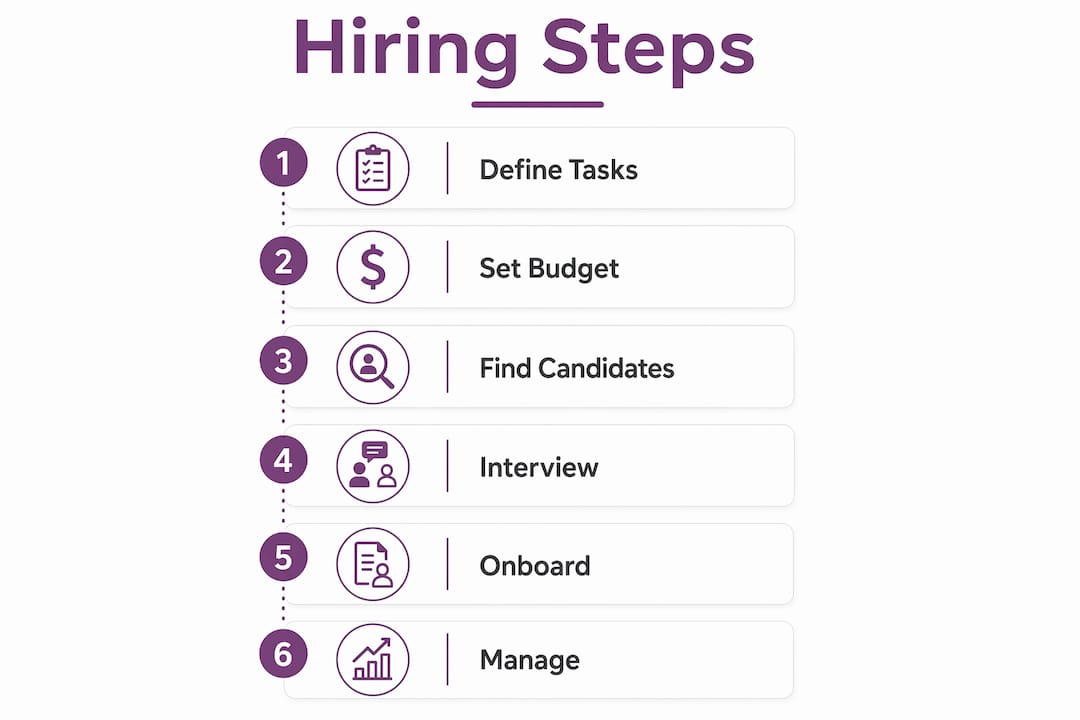
Hiring a virtual assistant successfully requires clear task definition, realistic budgeting, rigorous candidate screening, and a structured onboarding process that prioritizes communication from day one.
Point | Details |
Define tasks first | Document every task, tool, and availability window before posting a job listing. |
Budget by tier | VA rates range from $5 to $75 per hour; match the rate to the complexity of the work. |
Screen with test tasks | A paid test task is the most reliable way to evaluate real work quality before committing. |
Start part-time | Begin at 10–20 hours per week to reduce risk and build trust before scaling up. |
Prioritize communication | A VA with strong communication skills consistently outperforms a technical specialist who works in silence. |
What i’ve learned about hiring vas that most guides won’t tell you
Most hiring guides focus on platforms and price. After working with dozens of business owners and watching VA relationships succeed and fail, the pattern is clear: the technical skills rarely determine the outcome. Communication does.
The VAs who last are the ones who ask clarifying questions before starting a task, not after delivering the wrong output. They flag problems early. They tell you when something is unclear instead of guessing. That quality is harder to screen for than tool proficiency, but it is far more predictive of success.
My honest advice: start smaller than you think you need to. Ten hours a week on a defined set of tasks tells you more about a VA than any interview. You see how they handle ambiguity, how they communicate under pressure, and whether they take ownership of their work. That trial period is not a formality. It is your best decision-making tool.
The other thing most guides skip: your onboarding quality determines your VA’s output quality. If you hand someone a vague task list and disappear, you will be disappointed. If you invest two weeks in clear SOPs, regular check-ins, and honest feedback, you build a working relationship that compounds over time. The business owners who get the most from their VAs are the ones who treat the first 30 days as seriously as the hiring process itself.
— Ellis
Ready to build your remote support team?
R3source connects U.S. business owners with dedicated, pre-vetted virtual assistants from the Philippines who are trained to integrate directly into your operations. Whether you need administrative support, customer service, CRM management, or a full remote team, R3source delivers consistent performance without the overhead of in-house hiring.

Every R3source VA is matched to your specific business needs, not assigned from a generic pool. You get a long-term remote professional who learns your systems, represents your brand, and grows with your business. If you are ready to reclaim your time and build real capacity for growth, explore R3source’s offshore virtual assistant services and take the first step toward a team that works as hard as you do.
FAQ
How much does it cost to hire a virtual assistant?
Virtual assistants cost between $5 and $75 per hour depending on experience, location, and specialization. Offshore VAs from the Philippines typically fall in the $8–$18 per hour range for skilled work.
What are the best platforms for finding a virtual assistant?
Upwork, Fiverr, Belay, Time Etc, and OnlineJobs.ph are among the top platforms for hiring VAs. Dedicated staffing providers like R3source offer pre-vetted candidates for businesses that need long-term support.
What interview questions should i ask a virtual assistant?
Ask how they handle unclear instructions, what tools they use daily, and how they prioritize competing deadlines. Follow up with a paid test task to evaluate real work quality before making a hiring decision.
How do i manage a virtual assistant effectively?
Set clear SOPs, define communication expectations, and schedule weekly check-ins during the first 30 days. Tools like Slack, Trello, Asana, and Zoom support daily collaboration and keep work visible.
Should i hire a VA full-time or part-time to start?
Start part-time at 10–20 hours per week before committing to full-time support. This reduces risk, allows both sides to build trust, and gives you time to refine the role based on real output.
Recommended
Comments