

Role of Virtual Assistants in Sales Pipelines: 2026 Guide

Virtual assistants in sales pipelines are defined as dedicated support professionals or AI-powered tools that handle the administrative, research, and follow-up tasks that prevent sales reps from selling. The role of virtual assistants in sales pipelines has expanded significantly in 2026, covering everything from CRM updates and lead qualification to appointment setting and call summaries. Sales reps spend approximately 70% of their time on non-selling activities, which means the average rep dedicates less than a third of their day to actual revenue generation. Virtual assistants, whether human professionals from companies like R3source or AI tools like Apollo, exist specifically to reclaim that time.
How virtual assistants improve pipeline velocity and sales rep productivity
Pipeline velocity is the speed at which leads move from first contact to closed deal, and virtual assistant sales support directly accelerates it. When a VA handles CRM data entry, meeting scheduling, and follow-up sequences, the sales rep stays focused on conversations that close. Apollo reports that reclaiming the 70% time loss through VA delegation improves both pipeline speed and total revenue output. That is not a marginal gain. It is a structural shift in how your team operates.
The most measurable impact comes from speed-to-lead. Contacting a lead within 5 minutes of inquiry makes them 21 times more likely to qualify than reaching out after 30 minutes. That single statistic reframes the entire argument for virtual assistants. If your team is buried in admin work when an inbound lead arrives, you are not just losing time. You are losing qualified pipeline.
The drop-off is steep and non-linear. Lead qualification odds fall by 80% in the 5-to-10-minute window compared to a sub-5-minute response. Buyer expectations have also intensified. Speed-to-lead sensitivity has increased 4.2 times since 2025, with 67% of mobile searchers expecting a response within 60 seconds. A VA whose primary job is monitoring inbound leads and triggering immediate responses solves this problem directly.
“The biggest pipeline gains come from shrinking the window between inbound lead arrival and the first meaningful response.” — CallJolt Speed-to-Lead Analysis
Here is what that looks like in practice for a sales team:
A human VA monitors a shared inbox and routes new leads to the right rep within minutes of arrival
An AI copilot like Apollo drafts the first outreach email automatically based on lead data
The rep reviews and sends within 5 minutes, hitting the qualification window every time
CRM records are updated in real time without the rep touching a keyboard
Sales teams delegating CRM management and follow-ups to virtual assistants see up to 30% faster lead response and 15-20% higher close rates. That combination of speed and consistency is what separates high-performing pipelines from stalled ones.
What types of virtual assistants work best for sales teams?

Virtual sales assistants come in three types: human VAs, AI copilots, and autonomous AI agents. Each serves a different function depending on your team’s size, workflow maturity, and where your pipeline is losing momentum.
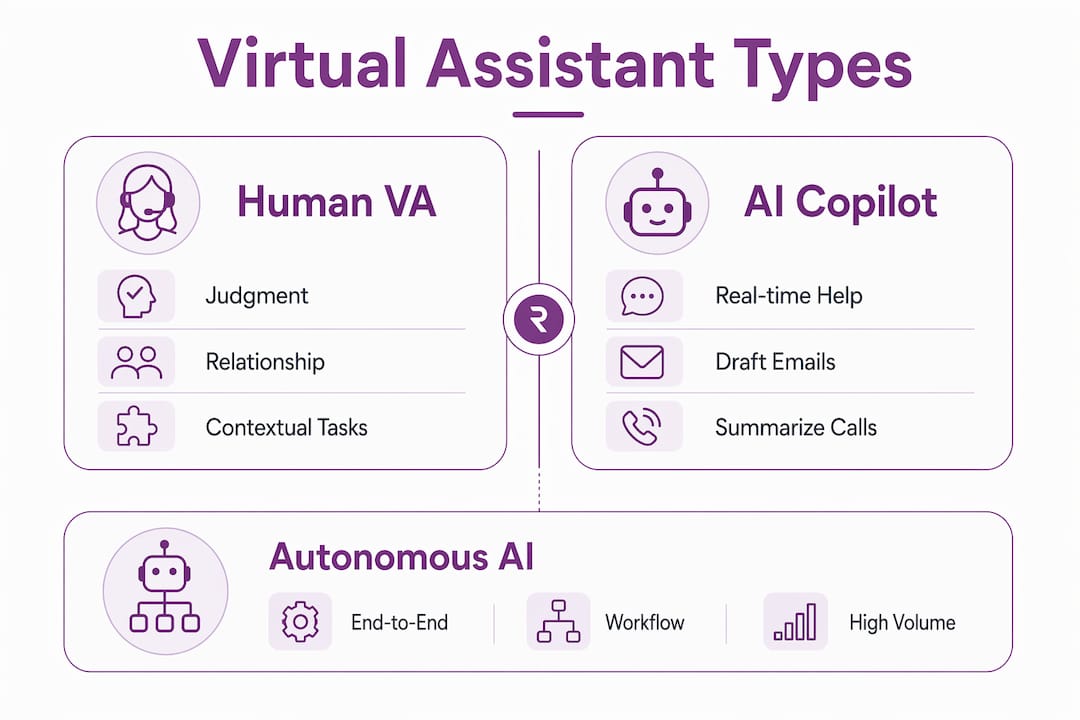
Understanding the difference matters because deploying the wrong type wastes money and creates friction. A small sales team with inconsistent CRM hygiene needs a human VA before it needs an AI agent. A mature RevOps team processing hundreds of leads per day may benefit from autonomous AI at the top of the funnel.
Task category | Human VA | AI copilot | Autonomous AI agent |
CRM updates and data entry | Best fit | Partial support | Possible with setup |
Email drafting and outreach | Capable | Best fit | Best fit at scale |
Appointment scheduling | Best fit | Partial support | Possible |
Call summaries and notes | Capable | Best fit | Best fit |
Lead routing and qualification | Best fit | Partial support | Best fit at scale |
High-touch relationship tasks | Best fit | Not suited | Not suited |
Human VAs from providers like R3source handle the tasks that require judgment, context, and relationship awareness. They update CRM records accurately, manage calendars across time zones, and follow up with leads using personalized messaging. They are also the right choice when your pipeline involves high-value deals where a generic automated response would damage trust.
AI copilots like those built into Apollo or Salesforce Einstein assist reps in real time. They draft emails, summarize calls, suggest next steps, and surface relevant prospect data during live conversations. They do not replace the rep. They make the rep faster and better informed.
Autonomous AI agents handle end-to-end workflows without human input at each step. They are suited for high-volume, lower-complexity tasks like initial lead outreach sequences, data enrichment, and meeting confirmations. They work best when your processes are already documented and tested.
Pro Tip: Before choosing a VA type, map your pipeline and identify the single stage where leads stall most often. That bottleneck is where you deploy your first VA resource, whether human or AI.
How to optimize sales pipelines with virtual assistants
Optimizing sales pipelines with VAs requires more than assigning tasks. It requires designing workflows around the moments that matter most, particularly lead arrival and first response.
Define your lead-arrival trigger. Every inbound inquiry should automatically notify a VA or trigger an AI workflow. Use tools like Zapier, HubSpot, or Apollo to connect your lead sources to your response system. No lead should sit uncontacted because a rep was in a meeting.
Set a 5-minute response SLA. Build this into your VA’s job description or your AI tool’s configuration. Designing VA workflows around lead-arrival events and rapid response windows prevents lost qualification momentum. Make the SLA measurable and review it weekly.
Separate speed from quality. A fast but generic response can damage your brand. Give your VA response templates that are personalized enough to feel human but structured enough to deploy in under 2 minutes. Review these templates quarterly.
Use a human-in-the-loop model before going fully autonomous. Start with a human VA reviewing AI-drafted responses before they send. Once quality is consistent, you can shift to autonomous sending for lower-stakes outreach while keeping human review for high-value prospects.
Address governance before scaling. Enterprise buyers now require governance measures like data handling policies, output controls, and auditability before adopting AI assistants. Even if you are not enterprise-level, documenting how your VA handles prospect data protects you and builds buyer trust.
Pro Tip: Assign one person on your team as the VA workflow owner. This person reviews response quality, monitors SLA compliance, and updates templates. Without ownership, VA workflows drift and quality drops.
For founders managing sales alongside operations, the VA workflow integration model applies directly. The same principles that work for founder productivity work for sales pipeline management.
How to measure ROI from virtual assistants in sales
ROI from virtual assistants flows through three channels: time reclaimed, pipeline velocity, and close rate improvement. Measuring all three gives you a complete picture of what your VA investment is actually producing.
Early adopter firms report 10-20% sales ROI boosts from VA programs, driven primarily by reclaimed selling time and faster lead response. That range is wide because results depend heavily on how well the VA is integrated and how clearly their tasks are defined.
Here are the metrics worth tracking from day one:
Hours reclaimed per rep per week. Baseline this before your VA starts. Track it monthly. A well-deployed human VA should reclaim 15 to 25 hours per rep per week from admin tasks.
Average lead response time. This is your most direct pipeline health indicator. Target under 5 minutes for inbound leads.
Stage-to-stage conversion rates. If your VA is handling follow-ups, you should see improvement in the conversion rate from initial contact to qualified opportunity within 60 to 90 days.
Close rate by rep. Reps freed from admin work close more deals. Track this individually to see which reps benefit most from VA support.
Consolidating multiple sales support functions into one platform reduces integration overhead and improves data quality across the workflow. This matters for ROI because fragmented tools create data gaps that make measurement unreliable.
The cost comparison against hiring additional headcount is also straightforward. A dedicated offshore VA from R3source costs a fraction of a full-time domestic sales coordinator, with no benefits overhead, office costs, or onboarding delays. For growing teams, this is how you scale capacity without scaling payroll at the same rate. You can explore how this model applies to SaaS and service businesses for additional context on scaling through VA support.
Key takeaways
Virtual assistants in sales pipelines deliver the highest ROI when deployed at the exact moments where speed, consistency, and follow-through determine whether a lead converts or disappears.
Point | Details |
Time reclaimed drives revenue | Sales reps lose 70% of their time to admin; VAs reclaim it and redirect focus to selling. |
Speed-to-lead is non-negotiable | Responding within 5 minutes makes leads 21x more likely to qualify. |
Match VA type to pipeline stage | Human VAs suit high-touch tasks; AI copilots accelerate rep output; autonomous agents handle volume. |
Governance protects your pipeline | Data handling policies and output controls are required before scaling VA adoption. |
Measure three ROI channels | Track hours reclaimed, lead response time, and close rate lift to quantify VA impact. |
Why I think most sales teams underestimate what a VA can actually do
Most sales managers I speak with think of a virtual assistant as a task-taker. Someone to handle the inbox or update the CRM when things get busy. That framing undersells the role by a significant margin.
The teams that see the biggest gains treat their VA as a pipeline architect. They map every stage where deals stall, assign a VA to own that stage, and build accountability into the workflow from day one. The result is not just time saved. It is a pipeline that moves faster and loses fewer deals to silence and slow follow-up.
The mistake I see most often is deploying a VA without a defined SLA. Speed-to-lead is the clearest example. You can hire the best VA in the world, but if there is no agreed response window and no system to enforce it, leads still fall through. The 5-minute rule is not a suggestion. It is the threshold where qualification odds collapse.
My honest advice for 2026: start with a human VA before you invest in AI automation. Human VAs surface the workflow gaps that AI tools will later automate. They also catch the edge cases that autonomous agents miss. Once your processes are clean and documented, layering in AI copilots and agents becomes much more effective. The VA onboarding process is where most of this groundwork happens, and getting it right from the start saves months of correction later.
— Ellis
Build a faster sales pipeline with R3source
R3source provides dedicated virtual assistants from the Philippines who specialize in sales support roles, including CRM management, lead follow-up, appointment setting, and pipeline coordination. These are not generalist freelancers. They are trained professionals who integrate directly into your sales workflow and operate with the consistency your pipeline depends on.
If your team is losing deals to slow response times or admin overload, a dedicated VA from R3source gives you the capacity to respond faster, follow up consistently, and close more without adding to your domestic payroll. Explore R3source’s offshore virtual assistant services to find the right fit for your sales team, or learn more about building a remote team tailored to your pipeline needs.
FAQ
What is the role of virtual assistants in sales pipelines?
Virtual assistants in sales pipelines handle the administrative, follow-up, and CRM tasks that prevent sales reps from selling. Their core function is to reclaim the roughly 70% of rep time lost to non-selling activities and redirect it toward revenue-generating work.
How do virtual assistants help with lead nurturing?
VAs manage follow-up sequences, send personalized outreach, and update CRM records to keep leads moving through the pipeline. The role of virtual assistants in lead nurturing is to maintain consistent contact without requiring the rep to manually track every touchpoint.
What tasks should I assign to a virtual assistant in sales?
The highest-value tasks for virtual assistants in sales include CRM updates, inbound lead routing, appointment scheduling, follow-up emails, and call note summaries. Start with the tasks that consume the most rep time and have the clearest process documentation.
How quickly should a VA respond to inbound leads?
A VA should respond to inbound leads within 5 minutes. Contacting a lead within that window makes them 21 times more likely to qualify than a 30-minute delay, making speed-to-lead the single most impactful SLA in any VA workflow.
What ROI can I expect from a sales virtual assistant?
Early adopter firms report 10-20% sales ROI boosts from VA programs, driven by reclaimed selling time and faster lead response. Teams delegating CRM and follow-up tasks to VAs also see up to 30% faster lead response and 15-20% higher close rates.
Recommended
Comments