

Virtual Assistant Cost: 2026 Guide for Small Businesses


Virtual assistant cost is defined as the total expense of hiring and maintaining VA support, including hourly rates, hours worked, and any agency or platform fees. Offshore VAs typically cost $5–$15 per hour, while US-based VAs run $25–$79 per hour. That gap represents a potential savings of 60–70% for small business owners who choose offshore staffing. Platforms like Upwork show a median VA rate of $13 per hour for freelancers, though specialized or executive-level support pushes rates far higher. Understanding the full picture, including hidden costs like training and management overhead, is what separates a smart hire from an expensive mistake.
What factors determine virtual assistant cost?
Virtual assistant pricing is not a single number. It is the product of several variables working together, and knowing each one helps you budget accurately.
Geographic location is the biggest driver. A VA based in the Philippines or India costs a fraction of what a US-based VA charges, simply because of regional labor market differences. Regional rates range from $5–$20 per hour for the Philippines and India, $8–$25 per hour for Latin America, and $20–$65 per hour for US-based professionals. Location alone can double or triple your monthly VA expense.

Skill level and specialization also move the needle significantly. A general admin VA who handles scheduling and email costs far less than a VA with expertise in CRM management, paid advertising, or financial bookkeeping. The more specialized the task, the higher the rate, regardless of geography.
Here are the core factors that shape what you will pay:
Hiring model: Freelancers cost less per hour but require more management. Agencies charge more but handle vetting, replacement, and accountability.
Hours committed: Part-time retainers of 10–20 hours per month cost less overall but carry higher per-hour rates than full-time arrangements.
Platform or agency markup: Agencies charge 30–60% more than freelancers but include reliability guarantees and replacement coverage. That markup buys you protection, not just labor.
Task complexity: Repetitive admin tasks sit at the low end of the rate scale. Tasks requiring judgment, client interaction, or technical skill command premium rates.
Onboarding and training: Every new VA requires time to learn your systems. That time has a real dollar value, even if it never appears on an invoice.
Pro Tip: Before you post a job or contact an agency, write out the exact tasks you need covered. Vague job descriptions attract mismatched candidates and inflate your true cost through wasted onboarding time.
How do offshore and US-based virtual assistant costs compare?
The cost difference between offshore and domestic VAs is substantial, and the numbers make a compelling case for offshore hiring when quality is managed well.
VA Type | Philippines / India | Latin America | US-Based (Freelance) | US-Based (Agency) |
General admin | $5–$10/hr | $8–$15/hr | $20–$35/hr | $25–$45/hr |
Specialized (CRM, marketing) | $10–$20/hr | $15–$25/hr | $35–$55/hr | $40–$65/hr |
Executive assistant | $12–$22/hr | $18–$28/hr | $45–$65/hr | $50–$79/hr |
On a monthly basis, the contrast is even sharper. A full-time Philippines-based VA costs $600–$1,200 per month, while a full-time US-based VA runs $3,200–$8,000 per month. That is not a minor budget line. For a small business owner, the difference could fund an entire additional hire or cover months of operating expenses.
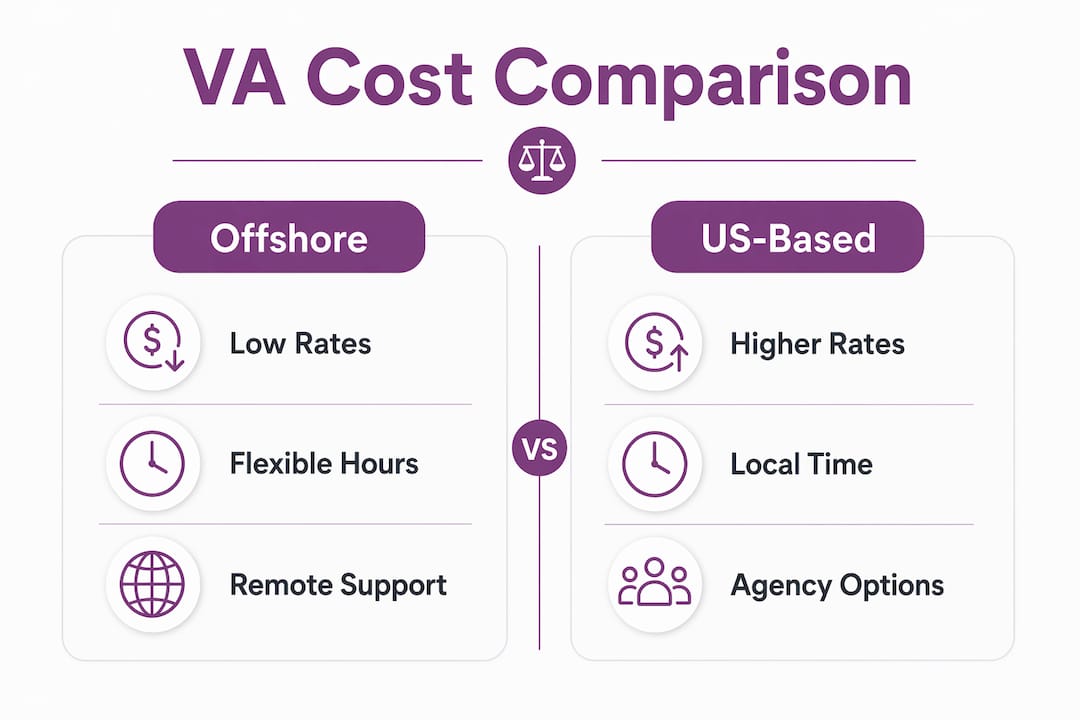
Latin American VAs occupy a middle ground. Rates are higher than Southeast Asia but lower than the US, and the time zone overlap with American business hours is a practical advantage for roles requiring real-time communication.
A few considerations beyond the price tag:
Communication quality: The Philippines has a strong English-language education system and a long history of supporting US businesses. Communication gaps are far less common than many owners expect.
Time zone management: Philippine VAs typically work adjusted hours to align with US business schedules. This is standard practice, not an exception.
Agency vs. direct hire offshore: A Philippines agency VA costs $12–$22 per hour versus $5–$10 per hour for a direct freelance hire. The agency premium covers vetting, HR compliance, and replacement guarantees. For offshore hiring considerations, understanding what that markup covers is critical before you choose a path.
The quality argument against offshore VAs has weakened considerably over the past decade. Businesses in real estate, e-commerce, and professional services regularly run core operations through offshore teams with strong results.
What are common pricing models and how to choose the right one?
Pricing structure matters as much as the hourly rate itself. Choosing the wrong model can cost you more than choosing the wrong rate.
Hourly rate model: You pay for time used, tracked by the hour. This works well for unpredictable workloads or project-based tasks. The risk is scope creep if you do not track hours carefully.
Monthly retainer: You commit to a set number of hours per month at a fixed rate. Small business owners typically start with 10–20 hour monthly retainers, costing $50–$200 per month for a Philippines-based VA or $300–$900 per month for a US-based VA. Retainers create predictability for your budget and priority access for your VA.
Project-based pricing: You pay a flat fee for a defined deliverable. This suits one-time tasks like research projects, content calendars, or database cleanup. It removes hourly tracking but requires a clear scope agreement upfront.
Agency packages: Platforms like Time Etc offer structured monthly plans. A 10-hour monthly plan runs around $380, a 20-hour plan around $740, and a 40-hour plan around $1,440. These packages include management oversight and quality assurance, which explains the premium over raw freelance rates.
Full-time dedicated staffing: This model works best when you have consistent, high-volume work. A full-time offshore VA through an agency delivers the most cost-efficient rate per hour and the deepest integration into your operations.
The right model depends on your workload volume, your tolerance for management overhead, and how quickly you need results. If you are hiring your first VA, a monthly retainer with a reputable agency reduces risk and gives you a structured starting point. You can read more about how to hire your first VA before committing to a model.
Pro Tip: Start with a 20-hour monthly retainer before committing to full-time. It gives you enough hours to test fit and workflow without locking in a large budget before you know what works.
What hidden costs should small business owners consider?
The hourly rate is only part of the story. Management, training, and replacing poor-fit VAs add real costs that most owners never put on a spreadsheet.
Here is what tends to get overlooked:
Onboarding time: Teaching a new VA your systems, preferences, and processes takes hours. If you bill your own time at $100 per hour, a 10-hour onboarding costs you $1,000 in opportunity cost, regardless of what you pay the VA.
Management overhead: Reviewing work, giving feedback, and coordinating tasks takes ongoing time. Owners who hire freelancers directly absorb this cost themselves. Agencies bundle management into their markup.
Turnover costs: A poor fit means starting over. Recruiting, re-onboarding, and lost productivity during the gap add up fast. Virtual assistant expense calculations that ignore turnover consistently underestimate true cost.
Platform fees: Upwork charges a service fee on top of the VA’s rate. Some platforms charge the client side as well. Always confirm the total cost, not just the posted rate.
Communication gaps: A VA who requires constant clarification or supervision is not saving you time. Poor communication fit is a hidden cost that compounds every week.
“The biggest mistake I see small business owners make is optimizing for the lowest hourly rate and then spending twice as many hours managing the relationship. The true cost of a VA is hourly rate plus your time.”
Agencies address most of these hidden costs by handling vetting, replacement, and accountability. The markup is real, but so is the value. For owners who want to reduce overhead effectively, understanding what you are buying with an agency fee changes the math entirely.
How to evaluate virtual assistant cost versus benefits for your business
The question is not just what a VA costs. The question is what that cost returns to your business.
Start by identifying which tasks are consuming your time without generating revenue. Scheduling, inbox management, data entry, CRM updates, and social media posting are common examples. These tasks are necessary but do not require your direct expertise. Delegating them frees you to focus on sales, client relationships, and growth.
Consider the comparison with in-house hiring. A full-time US employee at $40,000 per year costs closer to $52,000–$55,000 when you add payroll taxes, benefits, and workspace. A full-time offshore VA through a quality agency runs $12,000–$18,000 per year. The benefits of hiring a virtual assistant extend beyond wages to include zero benefits overhead, no office space, and no equipment costs.
A few practical steps to assess your return:
Track your time for one week. Log every task you complete and categorize each as revenue-generating or operational. The operational hours are your VA opportunity.
Assign a dollar value to your time. If your hourly value is $150, and a VA handles 20 hours of tasks per month at $10 per hour, you recover $2,800 in productive capacity for $200.
Start small and measure. A 10-hour monthly retainer is a low-risk way to test delegation before scaling. Track task completion rates and time saved in the first 60 days.
Compare VA cost to employee cost. Use the virtual assistant vs. employee comparison as a framework before making a long-term staffing decision.
The math almost always favors delegation when the VA is well-matched to the tasks and properly onboarded. The goal is not to find the cheapest option. The goal is to find the option that returns the most value per dollar spent.
Key takeaways
Virtual assistant cost is determined by location, skill level, hiring model, and hidden overhead, with offshore VAs delivering 60–70% savings over US-based alternatives when managed well.
Point | Details |
Offshore rates are significantly lower | Philippines and India VAs cost $5–$20/hr versus $20–$65/hr for US-based professionals. |
Monthly costs vary widely by region | Full-time offshore VAs cost $600–$1,200/month compared to $3,200–$8,000/month for US-based VAs. |
Hidden costs matter as much as rates | Management time, turnover, and onboarding overhead can exceed the VA’s hourly cost if unmanaged. |
Agencies cost more but reduce risk | Agency markups of 30–60% cover vetting, replacement guarantees, and management support. |
Start with a retainer to test fit | A 10–20 hour monthly retainer limits risk while you evaluate workflow and VA performance. |
What I have learned about virtual assistant costs after years in this space
The number one mistake I see business owners make is treating the hourly rate as the total cost. It is not. The total cost includes your time spent managing, correcting, and re-onboarding. I have watched owners hire a $6-per-hour freelancer and spend 15 hours a month supervising work that should have taken 5. The math does not work.
My honest recommendation is this: if you are hiring your first VA, go through a reputable agency, even if the rate is higher. The vetting, accountability, and replacement guarantee are worth the premium. Once you understand how to delegate effectively and what good VA work looks like, you can explore direct hiring to reduce costs.
The offshore vs. US debate is mostly settled for routine operational tasks. The Philippines, in particular, has a deep talent pool of English-fluent professionals who are experienced working with American businesses. The time zone adjustment is manageable. The quality, when you hire through a structured agency, is consistent.
What I would tell any small business owner is this: stop thinking about VA cost as an expense and start thinking about it as a capacity purchase. You are buying back hours. The question is whether those hours are worth more to your business than the rate you are paying. For most owners, they are.
— Ellis
How R3source helps you get more from your VA budget

R3source provides offshore virtual assistant services built specifically for US small businesses and entrepreneurs. Every team member is sourced from the Philippines, pre-vetted, and trained to integrate directly into your operations from day one. R3source handles the recruitment, HR compliance, and ongoing accountability so you do not have to. Whether you need part-time admin support or a full dedicated remote team, the pricing is structured to deliver real value without the overhead of domestic hiring. If you want to see what the right VA can do for your business, R3source offers a path to get started without guesswork. Explore affordable VA options or enter to win 90 days of free remote support and experience the difference firsthand.
FAQ
How much does a virtual assistant cost per month?
Monthly virtual assistant costs range from $50–$200 for a part-time Philippines-based VA to $3,200–$8,000 for a full-time US-based professional. The range depends on location, hours, and whether you hire through an agency or directly.
Are offshore virtual assistants reliable for US businesses?
Yes. The Philippines has a well-established outsourcing industry with English-fluent professionals experienced in supporting American businesses across real estate, e-commerce, and service sectors. Quality depends on the hiring process and agency standards, not geography alone.
What is the difference between a freelance VA and an agency VA?
Freelance VAs cost less per hour but require you to manage recruitment, vetting, and replacement yourself. Agency VAs cost 30–60% more but come with accountability structures, replacement guarantees, and management support built into the price.
What tasks are best suited for a virtual assistant?
Scheduling, inbox management, CRM updates, data entry, lead generation, appointment setting, and social media management are the most common VA tasks for small businesses. These are high-volume, repeatable tasks that do not require your direct expertise.
How do I know if hiring a VA is worth the cost?
Track how many hours per week you spend on non-revenue tasks, then multiply by your hourly value. If a VA can handle those tasks at a fraction of your rate, the return is positive. Most small business owners find the math favors delegation within the first 60 days.
Recommended
Comments