

How Virtual Assistants Reduce Overhead for Business Owners


Running a business without understanding the true cost of your workforce is like driving with your eyes closed. Most owners know how virtual assistants reduce overhead in theory, but the real savings go much deeper than the hourly rate. Full-time employees carry hidden expenses that quietly drain your operating budget, from payroll taxes to office supplies to the hours you spend managing them. This article breaks down exactly where those savings come from, how to reclaim your own productive time, and what to look for in a support model that actually works long term.
Table of Contents
Key takeaways
Point | Details |
True employment costs are higher than most expect | A $50,000 salary employee costs over $70,000 annually once benefits and overhead are added. |
VA savings are measurable and significant | Managed virtual assistants cost $12,000 to $27,000 per year, saving $33,000 to $58,000 per role. |
Owner time has real dollar value | Delegating 10 hours per week to a VA can translate to over $65,000 in annual growth impact. |
Managed services reduce hidden overhead | Recruitment, training, and turnover costs disappear when you work with a quality managed VA provider. |
Clear delegation multiplies results | Standard operating procedures and specific task delegation double VA productivity and reduce onboarding costs. |
How virtual assistants reduce overhead: the real numbers
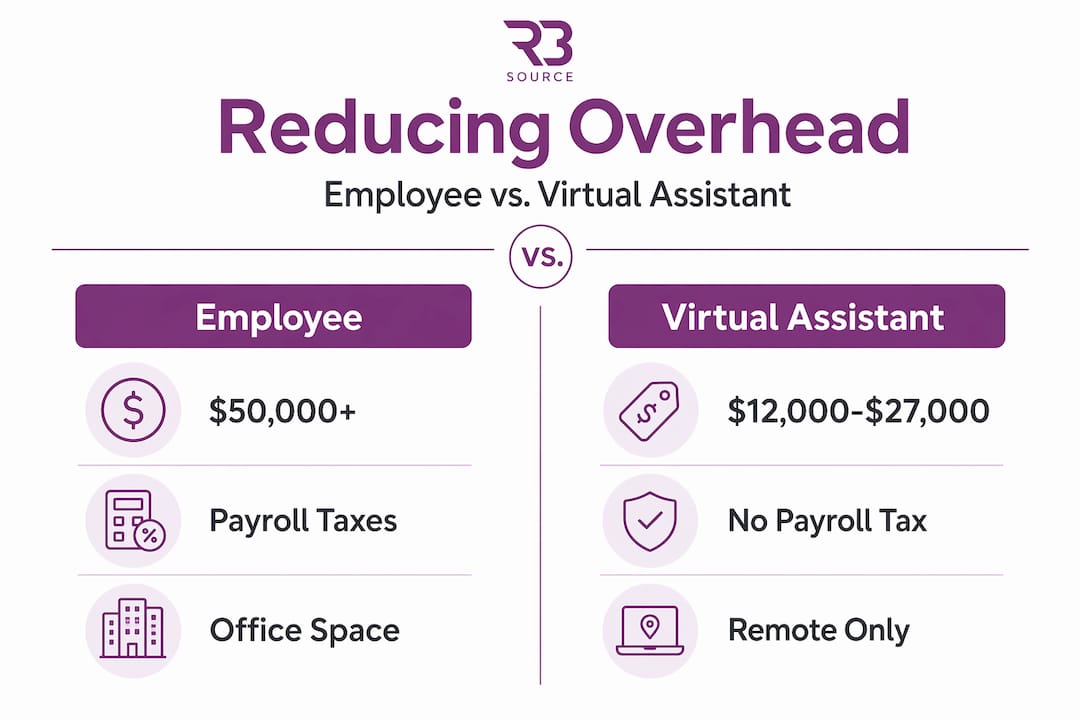
Most business owners look at a job posting and think about salary. That’s a mistake. The true cost of a full-time employee extends far beyond what you put on the offer letter. A $50,000 salary in the United States actually costs a business more than $70,000 annually once you factor in benefits, payroll taxes, workers’ compensation, and general office overhead. That gap is where most entrepreneurs stop thinking clearly.
Remote professionals, the industry term for skilled workers who operate entirely outside your physical office, change this equation at every level. They work under contractual arrangements that eliminate your liability for benefits packages, desk space, computer equipment, and the ongoing costs of keeping someone employed year-round. Virtual assistants can save businesses up to 80% on labor costs by removing these layers entirely.
Here is a direct comparison of cost components so you can see exactly where the savings appear:
Cost component | Full-time employee | Managed virtual assistant |
Base salary or rate | $50,000 to $70,000/year | $12,000 to $27,000/year |
Benefits and taxes | $15,000 to $20,000/year | $0 |
Office space and equipment | $5,000 to $10,000/year | $0 |
Recruitment and onboarding | $3,000 to $7,000/hire | Included in service |
Turnover and retraining | Frequent, high cost | Managed by provider |
Total estimated annual cost | $60,000 to $85,000+ | $12,000 to $27,000 |
The savings per VA role can reach $33,000 to $58,000 annually. For businesses with multiple support roles, that math compounds quickly.
Pro Tip: Before posting a job, calculate the fully loaded cost of that hire using salary plus 30 to 40 percent for taxes and benefits, plus your office overhead. That number is your actual baseline for comparing virtual assistant savings.
The opportunity cost your calendar is hiding
Here is something most cost analyses miss entirely. The overhead you reduce by hiring a VA is not just about dollars paid out. It’s also about the hours you spend doing work that someone else could handle.
Think about what an hour of your time is actually worth. If your business generates $500,000 in revenue and you work 2,000 hours per year, your effective hourly value is $250. Every hour you spend on email filtering, data entry, or scheduling is $250 in lost capacity for growth.

Delegating 10 hours per week to a VA at $25 per hour reclaims productive time valued at $1,500 per week. Across a year, that translates to more than $65,000 in potential growth impact. That is not a hypothetical. That is the opportunity cost framework applied to your actual business.
The tasks most worth delegating fall into a few clear categories:
Email management and inbox triage
Calendar scheduling and appointment setting
CRM data entry and contact updates
Customer service responses and follow-ups
Social media posting and community management
Research, reporting, and document preparation
Entrepreneurs regularly reclaim 10 to 20 hours weekly through this kind of task delegation. That’s time you can direct toward sales conversations, product development, or the strategic decisions that only you can make.
Task category | VA hourly cost | Your opportunity cost | Weekly impact |
Email and calendar management | $15 to $25/hr | $150 to $300/hr | High |
CRM and data entry | $12 to $20/hr | $150 to $300/hr | High |
Customer service | $15 to $25/hr | $100 to $250/hr | Medium to high |
Social media management | $15 to $25/hr | $100 to $200/hr | Medium |
Pro Tip: Audit your past week by listing every task you completed. Mark each one as “only I can do this” or “someone else could handle this.” The second list becomes your delegation starting point.
Why managed services beat the freelancer route
There is a version of outsourcing for lower overhead that many owners try first and quickly regret. Hiring individual freelancers through general platforms puts the full burden of recruitment, vetting, onboarding, and management back on you. That is time and money you were trying to save in the first place.
Managed VA providers work differently. They take on the infrastructure of finding, training, and supporting your remote professional. Here is what that looks like in practice:
Recruitment handled for you: The provider vets candidates before you ever speak with one.
Training and onboarding support: Your VA arrives with baseline skills already in place, reducing the ramp-up period.
Quality assurance ongoing: Performance monitoring happens at the provider level, not yours.
Replacement when needed: If a VA is not the right fit, the provider replaces them without you restarting the whole hiring process.
Flat monthly pricing: Predictable costs replace the billing uncertainty of hourly freelancers.
Managed VA providers handle recruitment, training, quality assurance, and replacement as part of their service model. That structure eliminates the hidden overhead of turnover and management that makes freelancing more expensive than it first appears.
The efficiency of virtual assistants from managed providers is higher from day one because the groundwork is already done. You are not teaching someone how to do their job. You are directing someone who already knows how.
Practical applications across your business
The benefits of virtual assistants show up differently depending on your industry, but the underlying cost savings follow the same pattern. Here are the most impactful applications for common business types:
Real estate businesses use VAs for lead follow-up, listing coordination, appointment scheduling with buyers, and CRM management. A single VA handling inbound inquiries keeps agents focused on closings instead of administrative work.
E-commerce operations delegate customer service tickets, order tracking updates, supplier communications, and product listing management to remote professionals. This eliminates the need for part-time staff during peak seasons.
Consulting and professional services firms rely on VAs for research, proposal formatting, client reporting, and inbox management. Consultants who bill by the hour can protect their billable time by offloading everything else.
Service-based companies assign VAs to appointment reminders, review requests, social media scheduling, and invoice follow-ups. These are tasks that fall through the cracks without dedicated support.
The range of tasks virtual assistants handle extends to CRM management, multilingual customer support, and proactive sentiment analysis. For growing businesses, that breadth means you can scale support without scaling headcount at your physical office.
For smooth onboarding, start by documenting your processes in writing. Clear standard operating procedures double VA productivity and reduce the shadow costs of getting someone up to speed. Check out this VA onboarding checklist for a practical framework you can apply in your first week.
To understand how VAs integrate across your entire operation, the real role of virtual assistants in daily workflows is worth exploring before you hire.
My perspective on what most business owners get wrong
I’ve seen hundreds of business owners go through the same cycle. They resist hiring a virtual assistant because they think it’s complicated or risky, and then they spend months doing tasks worth $15 an hour while their $300-per-hour work sits undone.
What I’ve learned is this: the cost of not delegating is almost always higher than the cost of hiring the wrong person. Doing everything yourself is not a free option. It has a real price.
I’ve also noticed that owners who struggle with VA relationships almost always share one trait. They hand over tasks without context. They say “manage my inbox” instead of “here are the five types of emails you will see, here is what to do with each one, and here is the priority order.” The impact of VA on expenses multiplies when you delegate specific processes, not vague goals.
My honest take on choosing a provider: avoid platforms that position VAs as interchangeable gig workers. What you actually want is a long-term team member who understands your business, not someone who disappears when a better offer comes along. That consistency is what turns a cost-saving experiment into a real operational advantage.
The scalability virtual assistants provide is a genuine business asset, but only if you treat the relationship with the same care you would give any hire. Invest in good communication upfront and the returns will follow.
— Ellis
How R3source helps you reduce overhead and grow

R3source provides dedicated remote professionals from the Philippines to growing businesses across the United States. These are not task-based freelancers. They are long-term team members trained to integrate directly into your operations and handle the daily work that slows you down.
R3source manages the recruitment, vetting, and ongoing performance of every professional they place. That means you get the cost-effective virtual support of a remote team without the hidden overhead of building one yourself. Services include administrative support, customer service, CRM management, lead generation, appointment setting, and marketing support.
If you are ready to build your support system and reclaim your time, explore dedicated remote professionals and see how the model works. You can also review how other business owners have used R3source to reduce costs and grow faster. For a risk-free way to get started, R3source is currently offering a chance to win 90 days free with a remote professional.
FAQ
How much can a virtual assistant reduce business overhead?
Managed VAs cost $12,000 to $27,000 per year compared to $60,000 to $85,000 for a comparable US-based employee, representing savings of $33,000 to $58,000 per role annually.
What tasks should I delegate to a virtual assistant first?
Start with high-volume, repeatable tasks like email management, calendar scheduling, CRM updates, and customer follow-ups. These are the tasks that consume 10 to 20 hours weekly for most business owners.
Is a managed VA service better than hiring a freelancer?
For most business owners, yes. Managed providers handle recruitment, training, and replacement, which removes the hidden costs that make freelancer management expensive and time-consuming.
How quickly can a virtual assistant become productive?
With clear documentation and standard operating procedures in place, a well-matched VA can contribute meaningfully within the first two weeks. Specific process delegation significantly reduces onboarding time compared to vague goal-setting.
Do virtual assistants work with specific industries?
Yes. Virtual assistants are particularly effective in real estate, e-commerce, consulting, and service-based businesses, handling everything from lead follow-up to CRM management and customer service support.
Recommended
Comments