

Best Tasks to Outsource to a Virtual Assistant in 2026


The most effective task to outsource to a virtual assistant is any repeatable, clearly documented activity that does not require your unique expertise or direct decision-making authority. Virtual assistants, known in the industry as VAs, handle everything from inbox management and CRM data entry to social media scheduling and customer support. Tools like Grammarly, Mailchimp, and QuickBooks are already built into many VA workflows, making handoffs faster and results more consistent. The key is identifying which tasks drain your time without growing your business, then delegating those first.
1. Email management and inbox triage
Email management is one of the highest-impact administrative tasks you can hand off to a VA. A skilled VA handles inbox triage by sorting messages, flagging urgent items, drafting replies using approved templates, and unsubscribing from irrelevant lists. This alone can reclaim hours each week that you would otherwise spend reacting instead of building.
Common email management sub-tasks include:
Sorting and labeling incoming messages by priority or category
Drafting responses to routine inquiries
Following up on unanswered threads
Unsubscribing from promotional lists
Forwarding action items to the right team members
Pro Tip: Set up a shared inbox or grant delegated access through Gmail or Outlook so your VA can act without needing your password. Define a clear escalation rule: anything involving money, legal matters, or unhappy clients comes to you first.
2. Calendar management and appointment scheduling

Calendar management is a natural VA responsibility because it is repetitive, rule-based, and time-sensitive. Your VA can schedule meetings, send confirmations, block focus time, and reschedule conflicts without pulling you into every back-and-forth email chain. Tools like Calendly and Google Calendar make this handoff straightforward.
Sub-tasks that fit this category well include:
Booking client calls and internal meetings
Sending calendar invites and reminders
Blocking time for deep work or travel
Coordinating across multiple time zones
Preparing daily or weekly schedule summaries
3. Customer service and order operations
Outsourcing customer service tasks like FAQ updates and returns processing improves response consistency and frees your core team for higher-value work. A VA handles first-response emails, order status updates, ticket tagging, and community replies using pre-approved templates. This keeps your customers informed without requiring your direct involvement in every interaction.
Key customer service tasks to delegate:
Responding to routine customer inquiries via email or chat
Processing return or refund requests using your standard policy
Tagging and routing support tickets in tools like Zendesk or Freshdesk
Updating customers on order status
Moderating comments and replies on social media
Pro Tip: Build a response template library before your VA starts. Include approved language for your top ten most common questions. Add an escalation guideline that defines exactly when to loop you in.
4. Social media scheduling and basic content management
Social media scheduling is a reliable task for VA delegation because the workflow is predictable and the tools are accessible. Your VA can load content into Buffer or Hootsuite, write captions from a brief, schedule posts across platforms, and monitor engagement. This keeps your brand active online without consuming your creative energy.
Tasks that fall into this category include:
Scheduling posts across Instagram, LinkedIn, Facebook, and X
Writing captions based on approved messaging guidelines
Monitoring comments and flagging items that need your response
Pulling basic engagement reports weekly
Organizing content assets in a shared Google Drive or Dropbox folder
5. Content operations and CMS management
Blog formatting, CMS uploads, and updating old posts are reliable content operations tasks that VAs handle well. These tasks require attention to detail and consistency, not creative strategy. Your VA follows a publishing checklist, formats posts in WordPress or Webflow, adds internal links, and updates metadata without needing to understand your full content strategy.
Specific content operations tasks include:
Uploading and formatting blog posts in your CMS
Adding images, alt text, and meta descriptions
Updating outdated links or statistics in older posts
Organizing your content asset library
Repurposing existing content into social snippets or email copy
Pro Tip: Start your VA on one content type before expanding. Let them master your blog publishing checklist before adding email formatting or social repurposing. Incremental delegation builds trust and reduces errors.
6. CRM data entry and sales pipeline support
Data entry is high-volume and templatable, which makes it one of the clearest wins for VA delegation. Your VA keeps your CRM clean by entering new leads, updating contact records, tagging deal stages, and flagging stale opportunities. A clean CRM in HubSpot or Salesforce directly improves your sales team’s ability to close.
Sales support tasks suited for a VA include:
Entering new leads from forms, events, or spreadsheets into your CRM
Updating contact records after calls or meetings
Qualifying inbound leads against a defined checklist
Researching prospect companies and adding notes
Generating weekly pipeline summary reports
7. Travel planning and itinerary organization
Travel planning is time-consuming, detail-heavy, and perfectly suited for delegation. Your VA researches flights, books hotels within your budget guidelines, builds a day-by-day itinerary, and handles confirmations. You receive a ready-to-use travel brief without spending two hours on Google Flights.
This category includes tasks like:
Researching and booking flights and accommodations
Building detailed travel itineraries with addresses and confirmation numbers
Coordinating ground transportation
Managing loyalty program numbers and preferences
Handling cancellations or rebookings when plans change
8. How to decide which tasks to delegate to a VA
Leaders often delegate too little or the wrong tasks. A delegation decision matrix fixes this by mapping tasks across two axes: the unique skill required and the business impact if something goes wrong. Tasks that score low on both axes are your first delegation targets.
Proper delegation requires providing the what, the why, and the guardrails. Most managers fail at delegation because they hand off tasks without enough context, which leads to repeated corrections and frustration on both sides. A one-page task brief that defines the outcome, the reason it matters, and the limits of the VA’s decision authority prevents most of those problems.
The table below shows how to categorize tasks using this framework:
Task type | Unique skill required | Business impact | Action |
Inbox triage, data entry | Low | Low | Delegate immediately |
Social media scheduling | Low | Medium | Delegate with templates |
Client proposal writing | High | High | Keep or co-create |
Reporting and analytics | Medium | High | Systematize first, then delegate |
Strategic planning | High | High | Keep entirely |
Delegation is a recurring, dynamic process. Tasks that belong in the “keep” column today may move to the “delegate” column in six months as your VA gains context and skill. Review task ownership quarterly, not just at onboarding.
The delegation decision matrix also identifies tasks worth eliminating entirely. If a task scores low on business impact and high on complexity, it may not be worth doing at all. That insight alone can save hours each month.
9. Situational recommendations based on business size and VA experience
The right tasks to outsource first depend on where your business is right now. A solo founder needs different support than a ten-person team scaling toward $1 million in revenue.
For startup founders: Start with repeatable work that has a clear definition of done. Inbox management, scheduling, and ticket tagging deliver fast wins because the success criteria are obvious. Avoid delegating tasks that are still undefined or changing weekly.
For scaling businesses: Move toward offshore VA services that cover customer service, CRM management, and content operations. These tasks have enough volume to justify a dedicated VA and enough structure to train against.
Situational guidelines by context:
New VA, any business size: Start with administrative tasks. Build documentation before expanding scope.
Experienced VA, small business: Add customer service and social media. Provide templates and escalation rules.
Experienced VA, growing business: Include CRM support, lead qualification, and content operations.
Specialist VA role: Assign focused work like paid ad reporting, bookkeeping support in QuickBooks, or email marketing in Mailchimp.
Budget-conscious outsourcing: Prioritize tasks with the highest time cost to you personally, not the most complex tasks.
The goal is a gradual handoff. You build trust through small wins, then expand the VA’s scope as their understanding of your business deepens.
Key takeaways
The best tasks to outsource to a virtual assistant are repeatable, low-unique-value activities that can be clearly documented and handed off with defined outcomes and decision guardrails.
Point | Details |
Start with repeatable tasks | Inbox triage, scheduling, and data entry deliver fast wins with clear success criteria. |
Use a delegation matrix | Map tasks by unique skill required and business impact to decide what to delegate first. |
Provide context, not just instructions | Define the outcome, the reason, and the decision limits before handing off any task. |
Expand scope gradually | Add complexity as your VA builds familiarity with your business and workflows. |
Review delegation quarterly | Task ownership should evolve as your business grows and your VA’s skills improve. |
What I have learned from watching delegation go right and wrong
Every business owner I have worked with who struggled with VA delegation had the same problem. They handed off tasks without writing anything down. They assumed the VA would figure it out. The VA tried, made a reasonable guess, and got it wrong. Then the owner decided delegation does not work.
Thorough task documentation is not bureaucracy. It is the difference between a VA who adds real capacity and one who creates more work. A one-page standard operating procedure, a short Loom video walkthrough, or even a bulleted checklist changes everything. The VA stops guessing, and you stop correcting.
The other pattern I have seen is owners who delegate and then hover. They check every output, rewrite every email, and undo every scheduling decision. That is not delegation. That is outsourcing your anxiety. Effective delegation means granting real decision authority within defined limits. If you trust your VA to handle inbox triage, let them handle it. Review weekly, not hourly.
The businesses that get the most from their VAs treat delegation as an ongoing practice, not a one-time setup. They add tasks as trust grows, document new processes as they emerge, and treat their VA as a genuine part of the team. That is when you stop carrying everything yourself and start building something that can actually grow.
— Ellis
R3source helps you delegate with confidence
You know which tasks are holding you back. The harder part is finding someone reliable enough to hand them off to.
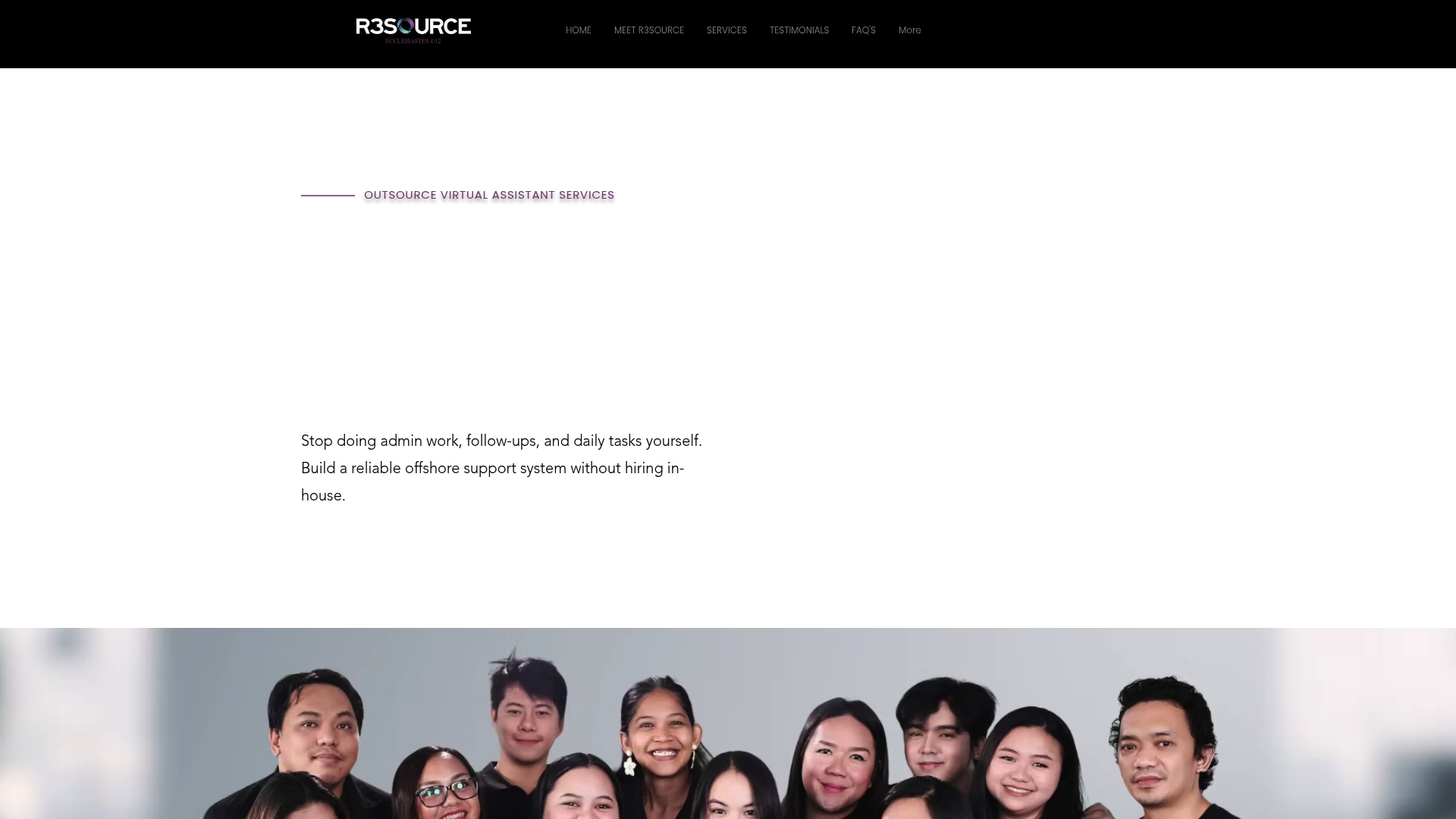
R3source provides skilled virtual assistants from the Philippines who are trained to integrate directly into your operations. Whether you need support with administrative work, customer service, CRM management, or content operations, R3source matches you with a dedicated professional who fits your business. Every placement comes with onboarding support so your VA is productive from day one. If you are ready to reclaim your time and build a support system that grows with you, explore offshore VA services from R3source and see what consistent, accountable remote support looks like.
FAQ
What is the first task to outsource to a virtual assistant?
Start with inbox management or calendar scheduling. These tasks are repeatable with a clear definition of done, which makes them easy to hand off and easy to measure.
How do I know which tasks are safe to delegate?
Use a delegation matrix that maps tasks by unique skill required and business impact. Tasks that score low on both axes are safe to delegate immediately.
What information should I give my VA when delegating a task?
Provide the desired outcome, the reason the task matters, and the limits of their decision authority. Effective handoffs that include this context prevent most rework and miscommunication.
Can a virtual assistant handle customer service tasks?
Yes. VAs effectively manage first-response handling and returns processing using approved templates and escalation guidelines. This improves response consistency without requiring your direct involvement.
How often should I review what my VA is handling?
Review task ownership quarterly. Delegation decisions evolve as your business grows and your VA’s skills deepen, so what belongs in the “keep” column today may be ready to hand off in six months.
Recommended
Comments