

What Does a Virtual Assistant Do in 2026?


A virtual assistant (VA) is an independent contractor who remotely handles key business tasks, including scheduling, email management, bookkeeping, and social media, to increase efficiency and reduce overhead. The term “virtual assistant” is the widely recognized industry label for this role, though you may also see it described in job postings as a “remote administrative professional” or “remote executive support specialist.” Understanding what does a virtual assistant do is the first step toward deciding whether hiring one is right for your business. VAs work from their own location, using tools like Google Workspace, Slack, and Zoom, and they cover everything from routine admin work to specialized marketing or technical support.
What does a virtual assistant do day to day?
A virtual assistant performs a broad array of administrative services remotely, including scheduling, email monitoring, bookkeeping, social media management, and customer service. That range is wider than most business owners expect when they first consider hiring one.
The core of most VA roles is administrative. Your VA can manage your inbox, filter out noise, flag urgent messages, and draft replies. They can own your calendar, schedule meetings, block focus time, and coordinate travel arrangements without you touching a single booking site.

Beyond admin, VAs handle technical and creative work. Many are proficient in QuickBooks for basic bookkeeping, WordPress for website updates, and tools like Canva or Hootsuite for social media content. VA responsibilities vary by skill set, which means the right hire can cover a surprisingly wide range of your operations.
Here is a practical list of tasks a VA commonly handles:
Email monitoring, filtering, and responding
Calendar scheduling and meeting coordination
Travel booking and itinerary management
Data entry and database maintenance
Bookkeeping and invoice tracking using QuickBooks
Social media scheduling and basic content creation
Customer service inquiries and first-level troubleshooting
Research and report preparation
Website content updates via WordPress or similar platforms
CRM updates and lead tracking
Appointment setting and follow-up outreach
File organization and document management
Pro Tip: Track your own time for one week before hiring. Log every task that took more than 15 minutes but did not require your direct expertise. That list becomes your VA’s job description.
How do virtual assistant roles vary by skill set?
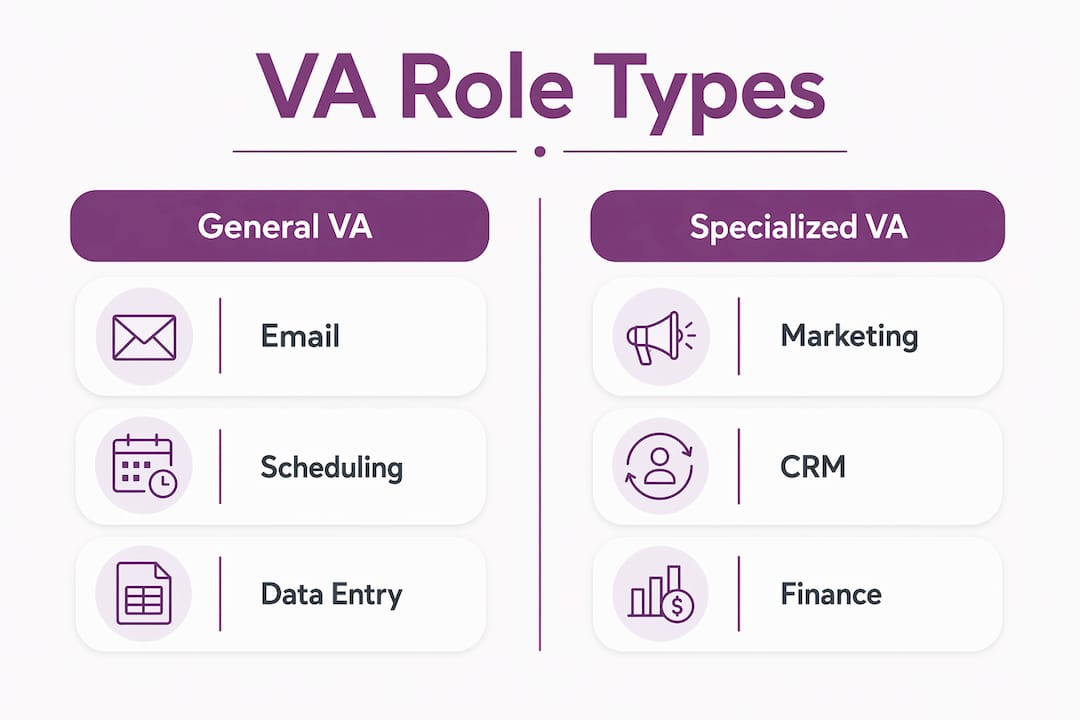
Not all VAs are the same. The role splits into three broad categories: general VA, executive VA, and specialized VA. Each serves a different business need, and choosing the wrong type is the most common mistake business owners make.
A general VA handles everyday admin tasks. Think inbox management, scheduling, data entry, and basic customer service. This is the right starting point for most small business owners who need to offload routine work.
A virtual executive assistant operates at a higher level. Executive VAs manage complex calendars, coordinate high-stakes meetings, handle communications strategically, and act as an extension of the executive they support. This role requires strong judgment, discretion, and the ability to anticipate needs before they arise. Think of it as a remote chief of staff rather than a task executor.
Specialized VAs focus on a single discipline. A marketing VA might manage your Facebook Ads account, write email sequences, and analyze campaign performance. A technical VA might handle your Shopify store, manage integrations, or run basic IT support. Their hourly rates reflect that depth.
VA Type | Typical Duties | Best For |
General VA | Email, scheduling, data entry, basic customer service | Solopreneurs and early-stage businesses |
Executive VA | Complex calendar management, strategic communications, executive support | Founders and C-suite leaders needing high-trust support |
Marketing VA | Social media, content creation, ad management, email campaigns | Businesses scaling their marketing output |
Technical VA | Website updates, CRM management, Shopify, basic IT support | E-commerce and tech-forward businesses |
VA services are modular, meaning you pay for only what you need and scale up as your business grows. That flexibility is one of the strongest financial arguments for hiring a VA over a full-time employee.
How do you work effectively with a virtual assistant?
Getting results from a VA depends almost entirely on how well you set up the relationship at the start. Most business owners who feel disappointed with a VA experience trace the problem back to unclear expectations, not the VA’s capability.
Effective VA engagement requires clearly defined decision boundaries and escalation protocols. Before your VA starts, write down which decisions they can make independently, which ones need your approval, and how they should flag urgent issues. This single step eliminates the majority of operational confusion.
Communication cadence matters too. VAs use tools like Zoom, Slack, and Google Workspace) to coordinate with clients. Set a weekly check-in via Zoom, use Slack for daily updates, and keep a shared task board in Asana or Trello so both of you always know what is in progress.
Onboarding is where most business owners underinvest. Spend the first two weeks walking your VA through your systems, preferences, and non-negotiables. Record Loom videos of recurring processes so they have a reference they can revisit. The upfront time pays back quickly.
Common pitfalls to avoid:
Assigning tasks without clear deadlines or output standards
Skipping a formal onboarding period and expecting immediate full output
Failing to give feedback in the first 30 days
Treating your VA as a task-taker rather than a team member
Pro Tip: Give your VA a 30-day priority list on day one. Rank tasks by impact, not urgency. This tells them where to focus when competing demands arise and builds their confidence in making good judgment calls.
How does hiring a virtual assistant benefit your business?
The financial case for hiring a VA is straightforward. VAs work as independent contractors), which means you do not pay for office space, equipment, benefits, or payroll taxes. You pay for productive hours only.
Small businesses can save thousands annually by paying for only the services they need rather than carrying a full-time salary. That saving compounds when you factor in the productivity gains from having someone dedicated to tasks that were previously eating your time.
The benefits extend beyond cost. Consider what you get back when routine work is handled:
Time reclaimed: Hours previously spent on email, scheduling, and data entry go back to revenue-generating work.
Reduced overhead: No office space, equipment costs, or employee benefits required.
Flexible scaling: Add hours or expand scope as your business grows, without a lengthy hiring process.
Faster response times: A dedicated VA handling customer inquiries means clients hear back sooner, which directly affects satisfaction.
Consistent execution: Recurring tasks get done on schedule, every time, without depending on your bandwidth.
Tracking time on routine tasks is the clearest way to see where a VA creates value. Business owners who do this exercise consistently find they are spending 15–20 hours per week on work that does not require their expertise. Reclaiming that time is not a luxury. It is a growth strategy.
For a deeper look at the financial side, the guide on reducing overhead costs breaks down exactly where the savings show up. If you are still weighing the decision, the article on benefits for small businesses covers the full picture.
Key takeaways
A virtual assistant is a remote independent contractor who handles administrative, technical, and creative tasks, and the right VA type, clear onboarding, and defined decision boundaries determine whether the engagement succeeds or stalls.
Point | Details |
VA scope is broader than admin | VAs handle bookkeeping, social media, CRM, customer service, and technical tasks beyond basic scheduling. |
Role type determines fit | Match the VA category (general, executive, or specialized) to your specific business need before hiring. |
Onboarding drives results | Invest two weeks in setup, process documentation, and communication protocols to get full output faster. |
Cost savings are structural | Hiring a VA eliminates payroll taxes, benefits, and office costs that come with a full-time employee. |
Time tracking reveals what to delegate | Log your weekly tasks first; the low-expertise, high-frequency items are your VA’s starting scope. |
What i’ve learned from watching businesses delegate well (and poorly)
The businesses that get the most from a VA are not the ones with the biggest budgets or the most complex operations. They are the ones who treat delegation as a skill they practice, not a task they complete once.
The most common mistake I see is what I call “dump and disappear.” A business owner offloads a pile of tasks, gives minimal context, and then wonders why the output does not match their expectations. A VA is not a mind reader. The clearer your instructions and the more consistent your feedback in the first 30 days, the faster your VA reaches full autonomy.
The second thing I have noticed is that many VAs start with general services and expand their capabilities over time. The best VA relationships grow with the business. If you hire someone for inbox management today, that same person can be handling your CRM, coordinating your marketing calendar, and managing your customer support team 12 months from now, if you invest in the relationship.
My honest advice: do not wait until you are overwhelmed to hire. The business owners who delegate early build systems that scale. The ones who wait until they are drowning spend their first months just catching up. Start with your first VA hire before you feel like you need one, and you will always stay ahead of the curve.
— Ellis
How R3source helps you build your remote team
If you are ready to put what you have learned into practice, R3source makes the process direct and dependable. R3source provides dedicated virtual assistants and remote professionals from the Philippines, trained to integrate into your business operations from day one.
R3source covers administrative support, customer service, CRM management, appointment setting, lead generation, and marketing support. Every team member is a long-term professional, not a rotating freelancer. That consistency is what turns a VA into a genuine part of your growth engine. Whether you need one person or a full remote team, explore your options with R3source’s offshore virtual assistant services or get answers to your team-building questions on the dedicated remote professionals page.
FAQ
What does a virtual assistant do for a small business?
A virtual assistant handles administrative, technical, and creative tasks remotely, including email management, scheduling, bookkeeping, social media, and customer service. This frees the business owner to focus on revenue-generating work.
What skills does a virtual assistant need?
Core skills include written communication, time management, proficiency in tools like Google Workspace, QuickBooks, and Slack, and the ability to work independently with minimal supervision. Specialized VAs add skills in areas like digital marketing, CRM platforms, or e-commerce management.
How is a virtual assistant different from a full-time employee?
A VA is typically an independent contractor who works remotely, so you do not pay for office space, equipment, or employee benefits. You pay only for the hours or services you need, which reduces overhead significantly compared to a salaried hire.
What tasks should i delegate to a virtual assistant first?
Start with high-frequency, low-expertise tasks: inbox management, calendar scheduling, data entry, and appointment setting. These are the tasks that consume the most time without requiring your direct decision-making.
How do i know which type of virtual assistant to hire?
Identify your biggest operational bottleneck first. If you need general admin relief, a general VA fits. If you need someone managing executive communications and priorities, hire an executive VA. If your gap is in marketing or technical operations, a specialized VA delivers better results.
Recommended
Comments