

Outsource Tasks to Virtual Assistants: Your 2026 Playbook


Yes, you can outsource tasks to virtual assistants today, and most growing small businesses should. The fastest path to reclaiming your time is to pick one repeatable task — calendar management, inbox triage, or basic bookkeeping entry — and hand it off for a one-week paid trial. Compared to a U.S. in-house hire, a managed VA through a Philippine-based provider like R3source can cost significantly less once you account for salary, taxes, benefits, and overhead. That gap is not a rounding error. It is the difference between staying stuck in operations and having real capacity for growth.
Here is what you need to know before you start:
Most digital and recurring business tasks can be handed off with minimal friction once you have a simple standard operating procedure (SOP) in place.
The managed VA model (a dedicated, long-term remote professional integrated into your operations) outperforms the freelance-per-task model for businesses with ongoing, recurring needs.
R3source provides dedicated managed virtual assistants from the Philippines, trained to integrate directly into U.S. business operations across industries including real estate, e-commerce, and service-based companies.
Your first action: document one repeatable task to SOP level this week and run a one-week trial to validate quality before committing to a full engagement.
Table of Contents
Which tasks can you outsource to virtual assistants right now?
What does it cost, and how long until your VA is productive?
What security and legal controls do you need before sharing access?
Why a managed, long-term VA model works better for most SMBs
R3source gives you dedicated remote staff, not just task coverage
Which tasks can you outsource to virtual assistants right now?
The range of tasks you can delegate is broader than most business owners expect. The Filipino BPO workforce includes a large number of trained professionals, covering everything from basic admin to bookkeeping in QuickBooks and Xero, customer service, e-commerce operations, and data analysis. The table below organizes tasks by function, expected outcome, and how much SOP work is required before you can hand them off.
Function | Tasks to hand off | Expected outcome | SOP effort |
Administrative & executive | Calendar management, inbox triage, travel booking, meeting prep | 5 hrs/week reclaimed | Low — fastest win |
Finance support | Invoicing, expense categorization, basic bookkeeping entry (QuickBooks, Xero) | Cleaner books, faster close | Medium |
Customer-facing | Live chat support, ticket management, appointment setting, follow-up calls | Faster response times, higher satisfaction | Medium |
Marketing & growth | Social media scheduling, content repurposing, lead list building, email sequences | Consistent output without owner involvement | Medium–High |
Operations & product | Data entry, order fulfillment coordination, QA support, supplier follow-up | Fewer errors, faster cycle times | Medium |
CRM & lead gen | CRM hygiene, pipeline updates, contact enrichment, outreach sequences | Cleaner pipeline, higher conversion visibility | High |
Specialized support | Medical billing support, legal document prep, e-commerce product listings | Domain-specific output at lower cost | High — requires training |
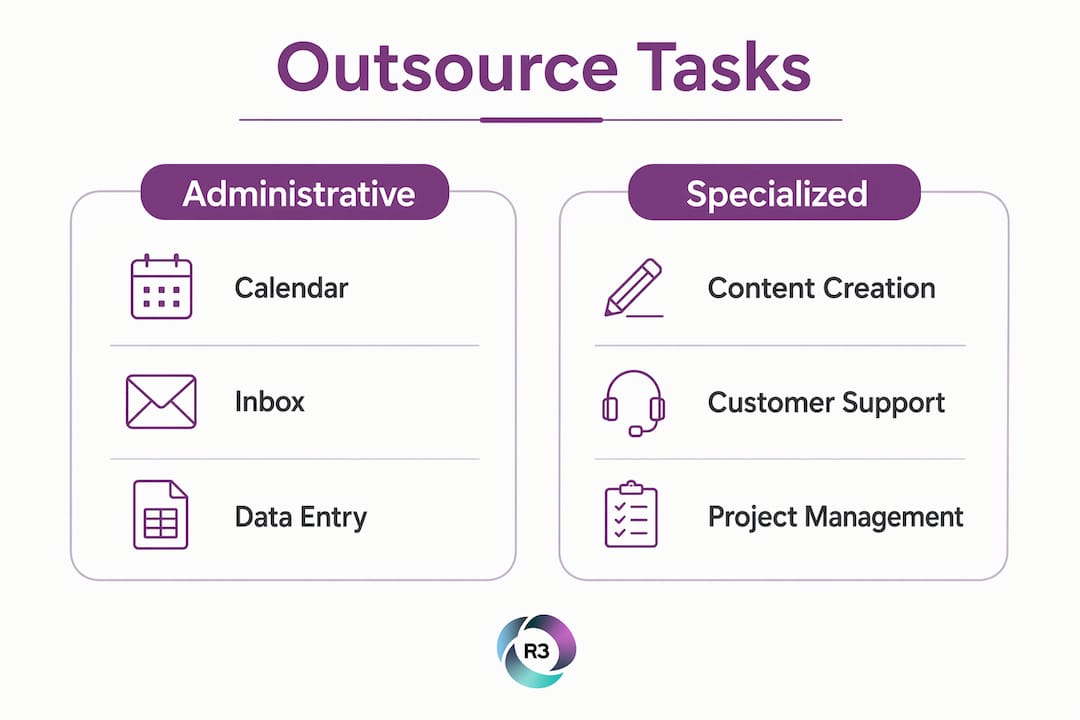
Fastest wins are administrative tasks: calendar, inbox, and data entry require almost no documentation to hand off and return immediate time savings. Medium-effort tasks like bookkeeping and customer support need a short SOP and a one-week overlap window. Advanced tasks like CRM management or specialized industry roles require structured onboarding and domain knowledge, but they deliver the highest long-term leverage once ramped.

For a prioritized list calibrated to 2026 workflows, the best tasks to outsource guide breaks down which functions deliver the fastest ROI for small businesses.
Which engagement model fits your business?
Not every outsourcing arrangement is built the same way. The model you choose determines how much you supervise, how fast you ramp, and what you pay.
Managed dedicated VA (the R3source model) A single remote professional is placed with your business full-time or part-time on a recurring contract. The provider handles sourcing, vetting, and HR administration. You direct the work. This model works best when you have recurring, ongoing needs and want someone who builds institutional knowledge of your business over time. Supervision load is low once onboarded, quality is predictable, and the cost structure is a flat monthly rate. The trade-off is a somewhat longer ramp period compared to a freelancer.
Freelance VA (platform-based) You hire directly through a marketplace, pay per hour or per project, and manage the relationship entirely yourself. Freelancers suit one-off tasks or highly specialized short projects where you need a specific skill for a defined period. The upside is speed and flexibility. The downside is higher variability in quality, no HR backstop, and the full burden of screening, contracting, and managing the relationship falls on you.
Agency (outsourced function) An agency takes ownership of an entire function, such as customer support or lead generation, and delivers results under a service-level agreement. You buy outcomes, not hours. This model is appropriate when you want to fully remove a function from your operations and are comfortable with vendor-managed delivery. Cost is typically the highest of the three models, and you have the least visibility into day-to-day execution.
Choose a managed dedicated VA when you need consistent, recurring support and want someone integrated into your team.
Choose a freelancer when the task is genuinely one-off, highly specialized, or short-term.
Choose an agency when you want to hand off an entire function and measure only outcomes.
For a detailed comparison of virtual assistant service types, including role descriptions and what to expect from each model, that overview covers the key differences in plain terms.
How do you prepare your business before delegating?
The majority of outsourcing failures trace back to one root cause: the business owner delegated a task that was never properly documented. If a process is not written down, it effectively does not exist for a remote team. SOPs are not bureaucratic overhead. They are the operational assets that let you scale without adding management headcount.
Start with your SOP minimum. For any repeatable task, document: the trigger (what starts the task), the steps in order, the tools used, the expected output, and the escalation path if something goes wrong. A five-minute Loom screen recording paired with a written checklist covers most admin tasks. You do not need a 20-page manual to hand off calendar management.

Pro Tip: Set a defined daily overlap window of a few hours when working with a remote VA in a different time zone. Push 80% of your collaboration to async written handoffs and end-of-day updates, but protect that overlap window as non-negotiable for the first 30 days. It is the fastest way to resolve blockers before they compound.
Your tool stack does not need to be complex. A password manager, a project board, a shared document workspace, and Loom for async walkthroughs covers the needs of most SMBs. The goal is to make process transfer explicit and portable — good process mapping is what makes quality consistent regardless of who executes it.
Handoff checklist before day one:
Permissions and access provisioned (least-privilege only)
Expected outputs defined with acceptance criteria
Escalation path documented (who to contact, how, and when)
Overlap window scheduled for the first week
First-week deliverables agreed in writing
How do you find, screen, and onboard a virtual assistant?
A strong hire starts with a job post that is honest about expectations. Include the time zone and required overlap hours, the specific responsibilities (not just a job title), outcome-based expectations for the first 30 days, and the tools your business uses. Vague job posts attract vague candidates.
Screening process:
Shortlist on written communication first. Remote work lives and dies on written clarity. A candidate whose application email is disorganized or unclear will not improve once hired.
Run a paid trial task that mirrors real work. A $50–$150 paid task with a 48-hour deadline is the single most predictive signal of remote readiness. Evaluate the output against your acceptance criteria, not your gut feeling.
Interview for four remote-specific skills: written communication, self-direction, proactive communication, and comfort with ambiguity. Ask situational questions: “Describe a time you had to complete a task without being able to reach your manager. What did you do?” A structured remote interview process consistently outperforms unstructured conversations for predicting remote performance.
Check references with specific questions. Ask former employers about reliability, communication habits, and how the candidate handled unclear instructions.
Sign a contractor agreement before sharing any access. Include an NDA, IP assignment clause, and confidentiality terms (more on this in the security section below).
30-60-90 onboarding roadmap:
Day 1: Provision all tools and access before the VA logs in. Schedule a live welcome call. Share company context beyond the job spec — your customers, your goals, and how their role connects to both. Assign a named point of contact for the first 60 days.
Days 2–7: Assign the first real task from your SOP library. Review output daily and give written feedback. Establish the async update rhythm (end-of-day summary, blockers flagged proactively).
Days 8–30: Expand task scope incrementally. Hold a weekly 30-minute check-in. Measure output against the KPIs you agreed on before hire.
Days 31–60: Reduce check-in frequency to biweekly. Introduce secondary tasks. Evaluate whether the VA is proactively flagging process gaps or waiting to be told.
Days 61–90: Full task ownership. Conduct a formal 90-day review against the original outcome expectations. Decide on scope expansion or role adjustment based on data, not impressions.
For practical interview questions and a vetting checklist, the guide on how to interview virtual assistants covers the screening process in detail.
What does it cost, and how long until your VA is productive?
Cost and timeline are the two questions every business owner asks before committing. Here are the honest answers.
Billing models:
Hourly: Best for variable workloads or initial trial periods. Gives you flexibility but makes budgeting harder.
Part-time or full-time monthly retainer: Best for recurring, predictable needs. Easier to budget, and the VA builds deeper knowledge of your business over time.
Dedicated monthly staffing (managed model): A flat monthly rate covering the VA’s compensation, HR administration, and provider support. This is the most cost-predictable model for ongoing operations.
Cost comparison:
Role | U.S. in-house (fully loaded) | Managed VA via Philippine provider | Annual savings |
Administrative assistant | ~$73,089/year | ~$24,000/year | ~$49,089 (~67%) |
Customer support rep | $50,000/year | $18,000/year | $32,000 (~64%) |
Bookkeeping support | $55,000/year | $20,000/year | $35,000 (~64%) |
The fully loaded cost comparison accounts for salary, payroll taxes, benefits, office space, and HR overhead. The savings range of 60–70% — with sample roles showing approximately 67% reduction — is consistent across most administrative and support roles.
Time-to-productivity by task complexity:
Task type | Ramp phase | Time to full productivity |
Simple admin (calendar, inbox, data entry) | Days 1–7 | 1–2 weeks |
Customer support, appointment setting | Days 1–7 | 2–4 weeks |
Bookkeeping, CRM management | Days 1–30 | 4 weeks |
Specialized (medical billing, legal support, e-commerce ops) | Days 1–30 | 6 weeks |
The ROI rule of thumb: outsourcing makes clear financial sense when the task consumes more than five hours of your week, recurs at least three times per week, and does not require your direct judgment to complete. If all three conditions are true, the cost of a managed VA is almost always lower than the opportunity cost of doing it yourself.
What security and legal controls do you need before sharing access?
Before you hand a VA any login credential or client data, put the right controls in place. This is not optional. A single data exposure can cost far more than the savings you gain from outsourcing.
Minimum security controls:
Use a password manager (1Password, Bitwarden, or LastPass) and share credentials through the vault, never via email or chat.
Apply least-privilege access: give the VA access only to the specific tools and data they need for their role, nothing more.
Enable two-factor authentication (2FA) on every shared account.
Create role-specific logins where possible, rather than sharing your primary credentials.
Remove all access immediately at offboarding, before the final payment clears.
Contract essentials before work begins:
NDA (non-disclosure agreement): covers confidential business information, client data, and internal processes.
IP assignment clause: any work product created during the engagement belongs to your business.
Confidentiality clause: explicit restrictions on sharing, storing, or reproducing your data outside the engagement.
Scope of work: defines deliverables, hours, and communication expectations to reduce classification risk.
On employment classification: if you direct a remote worker’s schedule, tools, and methods closely enough that the relationship resembles employment rather than independent contracting, U.S. law may treat them as an employee. Adding a remote worker in a new U.S. state can also trigger multi-state tax and payroll obligations within 20–30 days of the first payroll. When in doubt, consult an employment attorney or HR advisor before the engagement starts.
This article is general information, not legal or tax advice. Confirm your specific situation with a qualified professional.
How do you measure VA performance without micromanaging?
The goal is accountability without surveillance. A lightweight reporting structure gives you the data you need to manage performance while preserving the autonomy that makes remote work effective.
KPIs by task type:
Admin tasks: throughput (tasks completed per day/week), response time to requests, error rate on recurring outputs.
Customer support: first-response time, ticket resolution rate, customer satisfaction score (CSAT).
Bookkeeping: accuracy rate on entries, on-time delivery of weekly reports, number of corrections required.
Lead generation: contacts added per week, outreach sequences completed, qualified leads passed to sales.
Recommended reporting cadence: a simple end-of-day async update covering three items: what was completed, what is in progress, and any blockers. Weekly, hold a 30-minute synchronous check-in to review metrics, address blockers, and adjust priorities. Monthly, run a formal performance review against the KPIs you set at hire.
Pro Tip: When a VA consistently hits throughput targets but stops flagging blockers proactively, that is an early sign of disengagement, not high performance. Proactive communication is the metric that predicts long-term retention better than output volume alone.
When the offshore team grows to a small local group size, add a local team lead to avoid compounding communication lag. That team size point is where a single manager’s span of control starts to degrade quality and response time. Plan for it before you hit it, not after.
What mistakes do most businesses make when outsourcing?
The patterns that derail outsourcing engagements are consistent and avoidable. Most of them happen in the first 30 days.
Top mistakes:
Delegating without SOPs. Handing off a task with verbal instructions and expecting consistent output is the most common failure mode. Document first, delegate second.
Expecting instant parity with in-house staff. A new VA needs a ramp period. Expecting full productivity in week one creates frustration on both sides and leads to premature termination of good hires.
Insufficient overlap for handoffs. Async-only communication in the first two weeks means blockers sit unresolved for 24 hours at a time. Protect the overlap window.
Unclear ownership. If the VA does not know who to escalate to when something goes wrong, they will either guess or go silent. Define the escalation path before day one.
Skipping the trial task. Hiring based on a resume and an interview alone, without a paid real-work trial, is the fastest way to make an expensive mistake.
Red flags to watch for:
Missed commitments without proactive communication (the VA waits for you to notice, rather than flagging the issue).
Repeated quality issues after coaching, with no improvement trajectory.
Lack of documentation or end-of-day updates after the first two weeks.
Reluctance to ask clarifying questions on new tasks.
Recovery steps: scale back to daily check-ins, re-run a paid trial task on a specific deliverable, and rebuild the handoff with explicit acceptance criteria. If quality does not improve within two weeks of structured coaching, replace the hire and treat the experience as a process gap, not a people problem. The SOP you write after a failed hire is often the one that makes the next hire succeed.
Why a managed, long-term VA model works better for most SMBs
The freelance-per-task model works for isolated projects. For the recurring operational needs that consume most of a business owner’s week, a dedicated managed VA consistently outperforms it. The reasons are practical, not theoretical.
Concrete advantages of dedicated managed staff:
Institutional knowledge accumulates. A VA who has worked in your business for six months knows your clients, your preferences, and your processes. That knowledge does not reset every time you post a new job.
Supervision burden drops over time. The first 30 days require active management. By month three, a well-onboarded VA operates with minimal oversight on established tasks.
Quality is predictable. A managed provider handles HR, performance management, and replacement if a VA leaves, so your operations do not stall during transitions.
30-60-90 implementation checklist with success metrics:
Phase | Key actions | Metrics to track |
Days 1–30 | Provision tools, run onboarding, assign first tasks from SOP library, daily check-ins | Task completion rate, error rate, response time to requests |
Days 31–60 | Expand task scope, reduce check-ins to weekly, introduce secondary responsibilities | Throughput vs. target, proactive communication frequency |
Days 61–90 | Full task ownership, formal 90-day review, decide on scope expansion | Output quality score, KPI attainment, retention signal |
Hypothetical results from a managed VA engagement (placeholders for R3source client case studies):
A service-based business owner reclaims 15–20 hours per week by offloading calendar management, inbox triage, and CRM updates to a dedicated VA.
An e-commerce operator reduces order fulfillment coordination time by delegating supplier follow-up and listing management, with full productivity reached by week six.
A real estate team adds appointment setting and lead follow-up capacity without adding a local hire, reducing cost per qualified appointment significantly.
Real client results and case studies are available directly from R3source. When you are ready to see what a dedicated remote professional can do for your specific operations, those examples give you a concrete benchmark.
Key Takeaways
Outsourcing tasks to virtual assistants delivers the fastest ROI when you document one repeatable task, run a paid trial, and choose a managed model for ongoing needs.
Point | Details |
Start with one task | Pick a repeatable task, document it to SOP level, and run a one-week paid trial before committing. |
Cost savings are significant | A managed VA via a Philippine provider costs roughly 67% less than a fully loaded U.S. in-house hire once you account for salary, taxes, benefits, and overhead. |
Model choice matters | Choose a managed dedicated VA for recurring needs; freelancers suit one-off or short-term specialized projects. |
Security before access | Provision a password manager, apply least-privilege access, and sign an NDA before sharing any credentials. |
R3source for managed staffing | R3source provides dedicated managed VAs from the Philippines, integrated into U.S. business operations with onboarding support and measurable ramp milestones. |
What actually works when you scale with virtual assistants
The businesses that get the most out of remote staffing share one habit: they treat their SOPs as core operational assets, not afterthoughts. Every time a process gets documented, the business becomes a little less dependent on any single person, including the owner. That is the real leverage.
What often gets underestimated is the operational trade-off involved. You give up some direct control. You accept that a remote professional will not absorb institutional knowledge through proximity the way an in-office hire might. In exchange, you get predictable capacity at a fraction of the cost, and you free yourself to focus on the decisions that actually require your judgment.
The businesses that struggle with outsourcing are almost always the ones that skipped the documentation step. They delegate a task verbally, get inconsistent output, and conclude that virtual assistants do not work. The process was the problem, not the person. Protect the overlap window, write the SOP, and run the trial task. Those three habits predict success more reliably than any other factor.
R3source gives you dedicated remote staff, not just task coverage
Most businesses that come to R3source are not looking for a freelancer to complete a one-off task. They want someone who shows up every day, learns their business, and handles the operations that are consuming the owner’s time. That is exactly what R3source delivers: dedicated managed virtual assistants from the Philippines, integrated directly into your U.S. business operations.
The engagement starts with an introductory consultation to match your needs with the right professional. From there, R3source handles sourcing, vetting, and HR administration, so you focus on directing the work, not managing the hiring process. Clients across real estate, e-commerce, and service-based industries use R3source for administrative support, customer service, lead generation, CRM management, appointment setting, and more. Every placement comes with onboarding support and clear ramp milestones so you know exactly where you stand at 30, 60, and 90 days.
If you are ready to reclaim your time and build a support system that grows with your business, book an introductory consultation or explore the full offshore virtual assistant services R3source offers.
Useful sources and further reading
The claims and recommendations in this guide draw from the following sources. Each one is worth reading directly if you want to go deeper on a specific topic.
Cost comparison: outsourcing vs. in-house hiring — the source behind the 60–70% cost savings figure and the $24,000 vs. $73,089 annual cost comparison used in the pricing section. Business Money: Outsourcing vs. in-house hiring
Offshore team management playbook — the source for the 2–4 hour overlap window recommendation, async-first communication practices, and the five-to-seven person threshold for adding a local team lead. Wisemonk: Offshore Team Management
Remote hiring and trial task methodology — the basis for the paid trial task recommendation ($50–$150, 48-hour deadline) and the four remote-specific skills to evaluate. FirstHR: How to Hire Remote Employees
Multi-state compliance for remote workers — the source for the 20–30 day registration window when adding a remote worker in a new U.S. state. BusinessAnywhere: Hiring Out-of-State Employees
Process transfer and outsourced operations — partner guidance on making processes explicit and portable as the foundation of successful outsourcing. TaxBowl: Outsourced Financial Operations
R3source task list and hiring guides — practical task inventories and screening guidance for SMBs, published by R3source. 15 Tasks to Outsource to a Virtual Assistant Today
R3source managed VA services — the primary service page describing R3source’s dedicated remote staffing offering for U.S. businesses. R3source: Outsource Virtual Assistant Services
Finding a reliable long-term VA — vetting and evaluation guidance for business owners building a long-term remote team. R3source: How to Find a Reliable Long-Term Virtual Assistant
Affordable VA services for small businesses — pricing context and budgeting guidance for SMBs approaching their first outsourcing engagement. R3source: Affordable Virtual Assistant Services
When to hire a virtual assistant — decision-focused guidance on timing and the signals that outsourcing will deliver the most leverage. R3source: When Should You Hire a Virtual Assistant
Recommended
Comments