

How to Hire an Offshore Assistant: Step-by-Step Guide (2026)


Hire a dedicated offshore assistant by following six steps: define the role, source candidates, interview and vet, run a paid trial, onboard with SOPs, then set up compliant payroll. For most U.S. small and mid-sized businesses, a managed provider is the fastest, lowest-risk path to a fully productive hire.
Your 6-step hiring checklist:
Define the role: Write a one-page job description with measurable outputs before you post anything.
Source candidates: Choose a freelance marketplace, a referral network, or a managed provider like R3source.
Interview and vet: Use structured questions and a skills test; watch for red flags (vague answers, no portfolio, unavailable for overlap hours).
Run a paid trial: One to two weeks, defined deliverables, scored against acceptance criteria.
Onboard with SOPs: Grant role-based access, share process documentation, set 30/60/90-day goals.
Pay and comply: Use an Employer of Record (EOR) or a compliant contractor agreement; address IP assignment and confidentiality upfront.
Total timeline: From role definition to a fully onboarded, productive assistant typically takes 4–8 weeks when you use a managed provider, and up to 12 weeks when sourcing independently.
Pro Tip: If you want to skip the compliance and sourcing work entirely, R3source handles sourcing, onboarding, payroll, and ongoing account management for U.S. businesses. Start at the offshore virtual assistant services page.
Key Takeaways
Hiring an offshore assistant works best when you follow a structured six-step process and use a managed provider to handle compliance and sourcing from the start.
Point | Details |
Follow the six-step process | Define role → source → interview → paid trial → onboard → pay and comply for a 4–8 week path to productivity. |
Match tasks to offshore strengths | Admin, CRM, customer support, and lead generation are ideal; keep strategy, legal sign-offs, and high-privilege access onshore. |
Use an EOR for Philippine hires | An Employer of Record handles SSS, PhilHealth, 13th-month pay, and misclassification risk automatically. |
Manage with KPIs and a clear cadence | Weekly 1:1s, monthly reviews, and a 90-day evaluation keep output on track and problems visible early. |
R3source as your managed option | R3source sources, onboards, and manages payroll for dedicated Philippine assistants, with a replacement guarantee included. |
Table of Contents
What are the real benefits and tradeoffs of hiring offshore?
How to hire an offshore assistant: the full step-by-step process
What U.S. businesses need to know about legal, tax, and payment compliance
How do you manage an offshore assistant and measure success?
Why a managed provider reduces your risk and speeds up your results
R3source gives you a faster, lower-risk path to offshore support
Which tasks should you send offshore?
The roles best suited for offshore support share a clear profile: they are process-driven, well-documented, and do not require physical presence or high-privilege system access. Administrative coordination, CRM upkeep, lead follow-up, calendar management, customer support (email and chat), data entry, basic bookkeeping preparation, and marketing operations all fit that profile well. The Philippines, in particular, excels at customer-facing roles because of high conversational English fluency, making it a natural fit for U.S. businesses that need consistent, professional client communication.
Tasks that work well offshore:
Inbox management and email triage
CRM data entry, tagging, and pipeline updates
Appointment setting and calendar coordination
Inbound and outbound customer support (email, chat, phone)
Lead research and follow-up sequences
Social media scheduling and basic content coordination
Data entry, reporting, and spreadsheet management
Bookkeeping prep (transaction categorization, receipt logging)
Marketing ops (campaign tracking, list hygiene, basic graphic requests)
Tasks to keep local or in-house:
Core business strategy and high-stakes decision-making
Legal document signing and financial authorizations
Regulated work requiring a U.S. license (legal advice, medical diagnosis, licensed financial planning)
High-privilege system administration (root access, payroll approval)
Sensitive HR decisions (hiring, firing, performance improvement plans)
Pro Tip: For tasks that touch sensitive data, use role-based access controls, redact personally identifiable information (PII) from documents before sharing, and keep all signatory privileges with onshore staff. A well-structured SOP library makes this easy to enforce consistently.
What are the real benefits and tradeoffs of hiring offshore?
The core benefits of hiring an offshore assistant are significant cost savings, the ability to scale headcount quickly, extended coverage across time zones, and access to a deep pool of specialized skills. The tradeoffs are real but manageable: time-zone gaps require deliberate scheduling, remote management adds coordination overhead, and compliance missteps can create legal exposure. Knowing both sides upfront lets you build the right safeguards from day one. For a deeper look at the business-level ROI, the benefits of a virtual assistant for business owners breaks down the numbers clearly.
Benefits:
Cost savings: Offshore assistants in the Philippines generally cost substantially less than a comparable U.S. hire, freeing budget for revenue-generating activities.
Faster scaling: You can add capacity in weeks rather than months, without the overhead of a full-time local employee.
Extended coverage: A Philippine-based assistant working standard local hours covers your U.S. evening and overnight window, giving you near-24-hour operational coverage.
Specialized skills: Administrative, customer support, CRM, and marketing ops talent is abundant and well-trained in the Philippines.
Reduced overhead: No office space, equipment costs, or local benefits burden on your payroll.
Tradeoffs and how to mitigate them:
Time-zone gap (Philippines is 12–13 hours ahead of U.S. Eastern): Schedule 2–4 hours of daily overlap and use async handoff documents to keep work moving.
Management overhead: Invest in SOPs and a project tracker from day one; the upfront documentation pays for itself within the first month.
Compliance risk: Misclassifying an employee as a contractor under Philippine labor law carries real penalties. Use an EOR or a managed provider to handle statutory obligations.
Communication gaps: Set clear response-time expectations in writing and use async video tools for complex briefings.
Turnover risk: Managed providers typically offer replacement guarantees; freelance hires do not.
Risk-mitigation checklist:
Draft a written contract before work begins (IP assignment, confidentiality, termination terms)
Establish overlap hours and document them in the offer letter
Use role-based access and a password manager; never share master credentials
Build an SOP for every recurring task within the first 30 days
Schedule a 90-day performance review with documented KPIs
How much does it cost to hire an offshore assistant?
Three pricing models cover most situations: hourly freelance, dedicated contractor or employee, and managed provider subscription. Each fits a different need and risk tolerance.
Hourly freelance works for project-based or variable-volume work. You pay only for hours used, but you absorb all compliance, onboarding, and retention risk yourself. Rates for general administrative work from the Philippines typically range from $5–$12 per hour on major marketplaces.
Dedicated contractor or employee is the right model when you need consistent, full-time support. A dedicated Philippine-based assistant working 40 hours per week generally costs $800–$1,800 per month in total compensation, depending on role complexity and experience. You handle the contract, payroll method, and any statutory obligations.
Managed provider subscription bundles sourcing, onboarding, payroll, compliance, and account management into a single monthly fee. The all-in cost is higher than a raw contractor rate, but the total cost of ownership is often lower once you factor in recruiting time, compliance setup, and turnover replacement. For affordable virtual assistant services tailored to small businesses, managed providers offer the most predictable budget line.
Questions to ask any vendor before signing:
What is included in the monthly fee (equipment, benefits, training)?
What are the termination terms and notice period?
Is there a replacement guarantee, and how quickly is it fulfilled?
How is overtime handled?
Who manages payroll and statutory benefits in the assistant’s country?
When comparing virtual assistant staffing agencies, push every vendor on these five questions. Vague answers on termination and replacement are the clearest signal of a provider to avoid.
How to hire an offshore assistant: the full step-by-step process
A reputable offshore recruiter delivers a shortlist in 2–4 weeks and a signed hire in 4–8 weeks for most non-senior roles. Here is the full operational playbook.
Step 1: Define the role
Write a one-page job description before you contact a single candidate. Include:
Role title and reporting structure
Core responsibilities (5–7 bullet points, each with a measurable output)
Required tools (CRM, project tracker, communication platforms)
Working hours and overlap window
Success metrics for the first 90 days
A weak job description is the single biggest cause of a bad hire. If you cannot describe what “done well” looks like, the assistant cannot deliver it.
Step 2: Source candidates
You have four main sourcing routes. Virtual assistant platforms are useful for DIY sourcing, but buyers must handle onboarding, retention, and compliance themselves when using marketplace hires.
Freelance marketplaces: Fast access to a large candidate pool; you manage everything.
Referral networks: High-trust candidates; slower pipeline.
Staffing agencies: Pre-screened candidates; you still manage compliance.
Managed providers: Full-service sourcing, onboarding, and compliance; fastest time to productivity.
Step 3: Interview and vet
Use a structured interview with at least one skills test. Useful questions for any offshore assistant role:
“Walk me through how you manage a full inbox from scratch.”
“Describe a time you caught an error before it reached a client.”
“How do you handle a task when the instructions are unclear?”
“What tools do you use to track your daily workload?”
Red flags: Inability to give a specific example, no portfolio or work samples, unavailable during your required overlap hours, or reluctance to complete a paid skills test.
Step 4: Run a paid trial
A paid trial of 1–2 weeks with defined deliverables is the most reliable predictor of long-term fit.
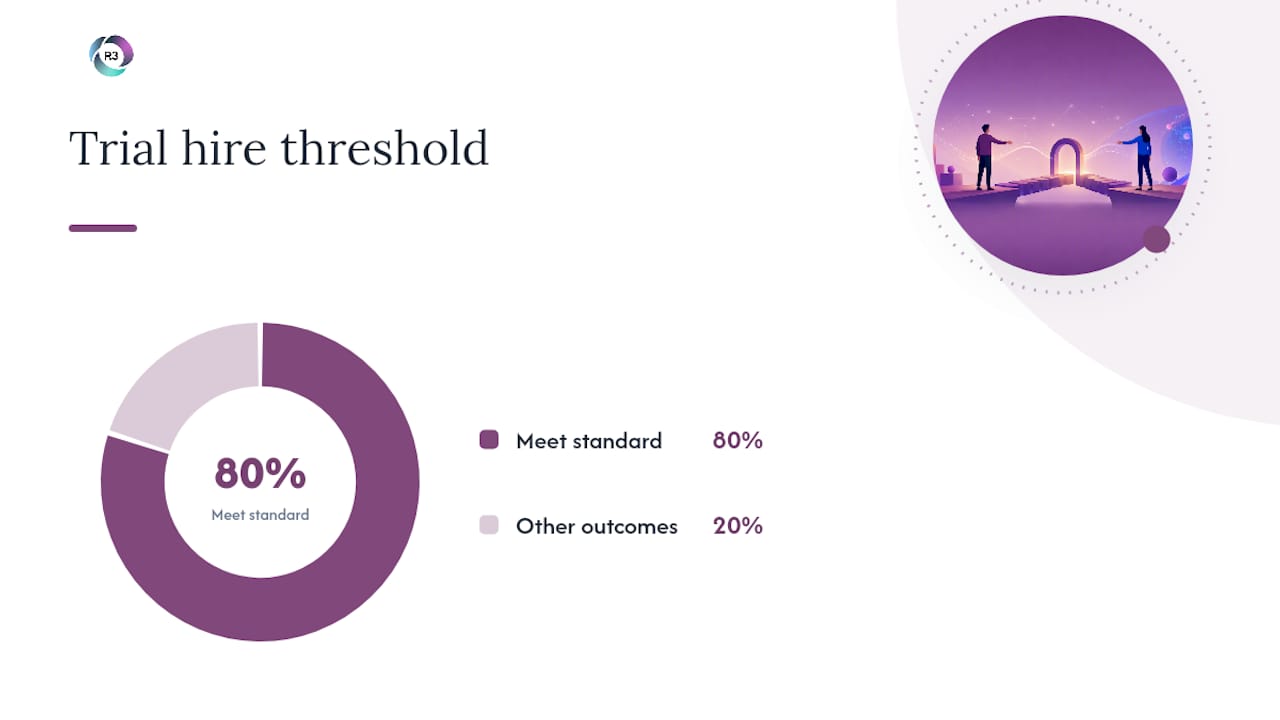
Trial element | Guidance |
Duration | 5 business days |
Compensation | Full agreed rate (never unpaid) |
Deliverables | 3–5 specific tasks with clear acceptance criteria |
Scoring | Rate each deliverable: meets standard / needs revision / does not meet standard |
Decision threshold | Hire if 4 of 5 deliverables meet standard on first submission |
Pro Tip: Give the trial candidate a real task from your current backlog, not a fabricated test. You get a useful work product either way, and the candidate’s approach to an actual business problem tells you far more than a hypothetical.
Step 5: Onboard with SOPs
A structured onboarding checklist prevents the most common early failures:
Create accounts and grant role-based access (no shared master passwords)
Share all relevant SOPs and process documentation on day one
Record a short async video walkthrough of your most complex recurring task
Set 30/60/90-day goals in writing and confirm the assistant understands them
Schedule a daily check-in for the first two weeks, then shift to weekly
Step 6: Manage for the long term
Weekly 1:1s, a shared task tracker, and a monthly performance review are the minimum cadence for a high-performing offshore relationship. Async-first collaboration combined with 2–4 hours of daily overlap is a proven operating model for U.S.-offshore teams, balancing productivity and cost across wide time-zone differences. For practical tactics, offshore team productivity strategies covers seven approaches that work in practice.
Timeline summary:
Role definition: 1–3 days
Sourcing and shortlist: 2–4 weeks
Interviews and skills test: 3–5 days
Paid trial: 1–2 weeks
Onboarding: 1–2 weeks
Fully productive: by day 60–90
What U.S. businesses need to know about legal, tax, and payment compliance
The most common compliance mistake U.S. businesses make when hiring offshore is treating an employee as an independent contractor. Philippine labor law applies a four-fold test to determine employer-employee relationships, and misclassification carries material legal and financial risk. Statutory benefits including SSS (Social Security System), PhilHealth, and 13th-month pay apply to employees, not contractors.
Key compliance considerations:
Classification risk: If you control how, when, and where the work is done, Philippine authorities may treat the worker as an employee regardless of what your contract says.
Statutory benefits: Philippine employees are entitled to SSS, PhilHealth, Pag-IBIG contributions, and 13th-month pay. An EOR handles these automatically.
U.S. tax treatment: Payments to foreign contractors are generally not subject to U.S. withholding, but you should collect a W-8BEN form to document the foreign status. Consult a tax professional for your specific situation.
Permanent establishment (PE) risk: Maintaining a dependent agent abroad can, in some structures, create a taxable presence. Get local counsel if you are scaling beyond a handful of hires.
IRS and DOL guidance: The IRS worker classification rules and the Department of Labor’s economic reality test both apply to how you structure offshore engagements from a U.S. perspective.
For U.S. companies hiring 1–50 offshore roles, an Employer of Record is often the lowest-risk path because it handles local payroll, benefits, and compliance. Direct entity setup takes 3–12 months and is rarely worth it at this scale.
Foreign employers should localize contracts, avoid imposing control that creates an employer-employee relationship, and use EORs or properly registered local entities to reduce liability. Local contracts should include IP assignment and localized statutory terms.
Contract clauses you must include:
IP assignment (all work product belongs to the client)
Confidentiality and NDA
Dispute resolution (specify governing law and jurisdiction)
Termination terms and notice period
Data protection obligations
Payment options by category:
International wire transfer: Reliable but carries fees and exchange-rate risk.
Global payment platforms (e.g., Wise, Payoneer, Airwallex): Lower fees, faster settlement, good audit trail.
EOR payroll: The EOR pays the worker in local currency; you pay the EOR in USD.
Pro Tip: If you are unsure whether your engagement structure creates an employer-employee relationship under Philippine law, engage local counsel before the first payment. The cost of a one-hour consultation is a fraction of the cost of a misclassification dispute.
How do you manage an offshore assistant and measure success?
Set clear output expectations, measure against them weekly, and iterate monthly. That rhythm, more than any single tool or technique, is what separates high-performing offshore relationships from ones that drift. Distributed teams and async collaboration practices underpin the most productive offshore hiring models, and the businesses that get the most from their remote staff are the ones that document expectations before problems arise.
KPI examples by role:
Administrative assistant: Tasks completed per week vs. target, calendar accuracy rate, inbox zero frequency
Customer support: First response time, resolution rate, customer satisfaction score
Lead generation: Leads researched per day, follow-up sequences sent, conversion rate from outreach
CRM management: Data accuracy rate, pipeline update frequency, duplicate record rate
Recommended tool categories:
Project tracker: Asana, ClickUp, or Trello for task assignment and visibility
Shared doc library: Google Workspace or Notion for SOPs and async briefings
Async video: Loom for walkthroughs and feedback that would otherwise require a meeting
Time tracking (where needed): Toggl or Hubstaff for hourly roles or trial periods
Check-in cadence:
Cadence | Format | Purpose |
Daily (first 2 weeks) | short async standup | Catch blockers early |
Weekly | 30-min 1:1 video call | Review output, adjust priorities |
Monthly | Written performance review | Track KPIs, address patterns |
90-day | Formal evaluation | Assess fit, set next-quarter goals |
Troubleshooting common problems:
Quality drop: Review the SOP together; often a process gap, not a motivation issue.
Time-zone mismatch: Shift the overlap window by 1–2 hours rather than adding meetings.
Motivation issues: Check whether the role has grown beyond the original job description without a corresponding adjustment in scope or compensation.
Why a managed provider reduces your risk and speeds up your results
A managed provider handles the parts of offshore hiring that consume the most time and carry the most risk: sourcing, vetting, onboarding, payroll, and compliance. For U.S. SMBs that want a productive assistant within weeks rather than months, this model consistently outperforms DIY marketplace sourcing on total cost of ownership.
What a quality managed provider delivers:
Pre-screened, interview-ready candidates within 2–4 weeks
Built-in payroll and statutory benefits management (no EOR to source separately)
Dedicated account management and performance reporting
Background checks and reference verification before placement
Replacement guarantee if the assistant does not work out
Training support and quality control throughout the engagement
What to expect from the service level:
A clear SLA covering response times and escalation paths
Transparent pricing with no hidden fees for overtime or replacement
Onboarding support during the first 30 days
Regular performance reporting tied to the KPIs you set
R3source’s offshore virtual assistant services cover all of these elements for U.S. businesses, with dedicated long-term staff from the Philippines across administrative, customer support, CRM, lead generation, marketing ops, and more. The managed model means you get a productive team member, not a compliance project.
What scaling with offshore staff actually looks like
The businesses that get the most from offshore hiring share one habit: they treat the assistant as a long-term team member from day one, not a temporary fix. That means a real onboarding process, documented expectations, and a genuine feedback loop.
The payoff is real. When you free 15–20 hours per week from administrative and operational tasks, you reclaim the capacity to focus on the work that actually grows your business. That shift is not theoretical. It shows up in the number of client calls you can take, the proposals you can send, and the decisions you can make with a clear head.
The managed provider model accelerates this outcome because it removes the friction of sourcing, compliance, and early-stage training. You spend your first week reviewing candidates, not writing job posts. You spend your second week running a paid trial, not negotiating contracts. By week four, you have a productive assistant integrated into your operations.
One practical takeaway you can apply immediately: write a six-line job description today. Role title, three core responsibilities with measurable outputs, required tools, and overlap hours. That document is the foundation of every step that follows, and it takes less than 20 minutes to draft.
R3source gives you a faster, lower-risk path to offshore support
Hiring offshore on your own means managing sourcing, compliance, payroll, and onboarding simultaneously, often while running a business that already needs your full attention. R3source removes that burden entirely.
R3source sources, vets, and places dedicated virtual assistants from the Philippines, then handles payroll, statutory compliance, and ongoing account management so you never have to. Every placement comes with a replacement guarantee and performance reporting built in. You get a long-term team member integrated into your operations, not a freelancer you manage on a marketplace.
The process is straightforward: you describe your role and goals, R3source delivers interview-ready candidates within weeks, and you run a paid trial before committing. No long-term lock-in before you have seen the work.
Book a free strategy call to walk through your staffing needs and get a clear picture of what a dedicated offshore assistant can take off your plate starting this month.
Sources
These resources back the core claims in this guide and are worth bookmarking as you move through the hiring process.
Recommended
Comments